Key Takeaways
- Standard residential concrete ranges from 2,500 to 4,000 PSI, with driveways requiring 3,000-4,000 PSI and sidewalks needing 2,500-3,000 PSI for optimal durability.
- Ready-mix concrete costs $122-$145 per cubic yard in Fayetteville, offering consistent quality and eliminating on-site mixing challenges.[1]
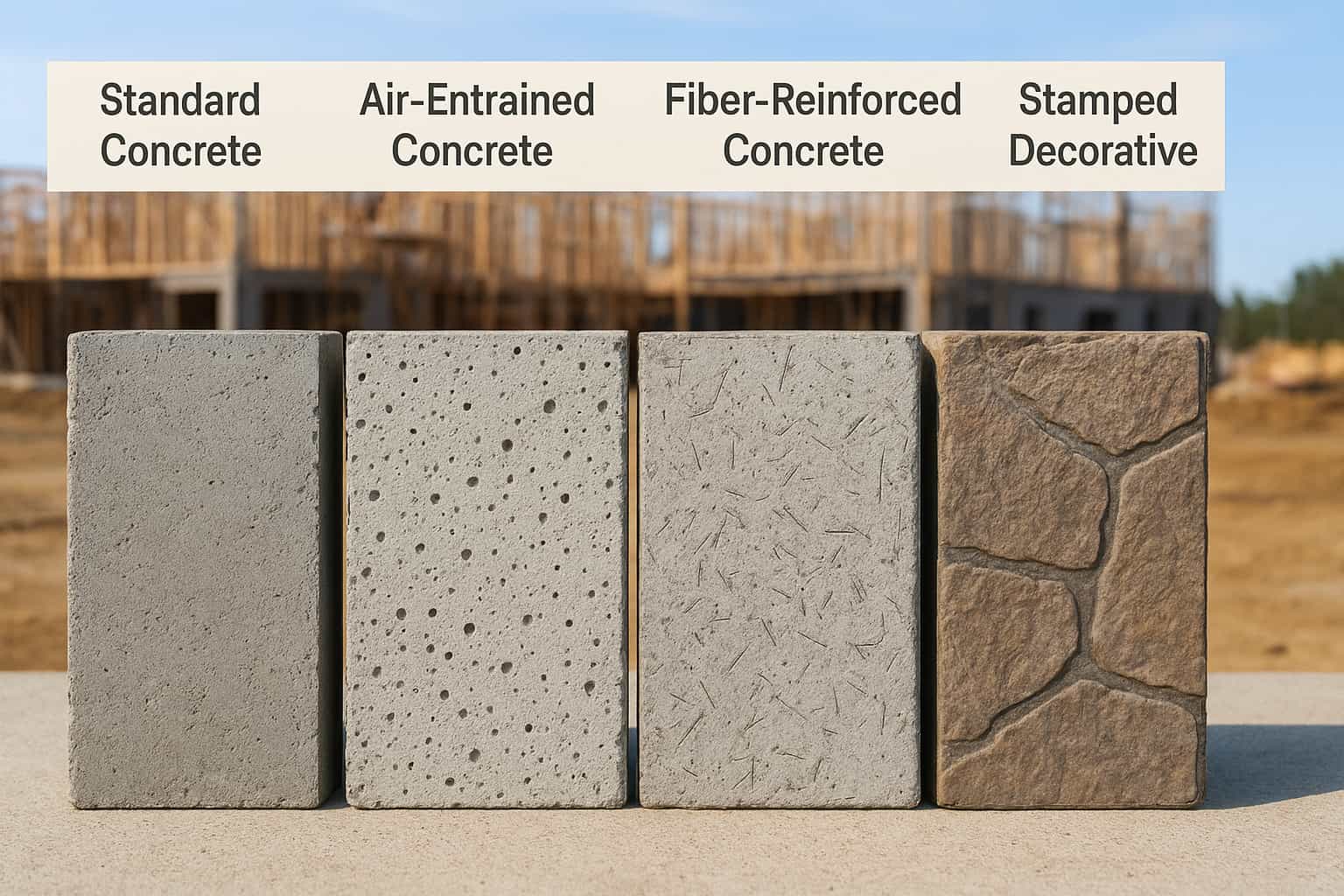
- Air-entrained concrete is essential for Arkansas freeze-thaw protection, with microscopic air bubbles (4-8% of volume) providing critical protection for outdoor applications during the 5-6 month freeze-thaw season.[2]
- Fiber-reinforced concrete reduces cracking by up to 90% compared to standard mixes, making it ideal for garage floors and driveways subject to temperature fluctuations.[3,63]
- Stamped decorative concrete replicates expensive materials at 40-60% lower cost, offering ashlar slate, cobblestone, and wood plank patterns that withstand Northwest Arkansas weather.[4]
Understanding Residential Concrete Types: A Quick Guide
Residential concrete projects use specific mix designs based on strength requirements (PSI ratings), application type, and climate exposure, with standard options including ready-mix concrete at 3,000-4,000 PSI for driveways, air-entrained mixes for freeze-thaw protection, fiber-reinforced concrete for crack resistance, and decorative stamped concrete for aesthetic appeal.
Standard Residential Concrete by Strength (PSI)
Concrete strength is measured in pounds per square inch (PSI), indicating how much compressive force the material can withstand before failure. For Fayetteville homeowners, understanding PSI ratings helps ensure your concrete performs reliably through Northwest Arkansas’s temperature swings and moisture cycles.[5]
Standard residential concrete typically achieves full strength after 28 days of curing, though it reaches approximately 70% strength within 7 days.[6] The American Concrete Institute recommends selecting PSI ratings based on anticipated loads and environmental exposure rather than simply choosing the strongest available mix.
2,500 PSI Concrete: Light-Duty Applications
This lower-strength concrete works well for sidewalks, pathways, and patios that won’t support vehicle traffic. In Fayetteville, 2,500 PSI concrete provides adequate performance for non-load-bearing applications where foot traffic is the primary concern.[7] The mix typically contains fewer cement bags per cubic yard, making it more economical for projects like garden walkways or decorative borders.
3,000-3,500 PSI Concrete: General Residential Use
Most residential driveways, garage floors, and standard patios require 3,000 to 3,500 PSI concrete to handle regular vehicle traffic without premature cracking. This mid-range strength provides the optimal balance between cost and performance for typical Arkansas homeowner needs.[8] A standard 3,000 PSI mix uses approximately 5 sacks of cement per cubic yard, while 3,500 PSI increases to 5.5 sacks for enhanced durability in high-use areas.
4,000+ PSI Concrete: Heavy-Duty Applications
Driveways supporting RVs, boat trailers, or commercial vehicles benefit from 4,000 PSI concrete, which uses 6 sacks of cement per cubic yard.[9] In areas experiencing severe weather conditions, the American Concrete Institute recommends 4,500 PSI for outdoor concrete exposed to frequent freeze-thaw cycles.[10] Higher PSI concrete offers superior impermeability, reducing water absorption that can cause frost damage during Arkansas winters.
| Concrete Strength (PSI) | Best Applications | Typical Cost per Yard (Fayetteville) | Cure Time to Full Traffic |
|---|---|---|---|
| 2,500 PSI | Sidewalks, pathways, light patios | $122-$130 | 48-72 hours (light use), 7 days (full) |
| 3,000 PSI | Standard driveways, patios, garage floors | $130-$138 | 5-7 days |
| 3,500 PSI | Heavy-use driveways, foundation slabs | $138-$142 | 7 days |
| 4,000+ PSI | RV pads, commercial driveways, structural | $142-$145 | 7-10 days |
Ready-Mix Concrete: The Standard for Residential Projects
Ready-mix concrete arrives at your property pre-batched in mixer trucks, eliminating inconsistencies from on-site mixing and ensuring quality control. For Fayetteville homeowners tackling projects larger than small repairs, ready-mix represents the most reliable option for achieving professional results.[11]
The concrete industry batches ready-mix in controlled plant environments, precisely measuring cement, aggregates, water, and admixtures according to engineered specifications. This consistency proves especially valuable for residential projects where concrete strength and durability directly impact long-term property value.
How Ready-Mix Concrete Works
Concrete plants combine Portland cement, sand, gravel or crushed stone, and water in specific ratios to achieve desired PSI ratings. The mixer truck’s rotating drum keeps ingredients blended during transport, preventing separation that would compromise strength.[12] Most ready-mix trucks hold 8-10 cubic yards of concrete, sufficient for a standard two-car driveway (approximately 640 square feet at 4 inches thick).
Benefits for Fayetteville Homeowners
Ready-mix concrete offers several advantages over bag mixes for residential projects. The quality control from batch plants ensures consistent strength throughout your driveway or patio, while professional delivery eliminates the physical labor of mixing dozens of 80-pound bags.[13] Time savings prove substantial—a mixer truck can pour a standard driveway in 1-2 hours compared to multiple days of mixing bags by hand.
In Fayetteville’s climate, ready-mix suppliers can adjust mix designs to include air-entraining admixtures for freeze-thaw protection without homeowners needing to measure and add these critical components themselves. The water-cement ratio remains precisely controlled, preventing the common DIY mistake of adding excessive water that weakens the finished concrete.[14]
Cost Considerations
Ready-mix concrete in Fayetteville ranges from $122 to $145 per cubic yard depending on PSI rating, with most residential projects using 3,000-4,000 PSI mixes.[1] Delivery fees typically apply for distances exceeding 20 miles from the batch plant, and many suppliers charge “short load” fees (an additional $50-$100) for orders under 4-5 cubic yards.[15]
Air-Entrained Concrete: Protection Against Freeze-Thaw Damage
Northwest Arkansas experiences a 5-6 month freeze-thaw season from late October through mid-April, making air-entrained concrete essential for outdoor residential applications.[16] This specialized concrete contains billions of microscopic air bubbles—typically comprising 4-8% of the concrete volume—that act as expansion chambers when water freezes within the concrete matrix.
The Science Behind Air Entrainment
During winter months, water that penetrates concrete through natural pores expands approximately 9% upon freezing. Without air entrainment, this expansion creates internal pressure that causes surface scaling, spalling, and progressive deterioration.[17] The microscopic air bubbles in air-entrained concrete provide relief spaces for freezing water, preventing destructive pressure buildup that would otherwise crack and damage the surface.
Air-entraining admixtures work similarly to soap, creating stable microscopic air voids uniformly distributed throughout the concrete. These bubbles measure 0.004 to 0.04 inches in diameter—far smaller than accidentally trapped air pockets from poor consolidation.[2]
Applications in Fayetteville
Any exterior concrete in Northwest Arkansas should specify air-entrained mixes, including driveways, patios, walkways, steps, and pool decks. The American Concrete Institute classifies Fayetteville’s climate as “moderate exposure” for freeze-thaw, recommending 5-7% air content for 3/4-inch maximum aggregate sizes.[18]
Interior concrete like basement floors and garage slabs generally don’t require air entrainment unless they’re exposed to moisture and freezing temperatures. However, garage floors near overhead doors may benefit from air entrainment in the first few feet closest to the entrance where snow and ice accumulation occurs.[19]
Impact on Workability and Finishing
Air-entrained concrete exhibits improved workability compared to non-air-entrained mixes, flowing more easily and requiring less water for proper placement. This characteristic proves particularly valuable for Fayetteville contractors working in summer heat when concrete can set quickly.[20] The air bubbles act as tiny ball bearings, improving the concrete’s plasticity without compromising strength when properly proportioned.
Finishers must allow air-entrained concrete to bleed (surface water evaporation) completely before troweling, as premature finishing traps bleed water beneath the surface, creating weak planes that spall in freeze-thaw conditions.[21] This typically requires 15-30 minutes longer than non-air-entrained concrete, depending on weather conditions.
Fiber-Reinforced Concrete: Enhanced Crack Resistance
Fiber-reinforced concrete incorporates synthetic, steel, or glass fibers throughout the mix, providing three-dimensional reinforcement that controls shrinkage cracking and improves impact resistance. For Arkansas homeowners concerned about concrete durability, fiber reinforcement offers substantial benefits without the placement complexity of traditional rebar or wire mesh.[22]
Types of Concrete Fibers
Polypropylene micro-fibers are the most common residential option, consisting of millions of tiny plastic fibers (typically 0.5-2 inches long) uniformly distributed throughout the concrete. These fibers primarily control plastic shrinkage cracking—the hairline cracks that appear within the first 24 hours as concrete loses moisture while curing.[23] Standard dosage rates of 1-1.5 pounds of micro-fibers per cubic yard reduce plastic shrinkage cracking by up to 90% compared to unreinforced concrete.[63]
Macro-synthetic fibers provide structural reinforcement, replacing or supplementing wire mesh in some applications. These larger fibers (1.5-2.5 inches long) improve the concrete’s post-crack load-carrying capacity, helping slabs hold together even after cracks develop.[24] Macro-fibers work particularly well for garage floors and basement slabs where traditional reinforcement placement proves challenging.
Steel fibers offer the highest strength enhancement but cost more and require careful handling to prevent worker injuries from sharp fiber ends. Commercial and industrial applications favor steel fibers, but residential projects rarely justify the additional expense.[25]
Benefits for Residential Applications
Fiber-reinforced concrete reduces shrinkage cracking that commonly plagues residential driveways and patios during the critical first 28 days of curing. In Fayetteville’s summer heat, where temperatures regularly exceed 90°F, concrete can lose moisture rapidly, increasing shrinkage stress that causes cracking.[26] Fibers act as thousands of tiny reinforcements holding the concrete together during this vulnerable period.
Impact resistance improves substantially with fiber reinforcement, making it ideal for garage floors subjected to dropped tools and equipment. The fibers also increase concrete abrasion resistance, extending service life for high-traffic areas like driveways serving multiple vehicles daily.[3]
Compatibility with Other Concrete Types
Fiber reinforcement combines effectively with air-entrained concrete, creating a highly durable mix suitable for Arkansas climate conditions. The fibers don’t interfere with air-entraining admixtures, and many ready-mix suppliers offer pre-packaged fiber options that can be added to any standard mix design.[27]
When paired with higher PSI concrete (4,000+), fiber-reinforced mixes create exceptionally durable driveways capable of withstanding heavy vehicle loads while resisting both shrinkage cracking and freeze-thaw damage. This combination proves especially valuable for RV pads and shop driveways where durability justifies the modest cost increase.[28]
Stamped and Decorative Concrete: Aesthetic Options
Stamped concrete transforms standard concrete into visually striking surfaces that replicate natural stone, brick, tile, or wood at 40-60% lower cost than authentic materials. For Fayetteville homeowners seeking curb appeal without premium material pricing, decorative concrete offers compelling value.[29]
Popular Stamped Patterns for 2025
Ashlar slate patterns continue dominating Arkansas installations, featuring rectangular stones in staggered layouts that create sophisticated, timeless appearances. The texture provides excellent slip resistance for pool decks and patios while complementing both traditional and contemporary home styles.[30]
Wood plank textures have surged in popularity, offering the warmth of hardwood decking without susceptibility to rot, termites, or Arkansas’s high humidity. These patterns work exceptionally well for covered patios and outdoor living spaces where homeowners desire natural wood aesthetics with concrete durability.[31]
Cobblestone designs bring Old World European charm to Fayetteville driveways and walkways. The mixed sizes and colors create visual depth while the textured surface improves traction during wet weather.[4]
Color Options and Durability
Contemporary stamped concrete uses integral color (pigment mixed throughout the concrete) combined with color hardener applied to the surface, creating rich, fade-resistant hues. Popular Arkansas choices include ash gray and charcoal for modern aesthetics, rustic brown and terra cotta for traditional homes, and sandy beige for brightening pool deck areas.[32]
UV-stable sealers protect stamped concrete from fading, with modern polyurethane and acrylic sealers maintaining color vibrancy for 2-3 years between resealing. Properly sealed stamped concrete withstands Northwest Arkansas’s freeze-thaw season better than individual pavers, which can shift and create tripping hazards.[33]
Maintenance Requirements
Stamped concrete requires routine cleaning with mild soap and water, plus resealing every 2-3 years to maintain protection and appearance. Arkansas winters necessitate avoiding deicing salts, which accelerate surface deterioration of the decorative finish.[34] Snow removal should use plastic shovels rather than metal blades that can scratch or chip the stamped texture.
The monolithic nature of stamped concrete—poured as a continuous slab—reduces weed growth and eliminates the joint maintenance required with pavers. For busy Fayetteville homeowners, this translates to less long-term upkeep despite the initial investment in professional installation.[35]
| Concrete Type Comparison | Standard Plain Concrete | Stamped Decorative Concrete |
|---|---|---|
| Cost (per sq ft) | $6-$9 | $10-$18 |
| Aesthetic Options | Broom or trowel finish only | 100+ patterns, unlimited colors |
| Durability | 20-30 years | 20-30 years with proper sealing |
| Maintenance | Minimal—occasional cleaning | Resealing every 2-3 years |
| Installation Time | 1-2 days | 2-3 days |
| Arkansas Climate Performance | Excellent with air entrainment | Excellent with proper sealing |
Self-Consolidating Concrete (SCC): Specialized Applications
Self-consolidating concrete flows easily into formwork without mechanical vibration, making it valuable for complex residential applications like foundations with dense reinforcement or intricate architectural elements. While less common for typical driveways and patios, SCC offers advantages for specific Fayetteville projects.[36]
How SCC Differs from Standard Concrete
SCC achieves exceptional flowability through high-range water-reducing admixtures (superplasticizers) combined with increased fine aggregate content. The result is concrete with slump flow measurements of 18-30 inches—far exceeding standard concrete’s 3-6 inch slump.[37] Despite this extreme flowability, properly designed SCC doesn’t segregate, maintaining uniform distribution of aggregate throughout the mix.
The viscosity modifiers in SCC prevent bleeding and segregation that would occur if standard concrete were simply made wetter. This creates concrete that flows like honey—filling every corner of formwork while suspending aggregate uniformly without vibration.[38]
Residential Applications
Foundation walls with congested rebar benefit from SCC’s ability to flow through tight spaces without creating voids. For Fayetteville homes built on sloped lots requiring retaining walls with dense reinforcement, SCC eliminates consolidation challenges that can compromise structural integrity.[39]
Architectural features like decorative columns, intricate steps, or custom concrete elements use SCC to capture fine formwork details without honeycombing or surface defects. The superior surface finish of SCC reduces patching and finishing labor, offsetting its higher material cost for appearance-critical applications.[40]
Cost and Availability
SCC typically costs 10-30% more than standard concrete due to higher cement content and specialized admixtures. Not all ready-mix suppliers in Northwest Arkansas stock SCC or have the quality control procedures to produce it consistently, so homeowners should discuss availability during project planning.[41]
Rapid-Set Concrete: Fast-Track Projects
Rapid-set concrete uses calcium aluminate cement or specialized admixtures to achieve structural strength in hours rather than days, making it ideal for repairs and projects requiring fast return to service. For Fayetteville homeowners needing to restore driveway access quickly, rapid-set mixes offer compelling advantages.[42]
Setting Times and Strength Development
Standard rapid-set concrete mixes achieve initial set in 20-40 minutes and reach 4,000 PSI compressive strength within 24 hours—compared to 28 days for traditional concrete.[43] Some high-performance rapid-set products allow light foot traffic in 3-4 hours and vehicle traffic in 6-12 hours, dramatically reducing project downtime.[44]
The accelerated strength gain comes from hydraulic cement chemistry that hydrates more quickly than standard Portland cement. This rapid hydration also generates more heat, requiring careful mixing and placement procedures to prevent thermal cracking.[45]
Ideal Applications
Driveway repairs, sidewalk sections, and concrete step replacements benefit most from rapid-set technology. Instead of barricading areas for days, homeowners can restore normal use within hours of pouring.[46] Fence post setting represents another popular application, allowing fence installation to proceed without waiting days for concrete to cure before hanging gates and panels.
In Arkansas’s winter months when temperatures drop below 50°F, rapid-set concrete cures more reliably than standard mixes that slow dramatically in cold weather. This extends the viable construction season for concrete projects requiring quick turnaround.[47]
Limitations and Considerations
Rapid-set concrete costs approximately 20-40% more than standard concrete per bag, making it less economical for large-scale projects like complete driveways or patios. The short working time (typically 15-30 minutes) demands quick, organized placement—inexperienced DIYers may struggle with the compressed timeline.[48]
For major residential projects, the labor and material cost savings from faster completion rarely offset rapid-set concrete’s premium pricing. It remains best suited for repairs, small installations, and situations where downtime costs exceed material premiums.
Pervious (Permeable) Concrete: Sustainable Drainage
Pervious concrete contains carefully controlled void spaces (15-20% of total volume) that allow water to drain through the pavement into underlying soil. While less common for Fayetteville driveways, this specialized concrete addresses drainage challenges and stormwater management for specific residential applications.[49]
How Pervious Concrete Works
By eliminating or drastically reducing fine aggregates (sand), pervious concrete creates connected voids that channel water vertically through the slab. Drainage rates of 2-8 gallons per square foot per minute far exceed natural soil infiltration, preventing puddles and runoff even during Arkansas’s heavy spring thunderstorms.[50]
The compressive strength of pervious concrete typically ranges from 400-4,000 PSI depending on void ratio—sufficient for residential driveways and parking areas but not appropriate for heavy commercial vehicles.[51] For Fayetteville properties with poor drainage or limited retention options, pervious concrete offers environmental and practical benefits.
Residential Applications
Long driveways on sloped properties use pervious concrete to eliminate runoff erosion and reduce water channeling onto sidewalks or neighboring lots. Patio areas around pools benefit from immediate drainage, improving safety by eliminating standing water that creates slip hazards.[52]
Some Fayetteville neighborhoods with strict stormwater management requirements favor pervious concrete for its ability to meet retention regulations without installing separate drainage infrastructure. The concrete’s natural filtering action also removes pollutants from runoff before water reaches groundwater.[53]
Maintenance Requirements
Pervious concrete requires periodic vacuuming or pressure washing to prevent void spaces from clogging with sediment, leaves, and debris. In Arkansas, this maintenance typically occurs annually to maintain optimal drainage performance.[54] Winter applications require caution—pervious concrete should never be sealed, which would eliminate its drainage capability, making deicing salt applications the only freeze protection option.
Arkansas-Specific Concrete Considerations
Northwest Arkansas’s climate creates unique challenges and requirements for residential concrete that homeowners should understand before selecting concrete types and mix designs.
Freeze-Thaw Cycle Protection
Fayetteville typically experiences first freezes in late October and last freezes in mid-April, creating a 5-6 month freeze-thaw season.[16,55] The American Concrete Institute classifies Northwest Arkansas as “moderate exposure” for freeze-thaw conditions, requiring air-entrained concrete for all exterior applications to prevent progressive surface damage over time.[18]
The American Concrete Institute recommends a maximum water-cement ratio of 0.45 for severe weather regions, though Fayetteville’s classification as moderate exposure allows up to 0.50 water-cement ratio when combined with proper air entrainment.[10] Local contractors familiar with Arkansas conditions will adjust mix designs appropriately without homeowner intervention.
Clay Soil Challenges
Much of Fayetteville sits on expansive clay soils that swell with moisture and shrink during dry periods. This soil movement can create uneven support beneath concrete slabs, leading to cracking even in well-designed mixes.[56] Proper subbase preparation with 4-6 inches of compacted gravel provides a stable, non-expansive foundation that isolates concrete from clay soil movement.
Reinforcement becomes particularly important for Arkansas clay soils. While some regions can skip rebar or wire mesh for residential driveways, Fayetteville contractors typically recommend at least #4 rebar at 18-24 inch spacing or 6×6 W2.9xW2.9 welded wire mesh to control cracking from subgrade movement.[57]
High Humidity Effects
Arkansas’s average relative humidity of 60-70% affects concrete curing, sometimes extending the time required for moisture content to drop sufficiently for sealers or coatings. Summer pours in high humidity may require 7-10 days of curing before applying decorative stains or sealers, compared to 5-7 days in drier climates.[58]
The humid conditions do benefit concrete strength development—moisture in the air reduces rapid surface drying that can cause shrinkage cracking. However, contractors must still apply curing compounds or keep concrete damp through periodic watering to achieve optimal strength gains.
Choosing the Right Concrete for Your Project
Selecting appropriate concrete for residential projects requires matching concrete type and strength to specific application requirements while considering Fayetteville’s climate conditions and your budget constraints.
Evaluation Framework
Start by identifying your project’s primary load requirements. Sidewalks and light-use patios need only 2,500-3,000 PSI, while driveways supporting daily vehicle traffic require 3,000-3,500 PSI minimum. Projects involving RVs, boats, or commercial vehicles justify 4,000+ PSI for long-term durability.
Consider exposure conditions next. Any exterior concrete in Northwest Arkansas should specify air-entrained mixes—discuss this requirement with your contractor or ready-mix supplier to ensure proper specification. Interior garage floors don’t require air entrainment unless the first several feet near door openings see regular snow and ice exposure.[59]
Crack control needs dictate fiber reinforcement decisions. If your property has experienced concrete cracking problems previously, or if the project involves long, narrow pours susceptible to shrinkage cracks, adding fiber reinforcement provides inexpensive insurance against premature failure.[60]
Budget Considerations
Ready-mix concrete in Fayetteville ranges from $122-$145 per cubic yard depending on strength rating and additives. A typical two-car driveway (18′ x 40′ x 4″ thick) requires approximately 8.9 cubic yards, costing $1,090-$1,290 for concrete alone.[1] Adding fiber reinforcement increases costs by $5-$8 per cubic yard, while air entrainment adds $2-$4 per cubic yard—modest premiums for substantial durability improvements.
Stamped decorative concrete costs $10-$18 per square foot installed compared to $6-$9 for plain concrete, representing a 65-100% premium. For many Fayetteville homeowners, the aesthetic value and property value enhancement justify this investment for highly visible areas like front walkways and patio spaces.[61]
Working with Contractors
Reputable concrete contractors will discuss mix design options during estimating, explaining PSI recommendations and additive benefits for your specific project. They should specify appropriate joint spacing based on project dimensions—residential concrete typically requires control joints every 8-10 feet to control cracking from shrinkage and thermal movement.[62]
For Northwest Arkansas conditions, contractors experienced with local climate challenges will automatically specify air-entrained concrete for exterior work and recommend appropriate curing procedures for the season. Verify that estimates include proper subbase preparation—inadequate gravel base and compaction cause more concrete failures than poor concrete quality.
Conclusion
Understanding the different types of concrete used in residential projects empowers Fayetteville homeowners to make informed decisions that balance performance, aesthetics, and budget. From standard ready-mix concrete providing reliable strength for driveways and patios, to specialized options like air-entrained mixes protecting against Arkansas’s freeze-thaw season and fiber-reinforced concrete controlling shrinkage cracks, each concrete type serves specific purposes.
The key to successful residential concrete projects lies in matching concrete specifications to application requirements while accounting for Northwest Arkansas’s unique climate conditions. Whether you’re installing a basic sidewalk requiring 2,500 PSI concrete or creating an elaborate stamped patio with 4,000 PSI decorative concrete, selecting appropriate materials ensures decades of reliable performance and enjoyment.
For professional concrete installation in Fayetteville that combines technical expertise with attention to local climate challenges, AR Concrete Fayetteville specializes in all residential concrete applications, from standard driveways to decorative stamped surfaces designed to enhance your property value and withstand Northwest Arkansas weather conditions.
Types of Concrete for Residential Projects FAQs
What types of concrete are best for driveways in Fayetteville?
For residential driveways in Fayetteville, 3,000-4,000 PSI air-entrained ready-mix concrete provides optimal performance, with fiber reinforcement recommended for enhanced crack resistance against Arkansas temperature fluctuations and clay soil movement. This combination typically costs $130-$145 per cubic yard and withstands daily vehicle traffic while protecting against freeze-thaw damage.
How do different types of concrete compare in cost for residential projects?
Standard ready-mix concrete costs $122-$145 per cubic yard in Fayetteville depending on PSI rating, with basic 3,000 PSI at the lower end and 4,000+ PSI at the higher end. Stamped decorative concrete ranges from $10-$18 per square foot installed compared to $6-$9 for plain concrete, while rapid-set concrete costs 20-40% more than standard mixes but reduces project downtime.
What is air-entrained concrete and why is it important in Arkansas?
Air-entrained concrete contains billions of microscopic air bubbles (4-8% of volume) that protect against freeze-thaw damage by providing expansion space for freezing water, preventing the surface scaling and cracking common during Northwest Arkansas’s 5-6 month freeze-thaw season from late October through mid-April. This concrete type is essential for all exterior residential applications including driveways, patios, and walkways.
Should I use fiber-reinforced concrete for my residential project?
Fiber-reinforced concrete benefits garage floors, driveways, and long narrow pours susceptible to shrinkage cracking, reducing crack formation by up to 90% compared to standard concrete at a modest cost increase of $5-$8 per cubic yard. For Fayetteville homeowners concerned about concrete durability or properties with previous cracking problems, fiber reinforcement provides valuable insurance against premature failure.
What’s the difference between stamped concrete and regular concrete?
Stamped concrete uses the same strength specifications as regular concrete (typically 3,000-4,000 PSI) but includes textured patterns and colors applied during finishing to replicate natural stone, brick, or wood at 40-60% lower cost than authentic materials. While regular concrete provides a plain broom or trowel finish, stamped concrete offers 100+ pattern options with unlimited color combinations for enhanced curb appeal.
Types of Concrete for Residential Projects Citations
- Concrete Slab Cost in Fayetteville, Arkansas (2025) – HomeBlue
- Fiber-Reinforced Deck Mix – Quikrete
- Fiber Reinforced Concrete for Durable Mixes – Cemex US
- Popular Stamped Concrete Patterns and Colors for 2025 – Sam The Concrete Man
- Concrete PSI Chart 2025 | Strength, Mix Ratio & Use Cases – Certified Material Testing
- What is Concrete PSI? Compressive Strength Explained – Concrete Network
- Concrete PSI Ratings: What is PSI for Concrete – Ergeon
- Understanding PSI in Concrete: Choosing the Right Strength for Your Project – Reel Concrete
- Choosing Concrete PSI – Ready Mix Concrete Delivery – Rocket Concrete
- What’s the Ideal Concrete PSI for Driveways and Other Residential Structures? – Richfield Concrete
- Understanding Concrete Strength: From PSI To Tips For Pouring Concrete – GRA-ROCK
- Concrete PSI: Expert Guide to Compressive Strength – Viking Concrete LLC
- 3000 PSI vs. 3500 PSI Concrete: Which Is Better for Your Project – Magnolia Concrete Pros
- Understanding Concrete Strength: PSI Ratings Explained – R.J. Potteiger Inc.
- Concrete Prices 2025 – How Much is a Yard of Concrete? – Concrete Network
- Weather Blog: Last Frost/Freeze Climatology For NW Arkansas & the River Valley – KNWA FOX24
- AR Concrete Fayetteville
- Adding Fiber to Cement – Fine Homebuilding
- FAQ’s of Fiber Reinforced Concrete – Jarco Supply
- Fibre Reinforced Concrete – Heidelberg Materials UK
- Admixtures for Fiber-Reinforced Concrete – Fritz-Pak Corporation
- The Advantages of Using Fiber-Reinforced Ready Mix Concrete – Orgain Ready Mix
- Concrete SikaFiber Reinforced Concrete Handbook – Sika
- Q•Max Pro – Quikrete
- Types of Concrete Mixes and their Strengths – EasyMix Concrete UK Ltd
- Concrete Contractor – Apron – Driveways – Patios – Fayetteville AR
- What are the Latest Stamped Concrete Patterns for 2025? – The Art of Concrete
- What Is Stamped Concrete? Everything You Need to Know – Fortis Paving
- Stamped concrete: what it is, advantages, moulds, colours and price – Topciment
- Stamped Concrete Floors – Interior Flooring – Concrete Craft
- What Does Stamped Concrete Look Like? A Complete Guide – Fortis Paving
- Concrete Stamps for Sale – 190+ Patterns – GlobMarble
- Is Stamped Concrete Outdated in 2025? – Northeast Decorative Concrete
- Decorative Stamped Concrete Patterns: The Perfect Blend of Beauty and Functionality – The Concrete Guy
- Concrete Stamps (130+ Concrete Stamp Patterns) – Brickform
- Self Consolidating High Performance Concrete – SCC
- Self Consolidating Concrete – Overview of SCC – Concrete Network
- Self-consolidating concrete – Wikipedia
- An Introduction to Self-Consolidating Concrete (SCC) – Chryso North America
- Self-Consolidating Concrete (SCC) – Specify Concrete
- Self Consolidating Concrete – Sika
- RAPID SET CEMENT Datasheet – CTS Cement
- Fast-Setting or Standard Concrete: How to Decide (2025) – Today’s Homeowner
- Product Concrete Mix – CTS Cement
- Understanding Rapid-Set Concrete: A Quick Guide – ProallInc
- Rapid Set Concrete Mix – Niagara Machine
- Fast Setting Concrete – Rapid Strength for Projects – Cemex US
- Product Rapid Set Cement – CTS Cement
- Freeze-Thaw Resistance of Pervious Concrete
- Self-Consolidating Concrete (SCC) – Cemex
- SCC CONCRETE – Self-Consolidating Concrete Mixes – Everything About Concrete
- Extraordinary Self-Consolidating Concrete – Euclid Chemical
- Guide To Implementing And Producing Self-Consolidating Concrete – Precast
- NWS Little Rock, AR – Frost and Freeze Information for Arkansas
- Frost Heave – Is it all or nothing? – My Large Scale
- 2025 Concrete Prices — Concrete Truck Delivery Costs (Per Yard) – HomeGuide
- How Much Does Concrete Cost in 2025? – Lawn Love
- How Much Does it Cost to Build a House in Arkansas? (2025) – Today’s Homeowner
- Concrete Cost Calculator — How Much Will It Cost? – How Much Concrete
- Concrete in Little Rock, AR – Costs 10 / 2025 – Homeyou
- 2025 Concrete Cost Calculator | Little Rock, Arkansas – Manta
- Polypropylene Fibre Concrete: The Ultimate Guide – TenaBrix (February 2025)
Leave a Reply