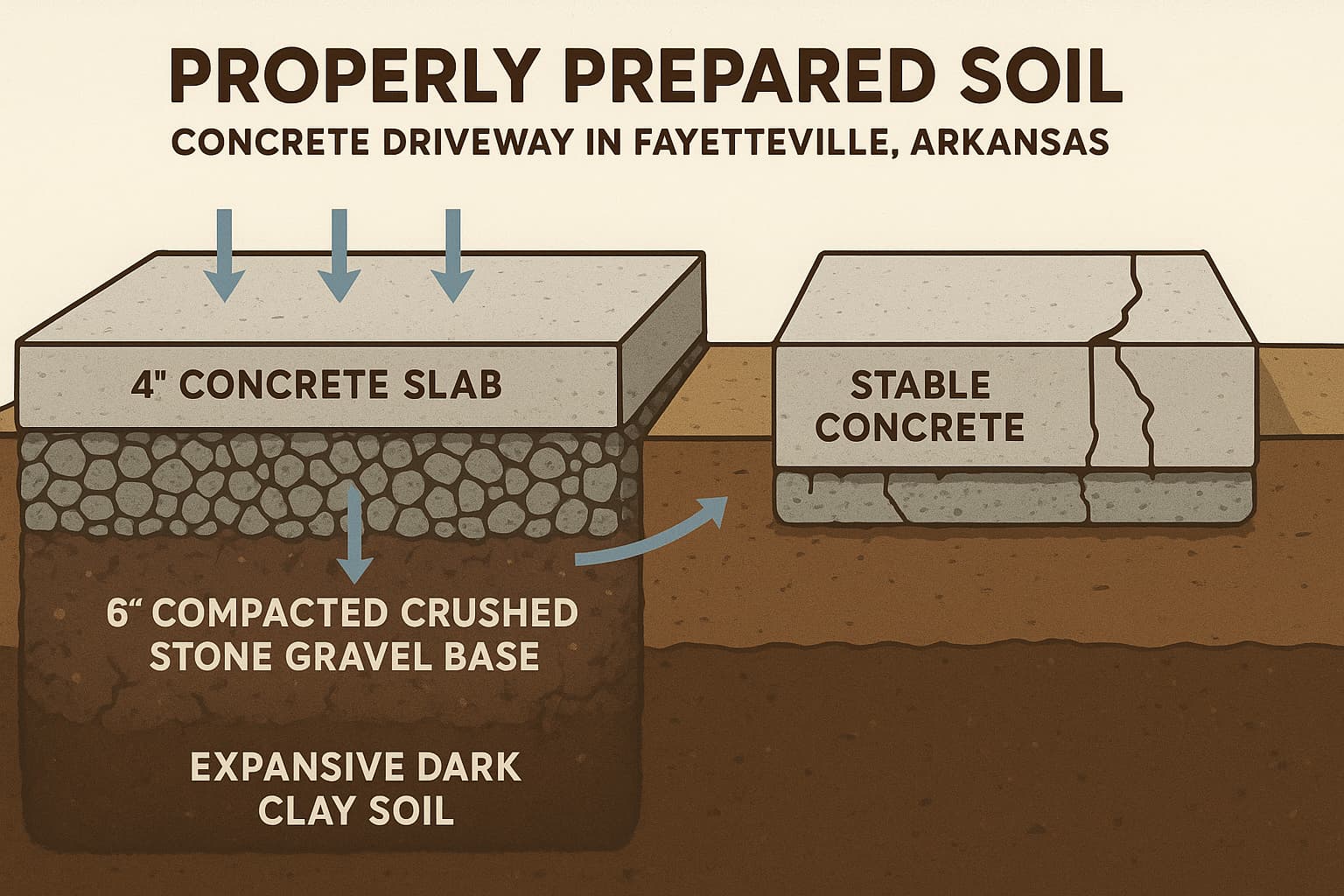
Key Takeaways
- Soil type determines load-bearing capacity and drainage performance beneath your concrete, with clay soils in Northwest Arkansas creating unique expansion and contraction challenges that can crack slabs if not properly managed.
- Moisture content directly affects both installation quality and long-term durability, as extremely wet or dry soil interferes with proper concrete curing while seasonal moisture changes cause the freeze-thaw damage common in Fayetteville winters.
- Proper soil compaction prevents 90% of concrete settling issues, but Arkansas’s expansive clay soils require professional testing to achieve the 95% density minimum that prevents future voids and structural failures.
- Arkansas homeowners face specific soil challenges including Porters Creek Clay expansion, seasonal ground movement, and the need for specialized drainage solutions that protect concrete from our region’s 43-47 inches of annual rainfall.
- Professional soil testing and preparation add upfront costs but prevent expensive repairs, with geotechnical evaluations costing $500-2,000 versus concrete replacement costs exceeding $8-15 per square foot when installations fail on unprepared soil.
Local soil conditions play a critical role in determining whether your concrete installation lasts 30 years or develops cracks within the first season. The type of soil beneath your driveway installation or patio affects load-bearing capacity, drainage performance, and resistance to seasonal movement—factors that become especially important in Northwest Arkansas where expansive clay soils create unique challenges for homeowners planning concrete projects.
Why Soil Matters for Concrete Success
Think of soil as the foundation for your foundation. Even perfectly mixed and poured concrete will crack, settle, or heave if the ground beneath it cannot provide stable, uniform support. Soil conditions affect concrete installations in three fundamental ways that determine long-term performance.
Load-Bearing Capacity Determines Structural Stability
Different soil types handle weight differently. Sandy and gravelly soils typically support 2,000-3,000 pounds per square foot, making them excellent for concrete slabs.[1] Clay soils, which dominate much of Fayetteville and Northwest Arkansas, often provide only 1,500-2,000 pounds per square foot of bearing capacity when properly compacted.[2] This difference becomes critical when you consider that a typical concrete driveway with vehicles can exert pressures exceeding 1,000 pounds per square foot.
Weak or unstable soils like uncompacted fill or organic-rich earth have even lower bearing capacity, sometimes under 1,000 pounds per square foot.[3] These soils compress under the weight of concrete and anything placed on top, creating the settling and sinking that causes cracked slabs and uneven surfaces. Professional contractors address this through soil removal, compaction, or using specialized foundation systems that distribute loads more effectively.
Moisture Movement Creates Seasonal Pressure Changes
Water in soil behaves differently depending on soil composition. Clay particles absorb water molecules into their chemical structure, causing significant volume expansion—sometimes increasing soil volume by 10% or more.[4][5] When that clay dries during Arkansas’s hot summers, it shrinks back down, creating a cycle of pressure that concrete simply cannot withstand long-term.
This expansion and contraction cycle becomes particularly problematic in Fayetteville where we experience both wet springs with 43-47 inches of annual rainfall and dry summer periods.[6] The repeated stress manifests as cracks that start small but widen over time, eventually compromising the entire slab’s structural integrity. Sandy soils avoid this expansion problem but create different challenges with erosion and moisture loss that can undermine concrete support.
Drainage Performance Prevents Water Damage
How quickly water drains away from concrete determines whether moisture-related problems develop. Clay soils in Arkansas drain slowly—sometimes less than 0.06 inches per hour—allowing water to pool beneath slabs.[7] This standing water creates multiple problems: it saturates the soil, increasing expansion pressure; it can freeze in winter, causing frost heave; and it gradually erodes soil particles, creating voids beneath the concrete.
Good drainage requires both proper soil characteristics and engineered solutions. Sandy and gravelly soils naturally drain at rates exceeding 2 inches per hour, but they need protection from erosion.[8] Clay-rich soils require intervention through grading, French drains, and permeable base layers that redirect water before it can accumulate and cause damage.
Arkansas Soil Types and Their Concrete Challenges
Northwest Arkansas sits in a geologically complex region where different soil types create varying challenges for concrete installations. Understanding which soil type exists on your property helps predict potential problems and plan appropriate solutions.
Expansive Clay Soils: Arkansas’s Primary Concrete Challenge
Much of Fayetteville and Northwest Arkansas sits atop expansive clay formations, particularly the Porters Creek Clay of the Midway Group.[9] This dark bluish-gray to black calcareous clay stretches in a continuous belt through central Arkansas and contains minerals like montmorillonite and smectite that make it highly reactive to moisture changes.[10]
When saturated, these clays can generate expansion pressures exceeding 5,000 pounds per square foot—enough force to lift a concrete slab several inches or crack foundation walls.[11] The active zone, which is the depth where seasonal moisture changes occur, typically extends 3-5 feet below ground in Arkansas.[12] This means concrete slabs installed directly on expansive clay without proper preparation will experience movement throughout the year as the soil beneath them swells and shrinks.
Contractors address expansive clay through several methods: removing and replacing with select fill, pre-wetting the soil before construction to limit future expansion, installing moisture barriers, or using post-tensioned concrete that can better accommodate some soil movement.[13] For driveways in areas with expansive clay, increasing concrete thickness to 5-6 inches provides additional resistance to cracking.
Sandy and Loam Soils: Better Drainage, Different Risks
Some areas of Northwest Arkansas, particularly near rivers and in alluvial zones, feature sandy or loam soils that offer advantages for concrete installations. These soils drain well, resist expansion and contraction, and compact effectively when properly prepared.[14] Loam, which contains a balanced mix of sand, silt, and clay particles, is considered the ideal soil for concrete foundations because it provides both stability and adequate drainage.[15]
However, sandy soils present their own challenges. They erode easily when exposed to water flow, potentially creating voids beneath concrete slabs.[16] The loose, granular nature of sand also means it can shift under heavy loads if not properly compacted. Contractors working with sandy soils focus on achieving proper compaction density—typically 95% of maximum dry density—and installing drainage systems that prevent erosion while still allowing water to dissipate.
Rocky and Gravelly Soils: Excavation Challenges with Stability Benefits
Parts of the Ozark region around Fayetteville feature rocky or gravelly soils formed from weathered bedrock. These soils provide excellent bearing capacity and natural drainage, often supporting loads exceeding 3,000 pounds per square foot.[17] They resist expansion and contraction, making them stable foundations for concrete work.
The primary challenge with rocky soils involves excavation difficulty and achieving proper grade for concrete installation. Large rocks must be removed or broken down to prevent creating voids beneath the slab. Once prepared, however, these soils provide some of the most reliable support for concrete projects. Many contractors view rocky subsoils as an advantage despite the extra preparation work required.
How Soil Conditions Impact Different Concrete Projects
| Project Type | Primary Soil Concerns | Recommended Solutions |
|---|---|---|
| Driveways | Load-bearing capacity for vehicles; expansion/contraction in clay; drainage | 4-6″ gravel base; 95% compaction; 5-6″ concrete thickness; proper drainage slope |
| Patios | Settlement from poor compaction; moisture wicking; freeze-thaw damage | 4″ gravel base; vapor barrier; proper slope away from house; 4″ concrete minimum |
| Walkways | Uneven settling creating trip hazards; cracking from soil movement | Consistent base preparation; control joints every 4-5 feet; compacted subgrade |
| Pool Decks | Expansive clay heave; water saturation from pool; drainage around water features | Clay removal/replacement; drainage systems; possible structural slab design |
| Foundations | Long-term stability; bearing capacity for structure weight; clay expansion pressure | Geotechnical evaluation; deep footings; engineered fill; moisture control systems |
Understanding Soil Moisture and Concrete Performance
Moisture content in soil affects concrete installations during both the construction process and throughout the life of the slab. Getting moisture levels right during installation determines curing quality, while managing long-term moisture prevents the most common concrete problems Arkansas homeowners face.
Construction-Phase Moisture Considerations
When contractors pour concrete, the soil beneath it should have optimal moisture content—not too dry and not saturated. Extremely dry soil acts like a sponge, drawing water from the fresh concrete mix.[18] This premature water loss prevents proper cement hydration, the chemical reaction that gives concrete its strength. The result is weaker concrete that may not reach its designed compressive strength of 3,000-4,000 PSI.
Conversely, saturated soil cannot provide stable support during installation. Water-logged ground lacks bearing capacity, making it difficult to achieve proper compaction and grade. Many professional contractors lightly moisten dry subgrades before pouring concrete, providing just enough moisture for proper curing without creating instability. This balance becomes especially important in Arkansas during summer months when prolonged dry periods can desiccate clay soils.
Long-Term Moisture Management Prevents Damage
After installation, ongoing moisture management protects concrete from several damage mechanisms. In clay soils, maintaining relatively constant moisture levels minimizes the expansion and contraction cycle that causes cracking.[19] This doesn’t mean keeping soil saturated—rather, it means preventing dramatic moisture swings through proper drainage and sometimes irrigation during extreme dry periods.
Poor drainage allows water accumulation beneath slabs, creating several problems. Saturated soil loses strength, increasing settlement risk. In winter, this water can freeze and expand, generating frost heave that lifts and cracks concrete.[20] Fayetteville typically experiences an estimated 20-30 freeze-thaw cycles per winter season, making frost damage a real concern for concrete installations without adequate drainage.[21]
Effective moisture management combines surface grading that directs water away from concrete, subsurface drainage systems like gravel beds or perforated pipes, and proper site selection that avoids natural drainage channels or low-lying areas where water naturally accumulates during Arkansas’s frequent rainfall events.
The Critical Importance of Soil Compaction
Proper soil compaction is the single most important factor in preventing concrete settlement and failure. Even excellent soil can cause problems if not properly compacted, while marginal soil can perform well when compaction is done correctly. Understanding compaction principles helps homeowners evaluate whether their contractor is following best practices.
What Compaction Achieves
Compaction removes air voids from soil, increasing its density and load-bearing capacity. Loose, uncompacted soil might support only 500-800 pounds per square foot, while the same soil properly compacted can support 2,000-3,000 pounds per square foot or more.[22] This difference determines whether concrete settles over time or remains stable for decades.
The compaction process involves applying mechanical force—through plate compactors, rollers, or tampers—while maintaining optimal moisture content. For most soils, this optimal moisture content allows soil particles to slide past each other and lock into a dense configuration. Too dry, and particles don’t pack effectively; too wet, and excess water prevents proper compaction.
Compaction Standards and Testing
Professional concrete installations follow specific compaction standards, typically requiring 95% of maximum dry density as determined by Proctor testing.[23] This testing method, codified in ASTM D698 and AASHTO T99, establishes the optimal moisture content and maximum achievable density for a given soil type.[24]
Field testing verifies that installed soil meets these standards. Common testing methods include the nuclear density gauge, which provides quick results, and the sand cone test, which offers high accuracy at lower cost.[25] For residential concrete projects, contractors typically test every 50-100 cubic yards of fill material to ensure consistent compaction throughout the site.
Compaction should occur in lifts—layers of 6-8 inches maximum thickness before compacting.[26] Attempting to compact thicker layers leaves loose soil in the middle, creating weak zones that will settle later. This lift requirement means that deep fills require multiple compaction cycles as material is placed, adding time and cost but ensuring proper support for concrete installations.
Soil Testing: Knowing What You’re Building On
Professional soil testing reveals the specific characteristics of earth on your property, allowing contractors to design concrete installations that address actual site conditions rather than making assumptions. While testing adds upfront cost, it prevents expensive failures and ensures installations perform as expected.
Types of Soil Tests for Concrete Projects
A basic geotechnical evaluation for residential concrete typically includes several tests. Soil classification determines the percentages of sand, silt, and clay, which indicates drainage characteristics and expansion potential.[27] Atterberg limits testing measures plasticity, revealing how much the soil will expand and contract with moisture changes.[28] This test is particularly important in Arkansas where expansive clays are common.
Bearing capacity tests determine how much weight the soil can support. Standard Penetration Tests (SPT) measure soil resistance at different depths, helping engineers specify appropriate foundation designs.[29] For most residential driveways and patios, simplified bearing capacity estimates based on soil classification provide sufficient information, though critical structures like homes require more detailed analysis.
Proctor compaction testing establishes the maximum dry density and optimal moisture content for site soils.[30] These parameters guide field compaction work, ensuring crews know exactly how dense the soil should be and what moisture content achieves that density. Without this information, achieving proper compaction becomes guesswork.
When to Invest in Professional Testing
Professional geotechnical evaluations for residential projects typically cost $500-2,000 depending on site size and testing depth.[31] This investment makes sense for several situations. Large projects like extensive driveways or patio installations exceeding 500 square feet justify testing costs by preventing expensive failures. Properties with visible soil problems—standing water, existing settlement, or cracks in nearby structures—definitely warrant testing before new concrete work.
Areas with known expansive clay, including much of Northwest Arkansas, benefit from testing that quantifies expansion potential and guides mitigation strategies. Contractors planning significant grading or fill work should test to verify that imported materials meet project requirements. Even smaller projects benefit when homeowners want certainty about long-term performance and are willing to invest in doing things right from the start.
Solutions for Challenging Soil Conditions
When soil testing or site observation reveals problematic conditions, several proven solutions allow successful concrete installations even on challenging ground. The right approach depends on specific soil characteristics, project requirements, and budget considerations.
Soil Removal and Replacement with Select Fill
For highly expansive clay, organic-rich soil, or very weak subgrades, complete removal and replacement provides the most reliable solution. Contractors excavate problematic soil to depths of 12-24 inches or more, then backfill with select fill materials that offer superior properties.[32]
Select fill typically consists of well-graded sand and gravel mixtures, crushed stone, or recycled concrete aggregate. These materials provide excellent bearing capacity (2,500-4,000 pounds per square foot when compacted), drain well, and resist expansion and contraction.[33] Common specifications include 3/4-inch crushed stone (ASTM #57) for the base layer with finer materials for the final lift that provides a smooth surface for concrete placement.[34]
The excavation depth depends on problematic soil depth and the active zone for moisture changes. In Arkansas, excavating 12-18 inches typically removes the most problematic surface soil and provides sufficient depth for a well-compacted base. Deeper excavations become necessary when expansive clays extend several feet down or when bearing capacity is exceptionally poor.
Moisture Control and Stabilization Methods
Rather than removing expansive clay, some situations allow stabilization through moisture control. Pre-wetting involves saturating the soil before construction, allowing it to expand fully before placing concrete.[35] This technique works best when clay depth is limited and when adequate time (several weeks) exists for the soil to equilibrate at its expanded state.
Chemical stabilization using lime or cement modifies clay properties, reducing plasticity and expansion potential while improving strength.[36] Lime treatment is particularly effective for Arkansas’s expansive clays. Contractors typically apply 3-6% hydrated lime by soil weight, mixing it thoroughly into the top 6-12 inches of soil. The lime reacts with clay minerals, creating a more stable matrix that resists moisture-induced volume changes.
Installing moisture barriers beneath concrete slabs helps regulate moisture movement from soil into concrete while also preventing downward moisture loss from freshly placed concrete during curing. Polyethylene sheeting (6-mil minimum thickness) serves as an effective vapor barrier, though it should be placed over a sand layer to prevent punctures and provide a smooth surface for concrete placement.
Enhanced Drainage Systems
Comprehensive drainage solutions address water accumulation that exacerbates soil problems. Surface grading should slope away from concrete at minimum 2% grade (1/4 inch per foot), directing rainfall and runoff away from slabs before it can penetrate beneath them.[37]
Subsurface drainage becomes necessary in low-lying areas or where clay soils prevent adequate percolation. French drains—perforated pipes surrounded by gravel—collect groundwater and direct it to appropriate discharge points.[38] For concrete slabs, installing a 4-6 inch gravel base beneath the concrete serves dual purposes: it provides a stable base and acts as a drainage layer that prevents water accumulation directly under the slab.
Around the perimeter of driveways and patios, edge drains intercept surface water before it can infiltrate beneath the concrete edges, which are vulnerable points where water commonly enters and causes erosion or frost damage.
Northwest Arkansas-Specific Soil Considerations
Fayetteville and surrounding Northwest Arkansas communities face unique soil challenges that affect concrete installation planning and performance. Understanding these local factors helps homeowners and contractors make informed decisions.
Porters Creek Clay and Expansive Soil Zones
The Porters Creek Clay formation creates a continuous belt of highly expansive soils through central Arkansas, extending through parts of the Fayetteville area.[39] This calcareous clay contains smectite clay minerals that can expand up to 15% in volume when saturated, generating pressures that easily crack concrete slabs and damage foundations.
Properties located within this geological zone require special attention to soil preparation. Homeowners should expect recommendations for deeper excavation, select fill replacement, or specialized foundation systems. Contractors familiar with Arkansas soil conditions will identify Porters Creek Clay indicators—dark gray to black coloration, high plasticity when wet, and hard, blocky structure when dry.
Seasonal Moisture Variations and Temperature Cycles
Northwest Arkansas experiences pronounced seasonal changes that affect soil moisture and concrete performance. Spring and late fall typically bring heavy rainfall, saturating soils and creating maximum expansion in clay formations.[40] Summer heat then dries surface soils, causing contraction. This annual cycle creates repetitive stress on concrete installations.
Winter freeze-thaw cycles, while less severe than northern states, still impact concrete durability. Fayetteville typically sees an estimated 20-30 cycles per winter where temperatures cross the freezing point.[41] When combined with moisture in inadequately drained soil, these cycles create internal pressure as water freezes and expands in concrete pores and beneath slabs. Using air-entrained concrete (containing 4-6% microscopic air bubbles) provides protection by giving frozen water expansion space without cracking the concrete matrix.[42]
Ozark Topography and Drainage Challenges
The rolling hills characteristic of the Ozark region create natural drainage patterns that affect where water accumulates. Properties on slopes might experience good natural drainage but face challenges with erosion beneath concrete. Low-lying properties often battle seasonal water accumulation that saturates soil and undermines concrete support.
Successful concrete installations in this topography require careful site grading that works with natural drainage rather than fighting it. Driveway installations on slopes need proper base preparation to prevent washout during heavy rains, while low-elevation sites might require raised grade or enhanced subsurface drainage.
| Soil Type | Stability Rating | Drainage Quality | Primary Arkansas Challenges |
|---|---|---|---|
| Expansive Clay | Poor (swells/shrinks) | Very Poor | Seasonal cracking, heaving, moisture retention, Porters Creek Clay expansion |
| Sandy Loam | Good (stable) | Excellent | Erosion during heavy rains, compaction requirements, limited availability |
| Loam | Excellent (ideal) | Good | Minimal if properly compacted; may contain some clay content in Arkansas |
| Rocky/Gravel | Excellent | Excellent | Excavation difficulty, achieving proper grade, removal of large rocks |
| Organic/Peat | Very Poor (unstable) | Variable | Ongoing decomposition, settling, requires complete removal for concrete |
Cost Implications of Soil Conditions
Understanding soil conditions affects project budgets significantly. While proper soil preparation adds upfront costs, it prevents far more expensive repairs when installations fail due to inadequate preparation.
Basic soil testing for residential concrete projects runs $500-2,000 depending on site size and complexity.[43] Select fill materials cost $30-80 per cubic yard delivered, with typical residential driveways requiring 10-20 cubic yards for adequate base preparation.[44] Compaction services add $200-500 for equipment rental and operator time on smaller projects.
Compare these costs to concrete replacement: full slab removal and reinstallation typically costs $8-15 per square foot.[45] A 500-square-foot driveway replacement runs $4,000-7,500—far more than the $1,500-2,500 additional cost of proper soil preparation during initial installation. Foundation repair for settlement caused by poor soil preparation can exceed $10,000 for residential structures.
Premium solutions like chemical stabilization or deep excavation add 15-30% to base project costs but provide long-term value through superior performance.[46] Homeowners should view soil preparation as essential insurance rather than optional expense, particularly in Northwest Arkansas where expansive clay soils make problems highly likely without proper preparation.
Expert Perspective on Soil and Concrete
According to the American Concrete Institute’s guide to floor and slab construction, “The soil support system beneath a concrete slab is there to support the slab. Soil must be properly identified, compacted, and tested to provide adequate support.”[47] This fundamental principle underscores that concrete’s long-term performance depends entirely on the foundation it rests upon.
Dr. Debakanta Mishra, a geotechnical engineering researcher, notes that “the critical saturation degree has been proposed to depict the influence of internal saturation on freeze-thaw damage development” in concrete exposed to challenging soil conditions.[48] His research emphasizes that moisture management—controlling how much water remains in soil beneath concrete—determines freeze-thaw resistance in regions like Northwest Arkansas that experience temperature fluctuations around freezing.
Conclusion
Local soil conditions fundamentally determine whether concrete installations perform reliably for decades or develop problems within the first few years. For Fayetteville homeowners planning driveways, patios, or other concrete projects, understanding your specific soil type and taking appropriate preparation steps makes the difference between a wise investment and an expensive mistake. Arkansas’s expansive clay soils, seasonal moisture variations, and freeze-thaw cycles create challenges that proper soil testing, preparation, and drainage solutions can effectively address. Working with experienced contractors who understand Northwest Arkansas soil conditions ensures your concrete project receives the foundation it needs for lasting performance. Don’t let poor soil preparation undermine your investment—insist on professional soil evaluation and proper base preparation that protects your concrete for the long term.
Local Soil Conditions Affect Concrete Installations FAQs
How do local soil conditions affect concrete installations?
Local soil conditions directly affect concrete installations by determining load-bearing capacity, influencing moisture management beneath the slab, and causing seasonal expansion or contraction that can crack concrete. Clay soils common in Arkansas expand when wet and shrink when dry, creating pressure that damages concrete, while sandy soils drain well but may erode and create voids. Proper soil testing and preparation address these conditions to ensure stable, long-lasting concrete performance.
What type of soil is best for concrete slabs in Fayetteville?
Loam soil is ideal for concrete slabs in Fayetteville because it balances sand, silt, and clay content, providing both stability and adequate drainage. Sandy soils also work well due to excellent drainage, though they require proper compaction to prevent settling. Expansive clay soils common in Northwest Arkansas require special preparation—including removal and replacement with select fill, or chemical stabilization—to prevent seasonal swelling and shrinking that cracks concrete.
How deep should soil be excavated for concrete driveways in Arkansas?
Arkansas concrete driveways typically require excavating 8-12 inches below the finished grade to remove organic topsoil and reach stable subgrade. In areas with expansive clay like much of Fayetteville, excavation depth increases to 12-18 inches or more to remove problematic soil and allow installation of 4-6 inches of compacted gravel base beneath the 4-6 inch concrete slab. Properties with very poor soil may require deeper excavation based on geotechnical recommendations.
Can concrete be poured directly on clay soil?
Pouring concrete directly on clay soil is not recommended in Arkansas due to the expansive nature of local clays, which swell when wet and shrink when dry. This movement causes concrete cracking and structural failure over time. Professional installations remove at least 12 inches of clay and replace it with compacted gravel base, or they stabilize the clay using lime treatment and moisture control methods that reduce expansion potential before placing concrete.
How does soil compaction prevent concrete problems?
Proper soil compaction removes air voids and increases density, preventing settlement and ensuring uniform support beneath concrete. Contractors achieve 95% of maximum dry density through mechanical compaction in 6-8 inch lifts, dramatically increasing bearing capacity from 500-800 pounds per square foot in loose soil to 2,000-3,000 pounds or more when properly compacted. Without adequate compaction, soil gradually settles under concrete weight, creating uneven surfaces, cracks, and structural problems that require expensive repairs.
Local Soil Conditions Affect Concrete Installations Citations
- Stratum Repair – The Role of Soil Composition in Concrete Settling and Leveling
- Venture Concrete Technologies – How Soil Conditions Affect Concrete Footing Stability
- Barrow Mix Concrete – Pouring Concrete Over Soil: A Comprehensive Guide
- Concrete Network – Does Expansive Clay Soil Cause Foundation Problems?
- Arkansas Geological Survey – Expansive Soils in Arkansas
- Airlift Concrete Experts – How Arkansas Soil Types Affect Your Home’s Foundation
- Leveled Concrete – Types of Soil for Building Foundation
- UltraTech Cement – Types of Soil and Their Properties
- Arkansas Geological Survey – Expansive Soils: Porters Creek Clay
- Mintek Resources – Dealing with Expansive Soils in Construction
- Structured Foundation Repairs – Preventing Foundation Problems in Expansive Clay Soil Environments
- Parrot Bay Pools – Arkansas Soil Types and Swimming Pool Construction
- Baird Foundation Repair – Foundation Problems Due to Expansive Soils
- NHI Foam – Types of Soil and Your Concrete
- Leveled Concrete – Best Soil Types for Foundations
- Stratum Repair – Soil Erosion and Concrete Stability
- UltraTech Cement – Rocky and Gravelly Soil Properties
- Withers Lumber – Why Soil Moisture Matters When Pouring Concrete Footings
- Concrete Network – Maintaining Moisture Balance in Expansive Soils
- DPS Construction – Freeze-Thaw Cycle Effects on Concrete
- A-1 Concrete Leveling – A Homeowner’s Guide to Freeze-Thaw Cycles
- G3 SoilWorks – Soil Compaction Test Methods
- Mintek Resources – Soil Compaction Test for Construction
- BigRentz – Proctor Compaction Test: Procedure and Tools
- Cat Rental Store – How to Measure Soil Compaction
- ACS Services – 4 Critical Things to Know About a Compaction Test
- GEO Forward – Soil Compaction Testing and Soil Density Testing
- Mintek Resources – Atterberg Limits Test for Expansive Soils
- GEO Forward – Geotechnical Testing Methods
- Mintek Resources – Proctor Compaction Testing Standards
- ACS Services – Geotechnical Evaluation Costs
- Wafflemat Foundation Systems – What Is the Best Fill Under Concrete Slab?
- Hello Gravel – What Type of Gravel Is Best to Use Under a Concrete Slab?
- Concrete Network – Best Fill Under Concrete Slabs
- Parrot Bay Pools – Pre-Wetting Soil Before Construction
- Mintek Resources – Chemical Stabilization of Expansive Soils
- Hello Gravel – Drainage Solutions for Concrete Slabs
- Slabjack Kings – Causes of Sunken Concrete and Prevention
- Arkansas Geological Survey – Porters Creek Clay Distribution
- Airlift Concrete Experts – Arkansas Seasonal Soil Conditions
- AR Concrete Fayetteville – Fayetteville Freeze-Thaw Cycles
- National Institutes of Health – Air-Entrained Concrete for Freeze-Thaw Resistance
- ACS Services – Soil Testing Cost Estimates
- TractorByNet – Gravel Base Material Costs
- Everything About Concrete – Concrete Replacement Costs
- Wafflemat Foundation Systems – Cost-Benefit of Soil Preparation
- American Concrete Institute – Soil Support System Requirements
- National Center for Biotechnology Information – Freeze-Thaw Deterioration Mechanisms in Concrete
Leave a Reply