Key Takeaways:
- Control joints act as planned weak points that guide cracks to specific locations, preventing random cracking across your concrete slab
- Proper control joint spacing in Arkansas should be 24 to 30 times the slab thickness, with joints cut to one-quarter of the slab depth
- Control joints help concrete slabs withstand Arkansas’s freeze-thaw cycles and expansive clay soil movements common throughout the region
- Well-placed control joints can reduce uncontrolled cracking by up to 85% according to ACI standards
- Control joints preserve structural integrity while making future repairs more predictable and manageable
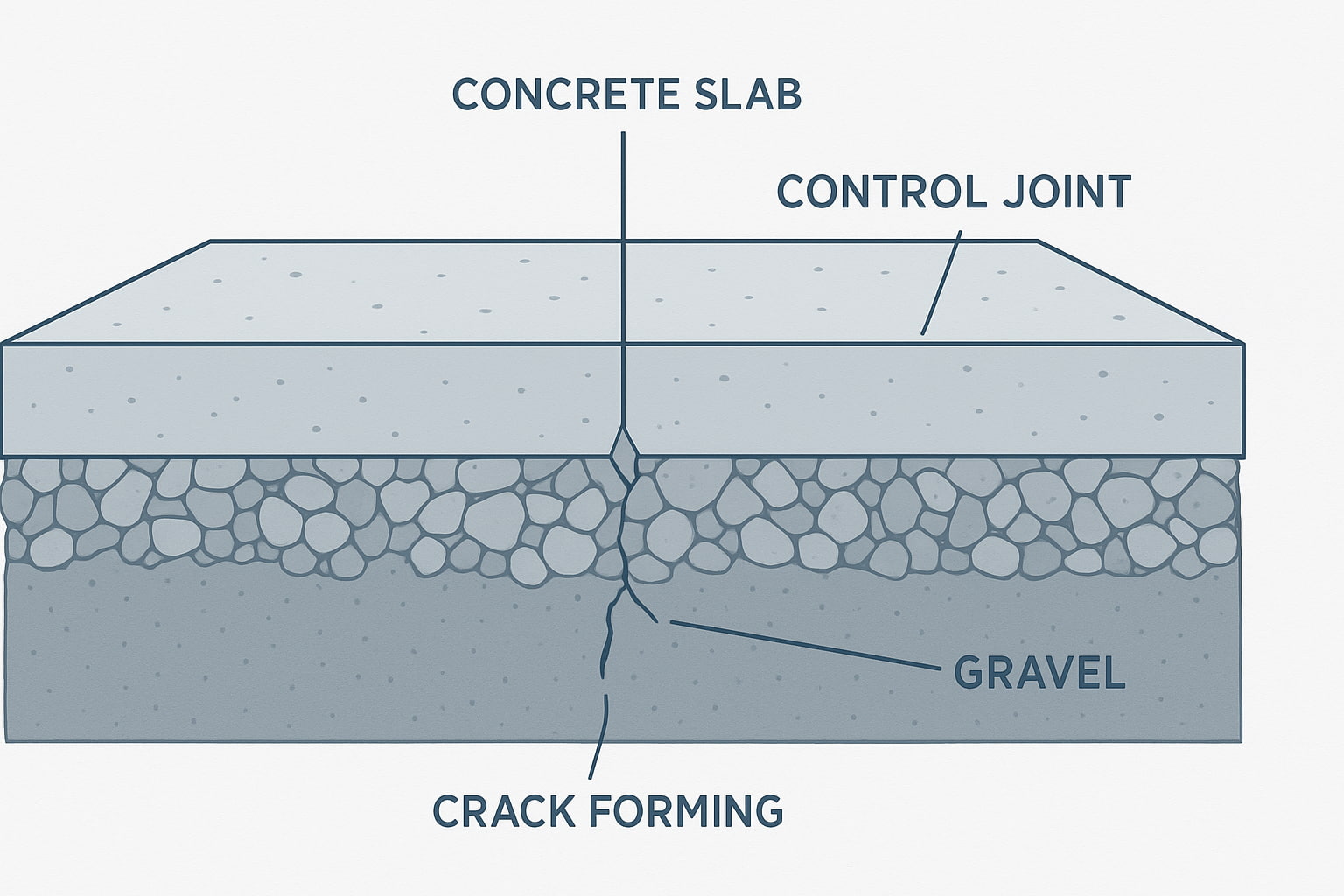
Control joints dramatically extend concrete slab durability by creating intentional weak points that direct where cracks form as concrete naturally shrinks during curing. Rather than allowing random cracks to compromise your slab’s strength and appearance, control joints confine cracking to straight, manageable lines that preserve the overall integrity of your concrete.[1]
Understanding How Control Joints Protect Your Concrete Slab
When concrete cures and loses moisture, it naturally shrinks, creating internal tensile stress throughout the slab. Since concrete excels at handling compression but struggles with tension, this shrinkage stress inevitably leads to cracking. Control joints work by creating a deliberately weakened plane in your concrete, essentially telling the crack exactly where to form.[2]
Think of control joints as relief valves for your concrete. As your slab dries and contracts, the stress concentrates at these pre-cut grooves rather than building up until it cracks randomly somewhere else. The joint creates a weak point that’s typically cut to one-quarter of the slab’s total depth, making it the path of least resistance when shrinkage stress develops.[3]
For Fayetteville homeowners, this is particularly important because Arkansas’s clay-heavy soils and temperature fluctuations create additional stress on concrete slabs. Expansive clay soils common throughout Arkansas swell when wet and shrink when dry, creating soil movement that stresses concrete foundations and slabs.[4] Control joints allow your slab to accommodate these soil movements without developing structural cracks.
The Science Behind Concrete Shrinkage and Cracking
Concrete doesn’t just shrink once and then stop. During the first few months after pouring, concrete undergoes significant drying shrinkage as water evaporates from the mix. Studies show that nearly 50 percent of the drying shrinkage that will occur over 20 years happens within the first two months, with about 80 percent occurring within the first year.[5]
The amount of shrinkage depends on several factors that matter specifically in Arkansas installations. Higher water content in the concrete mix leads to more shrinkage. The type and amount of aggregate used affects how much the cement paste can shrink. Even environmental conditions like temperature and humidity play major roles.[6]
Temperature changes add another layer of complexity. Concrete expands in heat and contracts in cold, creating additional stress beyond initial curing shrinkage. In northwest Arkansas, where temperatures can swing from below freezing in winter to over 100°F in summer, this thermal movement is substantial.[7] Without control joints to accommodate this natural expansion and contraction, your slab faces continuous stress that leads to premature failure.
How Freeze-Thaw Cycles Impact Uncontrolled Cracking
Arkansas experiences regular freeze-thaw cycles that make uncontrolled cracking particularly problematic. When water enters cracks in concrete and then freezes, it expands by approximately 9 percent in volume.[8] This expansion creates tremendous pressure from within the concrete, causing the cracks to widen and deepen.
Concrete needs to reach at least 500 psi compressive strength before it can safely tolerate a single freeze-thaw cycle. For exposure to repeated freezing and thawing, especially with deicing chemicals, concrete should reach at least 4,000 psi.[9] Control joints help by keeping cracks confined to locations where they can be properly sealed, preventing water infiltration that leads to freeze-thaw damage.
How Control Joints Maintain Structural Integrity
The primary purpose of control joints is preserving your slab’s load-bearing capacity. By directing cracks to specific, non-critical locations, control joints prevent the random cracking patterns that compromise structural integrity.
| Slab Condition | Load Transfer | Long-Term Performance | Maintenance Requirements |
|---|---|---|---|
| With Properly Spaced Control Joints | Excellent load transfer maintained across joints | Controlled cracking preserves slab function for 30+ years | Minimal joint sealing every 5-7 years |
| Without Control Joints | Poor load transfer after random cracking develops | Uncontrolled cracks worsen over time, requiring major repair within 10-15 years | Constant crack repair and potential slab replacement |
| Improperly Spaced Joints | Reduced load transfer as cracks form between joints | Additional cracks reduce effectiveness of joint placement | Increased maintenance addressing unexpected cracks |
When control joints are properly placed, they create panels of concrete that can flex slightly under load without transferring excessive stress to adjacent sections. This is especially important in Arkansas, where expansive clay soils can cause differential movement beneath your slab. The joints act as buffer zones, allowing different sections of your slab to move independently without creating stress concentrations that lead to structural cracking.[10]
Preventing Water Infiltration and Base Deterioration
Uncontrolled cracks that wander randomly across your slab create pathways for water to reach the base material beneath your concrete. Once water infiltrates below the slab, it can wash away base material, create voids, and in Arkansas’s expansive clay soils, trigger problematic swelling and shrinking cycles.
Control joints concentrate cracks in known locations where you can apply sealant to prevent water infiltration. This proactive approach protects the gravel base and prevents the erosion issues that lead to slab settlement and failure.[11] For homeowners dealing with expansive clay soils, which can swell by 10 percent or more when saturated, preventing water infiltration beneath the slab is critical for long-term durability.[12]
Proper Control Joint Spacing for Arkansas Slabs
The American Concrete Institute recommends spacing control joints at intervals of 24 to 30 times the slab thickness for unreinforced concrete slabs.[13] This means a 4-inch thick residential slab should have control joints every 8 to 10 feet, while a 6-inch slab can extend to 12 to 15 feet between joints.
However, Arkansas’s specific conditions may require adjustments to these general guidelines. The high clay content in local soils, combined with significant seasonal moisture changes, creates additional shrinkage stress that might warrant closer joint spacing in some installations.[14]
Key Factors Determining Control Joint Placement
Beyond basic spacing formulas, several factors influence where you should place control joints in Arkansas concrete installations:
Concrete mix design: Higher cement content and lower water-cement ratios generally produce more shrinkage, potentially requiring closer joint spacing. Mixes with larger aggregate content and lower slump values may perform better with standard spacing recommendations.[15]
Slab reinforcement: If your slab includes reinforcing steel or fiber reinforcement, you may be able to extend joint spacing slightly. However, the reinforcement doesn’t prevent cracking entirely—it just holds cracks tighter together. Control joints remain essential even in reinforced slabs.[16]
Exposure conditions: Slabs exposed to direct sunlight, wind, and temperature extremes need more frequent control joints. Arkansas’s hot summers and cold winters create significant thermal stress that benefits from closer joint spacing than the same slab might need in a more moderate climate.[17]
Panel shape: Control joints should create panel shapes as close to square as possible. Long, narrow panels are more prone to cracking between joints. If your design creates a 10-by-20-foot panel, expect shrinkage stress to crack it into a more square shape regardless of your joint placement.[18]
Control Joint Depth and Installation Methods
Control joint effectiveness depends not just on spacing but also on proper depth. Industry standards specify that control joints should be cut to a minimum depth of one-quarter the slab thickness.[19] A 4-inch slab needs 1-inch deep joints, while a 6-inch slab requires 1.5-inch joints.
| Installation Method | Best Use Case | Typical Depth | Timing |
|---|---|---|---|
| Hand Tooling (Grooving) | Small residential slabs, decorative finishes | 1/4 slab thickness, minimum 1 inch | During finishing while concrete is plastic |
| Wet Saw Cutting | Standard residential and commercial slabs | 1/4 slab thickness or minimum 1 inch | Generally 4-12 hours after finishing when concrete is firm but not fully hard |
| Early-Entry Dry Cutting | Larger commercial projects, tight schedules | 1.25 inches for slabs up to 9 inches thick | 1-4 hours after finishing |
| Pre-formed Strips | Challenging conditions, complex patterns | Full slab depth | Installed before concrete placement |
Timing is critical for saw-cut control joints. Cut too early, and the saw blade chips and ravels the edges of the joint. Wait too long, and the concrete has already developed shrinkage cracks in random locations. For most Arkansas residential slabs, contractors typically saw-cut within 4 to 12 hours after finishing, though exact timing depends on weather conditions and concrete mix design.[20]
Special Considerations for Expansive Arkansas Clay
When pouring concrete over expansive clay soils, additional precautions help control joints perform their intended function. A well-compacted gravel base at least 4 inches thick provides a stable, non-expansive foundation that reduces the stress transferred from soil movement to your slab.[21]
Some contractors recommend installing a vapor barrier between the base and concrete to prevent moisture migration from the soil. While this protects against moisture-related flooring problems in interior slabs, it can reduce friction between the slab and base, potentially increasing the movement that control joints must accommodate.[22]
Maintenance Benefits of Control Joint Systems
Beyond preventing initial cracking, control joints make long-term maintenance significantly more manageable. When cracks form at control joints rather than randomly across your slab, repairs become straightforward and predictable.
Simplified sealing: You know exactly where cracks will develop, allowing you to apply joint sealant proactively rather than chasing unexpected cracks around your slab. Quality polyurethane or silicone-based sealants protect joints from water infiltration and debris accumulation.[23]
Predictable repairs: If a section of your slab does require repair or replacement, control joints provide natural boundaries for the work. You can remove and replace concrete between joints without affecting adjacent sections of the slab.[24]
Preserved aesthetics: Straight control joint lines are far less visually jarring than the random spiderweb patterns of uncontrolled cracking. In stamped concrete or other decorative applications, control joints can even be integrated into the design pattern to enhance rather than detract from appearance.[25]
For homeowners maintaining their concrete over decades, the difference between maintaining sealed control joints every five to seven years versus constantly addressing random cracks represents substantial time and cost savings.
Common Control Joint Mistakes to Avoid
Even with professional installation, certain control joint errors can compromise slab durability:
Insufficient depth: Joints cut too shallow don’t create enough weakness to attract the crack, causing it to form somewhere else on the slab surface instead. Always ensure joints reach at least one-quarter of the slab thickness.[26]
Too-wide spacing: Following general spacing guidelines without considering your specific conditions can leave panels too large. In Arkansas’s challenging climate with expansive soils, err on the side of closer spacing rather than pushing the maximum recommendations.[27]
Poor panel shapes: Creating long, narrow panels almost guarantees cracking between joints. Plan your joint layout to create panels as close to square as possible, even if this means adding extra joints.
Ignoring reentrant corners: Wherever your slab has an inside corner, plan a control joint from that corner. These stress concentration points will crack if you don’t provide a planned path for the stress to relieve itself.[28]
Continuing reinforcement through joints: If your slab includes reinforcing steel, ensure it doesn’t cross control joints. Continuous reinforcement prevents the joint from opening, defeating its purpose and forcing cracks to form elsewhere.[29]
Control Joints vs. Expansion Joints: Understanding the Difference
Homeowners often confuse control joints with expansion joints, but these serve different purposes in concrete construction. Control joints manage shrinkage and minor thermal movement in a single concrete pour. Expansion joints, also called isolation joints, separate different concrete pours or isolate concrete from other structures like walls or columns.
Most residential slabs in Arkansas need control joints but may not require expansion joints. Expansion joints become necessary when concrete meets buildings, light posts, or other fixed structures that shouldn’t be connected to the slab. They’re also used between separate concrete pours, such as where a new patio connects to an existing driveway.[30]
The key difference is function: control joints expect and accommodate cracking beneath them, while expansion joints provide complete separation through the full depth of the slab with a compressible filler material.[31]
Conclusion: Protecting Your Investment Through Proper Joint Design
Control joints represent a small additional step during installation that pays enormous dividends in long-term slab performance. By directing inevitable shrinkage cracks to predetermined locations, control joints preserve your concrete’s structural integrity, prevent water damage to the base, and keep your slab looking good for decades. In Arkansas’s challenging environment of expansive clay soils and significant temperature swings, proper control joint design isn’t optional—it’s essential for durable concrete that stands up to local conditions.
Whether you’re planning a new driveway, patio, or workshop floor, insisting on properly spaced and cut control joints protects your investment and minimizes future maintenance headaches. For more information on preventing concrete problems during installation, see our guide on preventing cracks in newly poured concrete slabs.
Control Joints Concrete Slab Durability FAQs
How do control joints help with slab durability in freeze-thaw climates?
Control joints help with slab durability in freeze-thaw climates by confining cracks to planned locations where they can be sealed, preventing water infiltration that causes freeze-thaw damage. When water enters uncontrolled cracks and freezes, it expands by 9 percent, creating pressure that worsens the cracking and leads to spalling and deterioration.[32]
What happens if control joints are spaced too far apart?
If control joints are spaced too far apart, shrinkage stress exceeds the concrete’s tensile strength between the joints, causing random cracks to form in the middle of large panels. These uncontrolled cracks compromise structural integrity more than properly placed control joint cracks and are more difficult to repair and seal effectively.[33]
Do control joints work in reinforced concrete slabs?
Control joints work in reinforced concrete slabs, but the reinforcement must be discontinued at the joint location or it will prevent the joint from opening. Steel reinforcement or fiber reinforcement holds cracks tightly together but doesn’t eliminate cracking, so control joints remain necessary to direct where those cracks form.[34]
How often should I seal control joints in my concrete?
You should seal control joints every five to seven years with quality polyurethane or silicone-based sealant. Regular sealing prevents water, dirt, and debris from entering the joint, which protects the base material and prevents the joint edges from spalling or chipping under traffic and environmental exposure.[35]
Can I add control joints to existing concrete that’s already cracking?
You cannot effectively add control joints to existing concrete that’s already developed shrinkage cracks, as the concrete has already relieved its shrinkage stress. However, saw-cutting along existing cracks can sometimes help manage their growth and provide a straighter line for sealing and repair work.[36]
Control Joints Concrete Slab Durability Citations
- Portland Cement Association. “Joints in Concrete Construction.” https://www.cement.org/learn/concrete-technology/concrete-construction/contraction-control-joints-in-concrete-flatwork
- ProAll Inc. “Why Control Joints Are Crucial in Concrete Construction.” August 24, 2023. https://proallinc.com/news/the-importance-of-control-joints-in-concrete/
- Concrete Network. “Control Joints in Concrete – When To Cut & Spacing.” July 1, 2021. https://www.concretenetwork.com/concrete/slabs/controljoints.htm
- Arkansas Geological Survey. “Expansive Soils in Arkansas.” https://www.geology.arkansas.gov/geohazards/expansive-soils.html
- BASF Construction Chemicals. “Shrinkage of Concrete – Concrete Technology in Focus.” https://insights.basf.com/files/pdf/Shrinkage_Of_Concrete_CTIF.pdf
- BASF Construction Chemicals. “Shrinkage of Concrete – Concrete Technology in Focus.” https://insights.basf.com/files/pdf/Shrinkage_Of_Concrete_CTIF.pdf
- Foundation Pro. “Can Extreme Heat Cause Foundation Damage?” October 13, 2020. https://foundationpro.com/2020/07/10/can-extreme-heat-cause-foundation-damage/
- For Construction Pros. “How to Protect Concrete During Cold Weather Pours.” https://www.forconstructionpros.com/concrete/equipment-products/article/11232331/kb-engineering-llc-how-to-protect-concrete-during-cold-weather-pours
- For Construction Pros. “How to Protect Concrete During Cold Weather Pours.” https://www.forconstructionpros.com/concrete/equipment-products/article/11232331/kb-engineering-llc-how-to-protect-concrete-during-cold-weather-pours
- American Concrete Institute. “ACI 302.1R-15: Guide to Concrete Floor and Slab Construction.” http://www.concrete.org/Portals/0/Files/PDF/302.1R-15_Chapter5.pdf
- Green Hammer Concrete. “The Purpose of Control Joints.” https://www.greenhammerconcrete.com/blog-the-purpose-of-control-joints/
- Foundation Pro. “Foundation Repair in Arkansas: How Rain and Heat Can Damage Your Home’s Foundation.” May 10, 2022. https://foundationpro.com/2021/07/23/foundation-repair-in-arkansas-how-rain-and-heat-can-damage-your-homes-foundation/
- U.S. Bureau of Reclamation. “Joint Spacing for Concrete Structures.” September 2016. https://www.usbr.gov/tsc/techreferences/mands/mands-pdfs/JointSpacingForConcreteStructures_09-2016_508.pdf
- Airlift Concrete Experts. “How Arkansas Soil Types Affect Your Home’s Foundation.” May 12, 2025. https://airliftconcreteexperts.com/arkansas-soil-types/
- BASF Construction Chemicals. “Shrinkage of Concrete – Concrete Technology in Focus.” https://insights.basf.com/files/pdf/Shrinkage_Of_Concrete_CTIF.pdf
- American Concrete Institute. “ACI 302.1R-04: Guide for Concrete Floor and Slab Construction – Chapter 3.” https://www.concrete.org/Portals/0/Files/PDF/3021R_04Ch3.pdf
- Triangle Ready Mix. “Cold Weather Concrete.” January 13, 2025. https://trianglereadymix.com/placing-concrete-during-cold-weather/
- 4specs Discussion Forum. “Spacing of control joints in slabs.” http://discus.4specs.com/discus/messages/23/9724.html
- Everything About Concrete. “Install Effective Concrete Contraction Joints – Depth and Spacing.” https://www.everything-about-concrete.com/concrete-contraction-joints.html
- Everything About Concrete. “Install Effective Concrete Contraction Joints – Depth and Spacing.” https://www.everything-about-concrete.com/concrete-contraction-joints.html
- Structured Foundation. “Preventing Foundation Problems in Expansive Clay Soil Environments.” May 21, 2024. https://www.structuredfoundation.com/preventing-foundation-problems-in-expansive-clay-soil-environments/
- Eng-Tips Forum. “Residential foundations for expansive clay.” May 6, 2006. https://www.eng-tips.com/threads/residential-foundations-for-expansive-clay.154139/
- Royale Concrete. “The Benefits of Joint Filling in Concrete Slabs.” https://www.royaleconcrete.com/the-benefits-of-joint-filling-in-concrete-slabs
- ProAll Inc. “Why Control Joints Are Crucial in Concrete Construction.” August 24, 2023. https://proallinc.com/news/the-importance-of-control-joints-in-concrete/
- Calgary Concrete Services. “Definitive Guide to Control Joints.” https://www.calgaryconcreteservices.ca/definitive-guide-to-control-joints/
- Everything About Concrete. “Install Effective Concrete Contraction Joints – Depth and Spacing.” https://www.everything-about-concrete.com/concrete-contraction-joints.html
- ConcreteCaptain.com. “Essential Guide To ACI Concrete Wall Control Joints: Prevent Cracks And Ensure Stability.” August 6, 2025. https://concretecaptain.com/aci-concrete-wall-control-joints/
- Everything About Concrete. “Install Effective Concrete Contraction Joints – Depth and Spacing.” https://www.everything-about-concrete.com/concrete-contraction-joints.html
- American Concrete Institute. “ACI 302.1R-04: Guide for Concrete Floor and Slab Construction – Chapter 3.” https://www.concrete.org/Portals/0/Files/PDF/3021R_04Ch3.pdf
- EPP Concrete. “Control Joints vs Expansion Joints in Concrete.” https://eppconcrete.com/control-joints-expansion-joints-concrete/
- EPP Concrete. “Control Joints vs Expansion Joints in Concrete.” https://eppconcrete.com/control-joints-expansion-joints-concrete/
- For Construction Pros. “How to Protect Concrete During Cold Weather Pours.” https://www.forconstructionpros.com/concrete/equipment-products/article/11232331/kb-engineering-llc-how-to-protect-concrete-during-cold-weather-pours
- U.S. Bureau of Reclamation. “Joint Spacing for Concrete Structures.” September 2016. https://www.usbr.gov/tsc/techreferences/mands/mands-pdfs/JointSpacingForConcreteStructures_09-2016_508.pdf
- American Concrete Institute. “ACI 302.1R-04: Guide for Concrete Floor and Slab Construction – Chapter 3.” https://www.concrete.org/Portals/0/Files/PDF/3021R_04Ch3.pdf
- Royale Concrete. “The Benefits of Joint Filling in Concrete Slabs.” https://www.royaleconcrete.com/the-benefits-of-joint-filling-in-concrete-slabs
- OK Crete Solutions. “How Control Joints Prevent Concrete Cracks.” 2024. https://www.okcretesolutions.com/2024/how-control-joints-prevent-concrete-cracks/
Leave a Reply