Category: info

  • Can Heated Driveways Be Installed in Arkansas Homes?

    Can Heated Driveways Be Installed in Arkansas Homes?

    Key Takeaways:

    • Heated driveway installation is possible in Arkansas homes through specialized companies like Warmzone and experienced local contractors
    • Installation costs range from $12 to $28 per square foot, with a typical 800-square-foot driveway costing $9,600 to $22,400
    • Arkansas receives only 3-5 inches of snow annually, making heated driveways less cost-effective than in heavy snowfall regions
    • Both electric and hydronic systems work in Arkansas, with electric systems being more common for retrofits
    • Alternative solutions like heated mats ($1,600 each) offer budget-friendly options for Arkansas homeowners

    Yes, heated driveway installation in Arkansas homes is absolutely possible, though less common than in northern states. While Arkansas receives minimal annual snowfall compared to northern regions, specialized nationwide companies like Warmzone and select local concrete contractors can design and install both electric and hydronic radiant heating systems for Arkansas homeowners.[1]

    Understanding Heated Driveway Systems for Arkansas Climate

    Arkansas homeowners face a unique situation when considering heated driveway installation. Fayetteville, located in Northwest Arkansas, averages only 3 to 5 inches of snow per year—significantly less than the national average of 28 inches.[2] This modest snowfall raises an important question: does a heated driveway make financial sense for Arkansas homes?

    Heated driveways work by using radiant heating technology installed beneath your driveway surface to automatically melt snow and ice before dangerous accumulation occurs. The system consists of three main components: heating elements (either electric cables or hydronic tubing), an activation device (typically a snow sensor), and a control panel that manages the entire operation.[3]

    How Climate Affects Heated Driveway Performance in Arkansas

    Northwest Arkansas experiences a humid subtropical climate with mild winters. Temperatures in Fayetteville typically range from 28°F to 32°F during the coldest months of December through February.[4] The region sees snow for approximately 11.8 days annually, with February being the snowiest month at 2.2 inches of accumulation.[5]

    The occasional freeze-thaw cycles in Arkansas create specific challenges for concrete surfaces. When moisture penetrates concrete and then freezes, it expands and can cause surface spalling and eventually lead to cracks. A heated driveway system helps prevent this freeze-thaw damage by maintaining consistent surface temperatures above freezing.

    Who Should Consider Heated Driveways in Arkansas?

    Despite lower snowfall averages, heated driveway installation in Arkansas makes sense for specific homeowners:

    Homeowners with steep driveways that become hazardous even with light ice accumulation benefit significantly from radiant heating systems. Properties in shaded areas that don’t receive direct sunlight struggle with persistent ice patches throughout winter months. Older homeowners or those with physical limitations who cannot safely shovel snow find heated driveways eliminate this physical burden entirely. Investment property owners in areas near the University of Arkansas can use heated driveways as a premium amenity to attract quality tenants.

    According to Richard English, a hydronic heating-certified licensed master plumber whose company All-Island Radiant has been serving customers for over 75 years, “Many people call us in because of the incline of their driveway. They’ve had an incident, and it’s a safety issue.”[6]

    Heated Driveway Installation Options Available in Arkansas

    Arkansas homeowners have three primary options for heated driveway installation, each with distinct advantages and cost considerations.

    System TypeInstallation CostAnnual Operating CostBest For
    Electric System$12-$28 per sq ft$120-$600Retrofits, smaller areas, tire tracks
    Hydronic System$25-$40 per sq ft$80-$400New construction, large driveways
    Heated Mats$40 per sq ft (portable)$50-$150Minimal snowfall, budget-conscious, tire tracks only

    Electric Radiant Heat Systems

    Electric heated driveway systems use corrosion-resistant heating cables or pre-spaced mats embedded approximately two inches beneath the driveway surface. When activated, these cables produce about 50 watts per square foot of heat, effectively melting snow and ice as it falls.[7]

    For Arkansas homeowners, electric systems offer significant advantages. They require no mechanical room or boiler installation, making them ideal for existing homes. The system can be retrofitted into existing concrete driveways using saw-cut technology, where grooves are cut into the concrete and heating cables are placed in channels then sealed with special epoxy. For asphalt driveways, the cable is laid over the existing surface and a new layer of asphalt is applied.[8]

    A typical 800-square-foot Arkansas driveway consumes power of approximately 29.6 kilowatts whilst in operation. At Arkansas’s average electricity rate of $0.12 per kilowatt-hour, this equals about $3.55 per hour of operation.[9] Given Arkansas’s limited snowfall, annual operating costs typically range from $120 to $350 for the winter season.[10]

    Hydronic Heating Systems

    Hydronic systems circulate a heated water and antifreeze mixture through durable PEX tubing installed beneath the driveway surface. A boiler or water heater (typically located in the garage) heats the solution, which then flows through the tubing in a closed-loop system.[11]

    While hydronic systems cost 30% to 50% more than electric systems for installation, they typically have lower operating costs over time. For large driveways or new construction projects, hydronic systems can be more economical long-term, especially when connected to existing home heating systems.[12]

    The installation process requires removing the existing driveway, laying insulation and tubing, and paving with new concrete or asphalt. This makes hydronic systems best suited for new construction or complete driveway replacement projects rather than retrofits.

    Portable Heated Driveway Mats

    For Arkansas homeowners seeking a budget-friendly solution, portable heated driveway mats offer a practical alternative to permanent installation. These rubber mats with integrated heating elements plug into standard 120-volt outlets and can be positioned in tire tracks or high-traffic walkways.

    Each mat costs approximately $1,600 for a 2-foot by 20-foot size and can be laid out at the start of winter then rolled up and stored during warmer months.[13] This flexibility makes them ideal for Arkansas’s limited snowfall season. However, they don’t provide full driveway coverage and must be manually deployed before each snow event.

    Finding Heated Driveway Installers in Arkansas

    While heated driveway specialists are less common in Arkansas than in northern states, homeowners have several reliable options for professional installation.

    Warmzone: Nationwide Heated Driveway Specialist

    Warmzone serves as the primary nationwide provider offering comprehensive heated driveway installation services throughout Arkansas. The company provides both electric ClearZone systems and hydronic solutions specifically designed for residential applications.

    Warmzone’s services include complete system design with detailed AutoCAD layouts showing precise heating element placement, materials specifications, load calculations, and breaker requirements. They offer free installation training for contractors and connect Arkansas homeowners with qualified local installers. Their ClearZone heating cables carry a 10-year manufacturer warranty and are designed to withstand the stress of concrete pours and hot asphalt applications.[14]

    Arkansas homeowners can contact Warmzone at 888-488-9276 for free quotes and system designs. The company provides installation support throughout the entire project, with radiant heat professionals available to answer technical questions during installation.

    Local Arkansas Concrete Contractors

    Several Arkansas concrete contractors have developed expertise in radiant heating system installation. When selecting a local contractor, look for those with specific experience in concrete slab work and radiant floor heating applications.

    Local contractors familiar with Arkansas’s specific climate conditions understand the unique challenges of Northwest Arkansas’s rolling terrain and drainage requirements. They can integrate heated driveway systems with proper grading to ensure melted snow flows away from your home’s foundation and doesn’t create new ice hazards in surrounding areas.

    When interviewing potential contractors, ask about their experience with heated driveway installations, request references from previous Arkansas projects, and verify they work with quality system providers like Warmzone or WarmlyYours. Professional contractors should provide detailed quotes that include both material and labor costs, as well as estimated operating expenses.

    Cost Breakdown for Heated Driveway Installation in Arkansas

    Understanding the complete financial picture helps Arkansas homeowners make informed decisions about heated driveway installation.

    Initial Installation Costs

    For a standard two-car driveway in Arkansas (approximately 800 square feet), expect total installation costs between $9,600 and $22,400 depending on the system type and whether you’re installing during new construction or retrofitting an existing driveway.[15]

    The heating system components themselves typically cost $5,540 to $7,393 for an 800-square-foot residential installation, translating to approximately $6.52 to $8.69 per square foot for materials alone.[16] This includes resistance cables, automated sensors with manual override capability, contactor panels, and shipping.

    Additional costs to consider include electrical work, with licensed electricians charging $50 to $130 per hour to install dedicated circuits and potentially upgrade your electrical panel. If removing an existing driveway is necessary, add $1 to $2 per square foot for demolition and removal. Drainage improvements may cost $1,000 to $5,000 depending on site conditions.[17]

    Money-Saving Installation Strategies for Arkansas Homeowners

    Installing heating elements only in specific problem areas rather than covering the entire driveway can reduce costs by 35% to 50% while maintaining essential functionality. Many Arkansas homeowners choose tire track heating—two 24-inch wide heated strips where vehicle tires travel—providing effective snow melting at a fraction of full-coverage costs.[18]

    Scheduling installation during new driveway construction eliminates the expense of removing an existing driveway. If you’re already planning to replace a deteriorating driveway, adding radiant heating during the project involves minimal incremental labor costs compared to retrofit installation.

    For driveways with steep sections or shaded areas that consistently ice over, installing heating only in these trouble spots addresses safety concerns while keeping costs manageable. An 8 to 10-foot wide heated strip down the center of a driveway often provides sufficient snow melting for Arkansas’s modest snowfall.

    Long-Term Operating and Maintenance Costs

    Electric heated driveway systems are virtually maintenance-free once installed, with no moving parts requiring service. The primary ongoing expense is electricity usage during winter months. For Arkansas’s climate with minimal snowfall, annual operating costs typically range from $120 to $350.[19]

    Automated control systems with moisture and temperature sensors ensure the system only activates when necessary, preventing unnecessary energy consumption. These controllers monitor weather conditions and automatically turn off the system after snow melts and the surface dries, avoiding the formation of dangerous black ice.

    Hydronic systems require annual boiler inspections and occasional fluid checks, typically costing $150 to $300 for professional service. However, their operating costs are generally lower than electric systems, especially for larger installations. Over a 15 to 20-year lifespan, a properly maintained heated driveway system can actually save money compared to repeated professional snow removal services.[20]

    Arkansas-Specific Installation Considerations

    Northwest Arkansas’s unique geography and climate conditions require specific attention during heated driveway installation to ensure optimal system performance and longevity.

    Drainage and Site Preparation

    The Ozark Mountain foothills create rolling terrain throughout Fayetteville and surrounding areas, making proper drainage critical for heated driveway success. When the system melts snow and ice, that water must flow away from your home’s foundation and adjacent landscape without creating puddles that could refreeze into new hazards.

    Professional installers grade the driveway surface with a minimum 2% slope to encourage water runoff. In areas with heavy clay soil common throughout Arkansas, additional drainage solutions like French drains or channel drains may be necessary to handle melted snow efficiently. Poor drainage not only creates safety issues but can also undermine the driveway foundation over time, leading to expensive repairs.

    Concrete vs. Asphalt Selection for Arkansas

    Both concrete and asphalt driveways work effectively with radiant heating systems, but each material has specific considerations for Arkansas’s climate. Concrete driveways cost slightly more at $13 to $28 per square foot installed with heating, compared to asphalt at $12 to $27 per square foot.[21]

    Concrete offers superior durability and works particularly well with Arkansas’s temperature fluctuations. The material’s thermal properties allow for efficient heat transfer from the embedded cables to the surface. Concrete also resists the occasional freeze-thaw cycles that occur during Arkansas winters better than some asphalt formulations.

    Asphalt driveways require special heat-resistant cable designed to withstand the extreme temperatures during hot asphalt installation. Warmzone and other major manufacturers provide specially constructed cables rated for asphalt applications, ensuring the heating elements aren’t damaged during the paving process.[22]

    For homeowners interested in decorative options, stamped concrete installation can be combined with radiant heating systems to create an attractive, functional driveway that adds significant curb appeal while providing winter safety benefits.

    Electrical Requirements and Panel Upgrades

    Most heated driveway systems require dedicated electrical circuits and sufficient amperage to power the heating elements. A 170-square-foot heated area typically requires one 30-amp breaker, while an 800-square-foot driveway needs approximately two 30-amp breakers or one 60-amp breaker.[23]

    Arkansas homes built before 1990 may have 100-amp electrical service, which could require upgrading to 200-amp service to accommodate a heated driveway system. Consulting with a licensed electrician early in the planning process helps identify potential electrical infrastructure needs and associated costs.

    For situations where available electrical capacity is limited, the heating system can be designed with multiple zones that activate sequentially rather than simultaneously. This staged heating approach allows for effective snow melting without exceeding the home’s electrical capacity.

    Alternatives and Practical Solutions for Arkansas Winters

    Given Arkansas’s relatively mild winters and modest snowfall, several alternative approaches may better suit homeowners’ needs and budgets.

    SolutionInitial CostBest ApplicationROI Timeline
    Full Heated Driveway$9,600-$22,400Steep driveways, elderly homeowners, luxury homes15-20 years
    Tire Track Heating$3,500-$8,000Budget-conscious, problem areas only10-15 years
    Heated Mats$1,600 per matOccasional snow, walkways, seasonal use5-8 years
    Professional Snow Removal$450-$650/seasonInfrequent snow events, rental propertiesOngoing annual cost

    Strategic Partial Heating Installation

    Rather than heating an entire driveway, Arkansas homeowners can achieve significant safety benefits by targeting specific problem areas. Installing radiant heating on steep inclines where ice accumulation creates hazardous conditions addresses the primary safety concern at a fraction of full-coverage costs.

    Heating a 10-foot wide strip along the center of the driveway or focusing on shaded areas that never receive direct sunlight provides practical ice prevention where it matters most. This approach works particularly well in Arkansas where total snowfall is limited but occasional ice patches create isolated hazards.

    Heated Walkways and Entry Areas

    For many Arkansas homeowners, installing radiant heating in walkways, entry steps, and porch areas delivers better value than heating the entire driveway. These high-traffic areas pose the greatest slip-and-fall risks and require smaller heated zones, significantly reducing installation and operating costs.

    A heated walkway system for a typical 3-foot by 20-foot path costs $720 to $1,680 installed, making it far more accessible than full driveway heating while still addressing primary safety concerns. Combining heated walkways with traditional snow removal for the driveway itself often represents the most practical solution for Arkansas’s winter conditions.

    Seasonal Heated Mat Systems

    Portable heated driveway mats offer Arkansas homeowners maximum flexibility with minimal investment. These plug-and-play systems can be deployed when winter weather is forecast and stored away during Arkansas’s extended mild seasons.

    Quality heated mats feature non-slip rubber surfaces rated to support vehicle weight, automatic temperature control, and weather-resistant construction. While they don’t provide the seamless appearance of embedded systems, their portability and low cost make them ideal for Arkansas’s occasional winter weather events.

    Return on Investment for Arkansas Heated Driveways

    Evaluating whether heated driveway installation makes financial sense in Arkansas requires considering both quantifiable savings and quality-of-life improvements that are harder to measure in dollars.

    Quantifiable Financial Benefits

    Professional snow removal services in Northwest Arkansas typically charge $25 to $75 per hour for snow clearing or $450 to $650 for seasonal contracts.[24] Given Arkansas’s modest snowfall, you might need professional services 3 to 5 times per winter, totaling $150 to $375 annually.

    Over a heated driveway’s 15 to 20-year lifespan, you would spend $2,250 to $7,500 on professional snow removal. When compared against a $10,000 to $15,000 heated driveway installation, the pure financial payback extends beyond the system’s useful life for most Arkansas homes. However, this calculation doesn’t account for the value of prevented injuries, avoided concrete damage from freeze-thaw cycles, or increased property values.

    Heated driveways can recover up to 60% to 80% of their installation cost when selling a home, particularly in upscale neighborhoods or properties marketed to older buyers concerned about winter safety. The system’s appeal as a luxury amenity can differentiate your property in competitive real estate markets.

    Quality of Life and Safety Considerations

    The primary value of heated driveways in Arkansas extends beyond dollars and cents to encompass safety, convenience, and peace of mind during winter weather events. Eliminating the physical demands of snow shoveling prevents overexertion injuries, particularly important for homeowners with heart conditions or mobility limitations.

    Slip-and-fall accidents on icy driveways and walkways represent a significant safety concern for homeowners nationwide. For Arkansas homeowners, even minimal ice accumulation can create serious hazards, especially on sloped driveways or shaded areas that remain frozen after surrounding areas thaw.

    The convenience of never shoveling snow again has significant value for busy professionals, parents with young children, or anyone who simply prefers to avoid the hassle of winter maintenance. Many heated driveway owners report that the comfort and peace of mind justify the investment regardless of strict financial calculations.

    Conclusion: Making the Right Decision for Your Arkansas Home

    Heated driveway installation in Arkansas homes is absolutely feasible through companies like Warmzone and experienced local contractors, though the investment requires careful consideration given the region’s limited snowfall. While the technology works effectively in Arkansas’s climate, the annual costs of $120 to $350 for operation plus $10,000 to $20,000 for installation make heated driveways a premium solution best suited for specific situations.

    Arkansas homeowners with steep driveways, persistent ice problems in shaded areas, or physical limitations preventing manual snow removal gain the most value from heated driveway systems. For those seeking middle-ground solutions, tire track heating or portable heated mats offer practical ice prevention at more accessible price points. The decision ultimately depends on your specific property characteristics, winter safety concerns, budget flexibility, and how you value the convenience of automated snow melting.

    Whether you proceed with a full heated driveway system or explore alternative solutions, proper installation by experienced professionals ensures optimal performance and longevity. Contact AR Concrete Fayetteville to discuss how heated driveway technology can improve your home’s winter safety and convenience.

    Heated Driveway Installation Arkansas FAQs

    How much does heated driveway installation cost in Arkansas?

    Heated driveway installation in Arkansas typically costs between $12 and $28 per square foot, with total project costs ranging from $9,600 to $22,400 for an average 800-square-foot driveway. Electric systems are generally less expensive to install than hydronic systems, though both options work effectively in Arkansas’s climate. Operating costs add $120 to $350 annually for most Arkansas homes.

    Do heated driveways make sense in Arkansas with only 3-5 inches of annual snowfall?

    Heated driveways make sense for specific Arkansas homeowners despite modest snowfall averages. Properties with steep inclines, persistent shaded areas that ice over, or homeowners with physical limitations benefit most from radiant heating systems. The technology prevents dangerous ice accumulation even with minimal precipitation, though the financial return on investment takes longer in Arkansas compared to northern states with heavy snowfall.

    Can I retrofit my existing concrete driveway with heated driveway installation in Arkansas?

    Yes, existing Arkansas driveways can be retrofitted with electric radiant heating systems using saw-cut technology. Contractors cut grooves into the concrete, place heating cables in the channels, and seal them with special epoxy. Retrofitting costs $7 to $17 per square foot depending on project size. For asphalt driveways, heating cables are laid over the existing surface and covered with a new asphalt layer.

    What are the best companies for heated driveway installation in Arkansas?

    Warmzone is the primary nationwide provider serving Arkansas, offering comprehensive design services, installation support, and a 10-year warranty on their ClearZone heating systems. They connect Arkansas homeowners with qualified local installers and provide free installation training. Local Arkansas concrete contractors experienced with radiant floor heating can also install heated driveway systems when paired with quality components from manufacturers like Warmzone or WarmlyYours.

    Are heated driveway mats a good alternative for Arkansas winters?

    Heated driveway mats are an excellent alternative for Arkansas homeowners seeking budget-friendly winter solutions. Costing approximately $1,600 per mat, these portable systems plug into standard outlets and can be deployed during Arkansas’s occasional winter weather events. They work well for tire track coverage or walkways but require manual setup and don’t provide the seamless appearance of permanently installed systems.

    Heated Driveway Installation Arkansas Citations

    1. Warmzone – Heated Driveway Systems & Radiant Snow Melting Solutions
    2. Best Places – Fayetteville, AR Climate Data
    3. Warmzone – About Heated Driveways
    4. Weather Spark – Fayetteville Climate Profile
    5. Weather US – Fayetteville, Arkansas Climate & Weather Forecast
    6. Bob Vila – The Pros and Cons of Heated Driveways
    7. WarmlyYours – Heated Driveway Cost Breakdown 2025
    8. Warmzone – Radiant Heated Driveway Installation Tips
    9. Warmzone – Heated Driveway Costs Blog
    10. Floor Heating Systems Inc – Driveway Heating Cost Breakdown
    11. Today’s Homeowner – Heated Driveways: Your Guide to Costs, Installation, and Benefits 2025
    12. HomeAdvisor – How Much Does It Cost to Install a Heated Driveway?
    13. Angi – How Much Does a Heated Driveway Cost? 2025 Data
    14. Warmzone – Heated Driveway Systems
    15. HomeGuide – 2025 Heated Driveway Cost
    16. Warmzone – About Heated Driveways Cost Information
    17. Bob Vila – Budget Breakdown: How Much Does a Heated Driveway Cost?
    18. WarmlyYours – How to Calculate the Cost of a Heated Driveway
    19. Floor Heating Systems – Driveway Heating Cost Breakdown
    20. Family Handyman – A Heated Driveway: Is It Actually Worth It?
    21. Bob Vila – Heated Driveway Cost Breakdown
    22. Warmzone – Installation Tips for Heated Driveways
    23. Warmzone – Heated Driveway Costs & Power Requirements
    24. Bob Vila – Pros and Cons of Heated Driveways: Installation, Cost, and Maintenance
  • 5 Signs You Need a New Driveway in Fayetteville

    5 Signs You Need a New Driveway in Fayetteville

    Key Takeaways:

    • Deep, widespread cracks signal foundation failure and usually require full replacement rather than simple repairs
    • Multiple potholes indicate water damage to the base layer that patching alone cannot fix long-term
    • Standing water after rain reveals poor drainage that accelerates deterioration and creates safety hazards
    • Uneven surfaces from sinking or heaving point to compromised sub-base issues beyond surface-level fixes
    • Constant recurring repairs mean the entire structure is compromised, making replacement more cost-effective

    You need a new driveway in Fayetteville when you notice deep widespread cracking, multiple potholes, persistent drainage problems with standing water, uneven surfaces from sinking or heaving sections, or when you’re making constant repairs that don’t provide lasting results. These signs indicate structural failure rather than simple surface wear, especially in Fayetteville’s climate where freeze-thaw cycles accelerate concrete damage.

    Your driveway does more than provide a place to park—it protects your home’s foundation, enhances curb appeal, and ensures safe access to your property. But when damage goes beyond simple cracks and wear, you’re facing a choice: keep patching problems or invest in a lasting solution. For Fayetteville homeowners, this decision becomes even more critical because Arkansas’s freeze-thaw cycles can turn minor issues into major failures surprisingly fast.

    Most concrete driveways last between 25 to 30 years with proper maintenance, though some can reach 50 years under ideal conditions[1]. However, Fayetteville’s climate—with its temperature fluctuations that regularly cross the freezing point—puts extra stress on concrete surfaces. When water enters cracks and freezes, it expands by approximately 9%, creating internal pressure that breaks down the concrete from within[2]. This makes recognizing the warning signs even more important.

    The difference between a repair that costs $1,800 on average and a replacement that runs about $6,400 often comes down to catching problems early—or waiting too long[3]. Let’s explore the five critical signs that tell you it’s time to stop patching and start fresh with a new driveway.

    Sign #1: Deep, Widespread Cracking That Resembles Alligator Skin

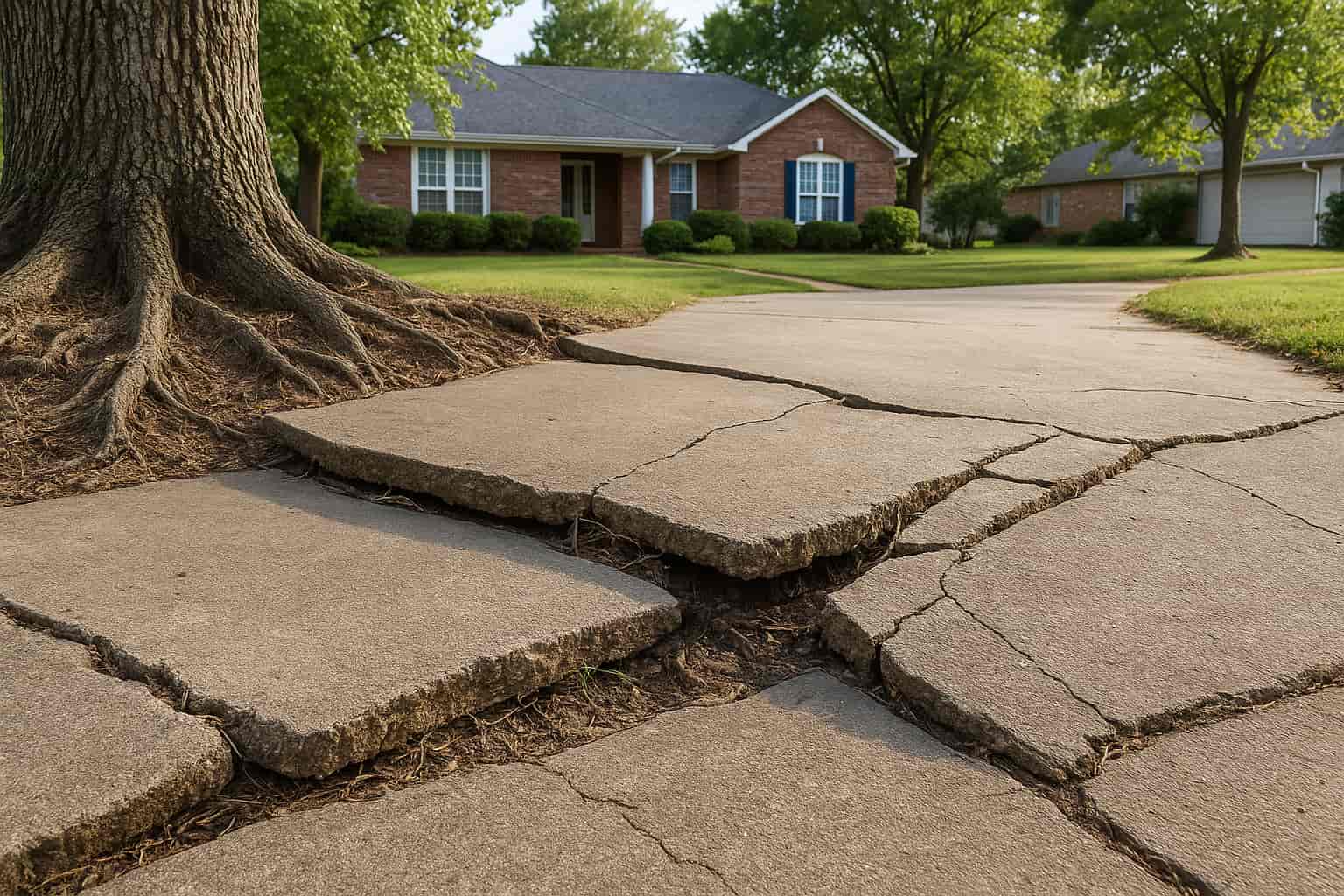
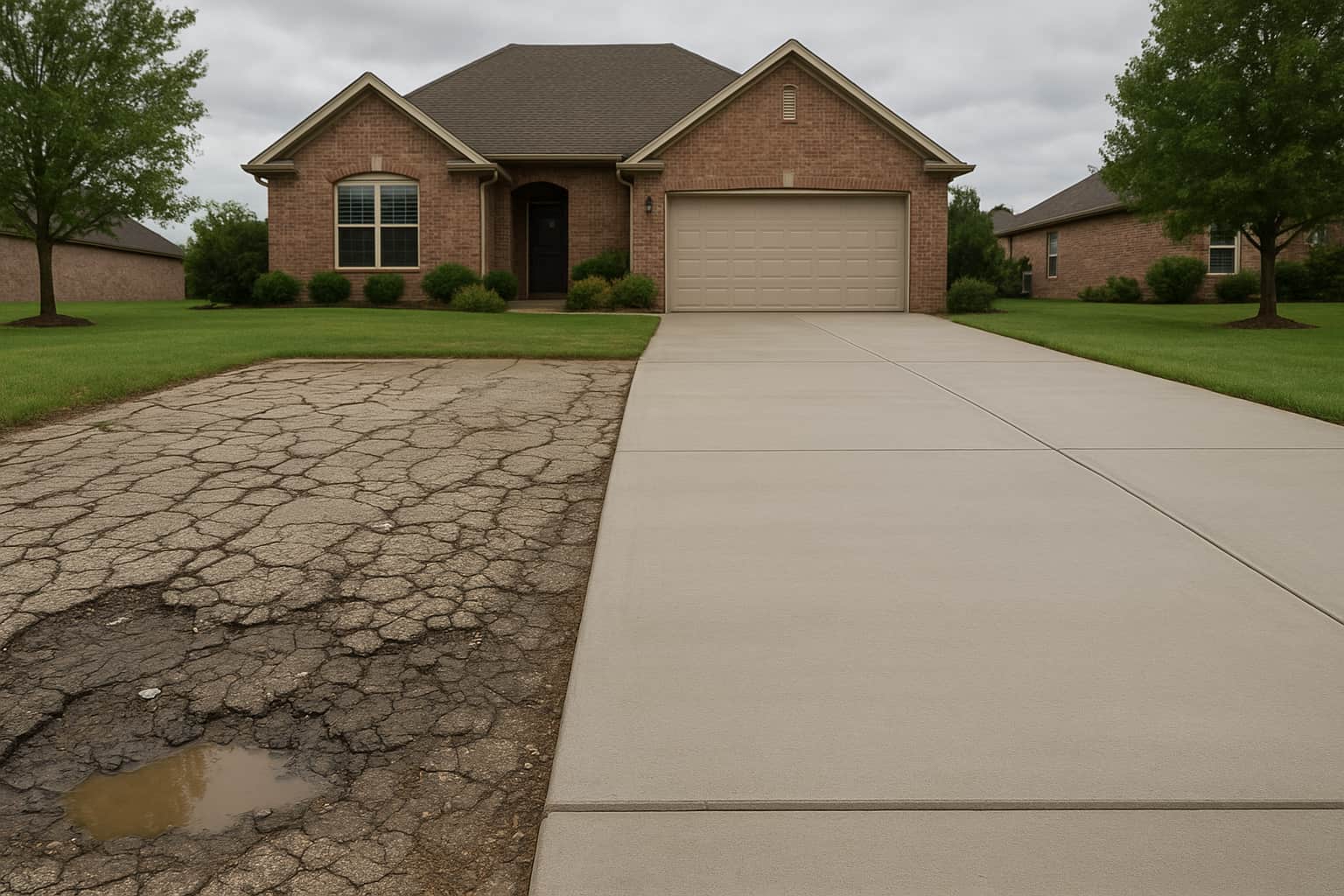
    Not all cracks are created equal. Those thin hairline cracks you see forming in your first few years? Those are often normal settling cracks that can be sealed affordably. But when you start seeing something different—deep cracks that connect to form patterns resembling alligator skin or spiderwebs—you’re looking at a structural problem that runs much deeper than the surface.

    These interconnected crack patterns indicate that your driveway’s foundation has failed. The concrete has lost its structural integrity, meaning the base layer that’s supposed to support everything above it has either eroded, shifted, or broken down. Surface patching these types of cracks is like putting a band-aid on a broken bone—it might look better temporarily, but the underlying problem remains and will resurface.

    Why This Type of Cracking Happens

    In Fayetteville, the most common culprit is our freeze-thaw cycle. Water seeps into small cracks during warmer days, then freezes overnight when temperatures drop. As it freezes, that water expands and pushes the concrete apart from the inside. When spring arrives and temperatures fluctuate daily, this process repeats over and over, gradually breaking down the internal structure[4].

    Poor initial installation also plays a role. If the original contractor didn’t use proper control joints, the right concrete mix, or adequate base preparation, your driveway was fighting an uphill battle from day one. Add Fayetteville’s climate to an already weak foundation, and failure happens much faster than it should.

    When to Replace vs. Repair

    If your cracking affects less than 25% of your driveway surface and the cracks are isolated to specific sections, repairs might still be viable. However, when the cracking pattern covers more than half your driveway or shows that “alligator skin” interconnected pattern, replacement becomes the more economical long-term solution. You’ll spend less money replacing it once than repeatedly repairing sections that will continue to fail.

    For homeowners concerned about identifying whether concrete damage is repairable or requires replacement, understanding the early signs of concrete failure can help you make informed decisions before problems escalate.

    Sign #2: Multiple Potholes That Keep Growing

    Potholes don’t appear overnight—they’re the final stage of a process that’s been happening beneath your driveway’s surface for months or even years. When you see one pothole, you’re seeing visible evidence of water damage that has already compromised the base layer. When you see multiple potholes, or when patched potholes keep coming back, your driveway is telling you that the damage runs throughout the entire structure.

    Here’s what’s happening: Water infiltrates through cracks in the surface. It reaches the base layer—typically compacted gravel or crushed stone that supports the concrete. In Fayetteville’s winter months, that water freezes and expands, pushing materials apart and creating voids. When the ice melts, these voids remain, leaving areas without proper support. Eventually, the concrete above collapses into these voids, creating potholes.

    The Safety and Damage Risk

    Beyond being eyesores, potholes create real risks. They can damage vehicle undercarriages, tires, and suspension systems. For pedestrians, they’re trip hazards, especially at night when they’re harder to see. In wet conditions, potholes fill with water, hiding their true depth and making them even more dangerous.

    Patching individual potholes costs between $3 to $5 per square foot, but when you have multiple potholes or potholes that keep recurring, these repair costs add up quickly[3]. More importantly, patching doesn’t address the base-layer damage that caused the potholes in the first place. You’re treating symptoms, not the disease.

    The Economics of Repeated Repairs

    Consider this scenario: You patch three potholes this year for $600. Next year, two more appear, costing another $400. The year after, the original patches start breaking down. By year three, you’ve spent $1,800 on temporary fixes for a driveway that’s fundamentally failing. That’s approaching half the cost of a full replacement that would have given you 25-30 years of worry-free use.

    Sign #3: Standing Water and Persistent Drainage Problems

    A properly installed driveway should never have standing water more than a few hours after rainfall. If you regularly see puddles that stick around for days, or if you notice water pooling in the same spots after every rain, your driveway has a drainage problem—and drainage problems are among the most destructive issues a driveway can face.

    Concrete driveways need proper slope (typically 1-2% grade) to channel water away from the surface and away from your home’s foundation. When water pools instead of draining, it’s a sign that either the original grading was incorrect, or your driveway has settled unevenly over time, creating low spots where water collects.

    Why Standing Water Is So Destructive

    Standing water isn’t just sitting there harmlessly—it’s actively working to destroy your driveway. Here’s how:

    First, it keeps the concrete continuously saturated. Concrete is naturally porous, like a hard sponge. When it stays wet, water penetrates deep into the material. In Fayetteville’s winter months, this trapped water freezes and expands, causing internal damage through freeze-thaw cycles[5].

    Second, standing water erodes the base layer beneath your concrete. Water finds its way down through tiny cracks and works its way under the slab, washing away the compacted base materials. This creates voids beneath your driveway, leading to settling, cracking, and eventual collapse.

    Third, in freezing weather, standing water creates serious safety hazards. Those puddles turn into ice patches that are difficult to see and extremely slippery—dangerous for both vehicles and pedestrians.

    Beyond the Driveway: Foundation Concerns

    Perhaps most concerning, poor driveway drainage often means water is flowing toward your home’s foundation instead of away from it. This can lead to basement flooding, foundation cracks, and structural issues that cost far more to repair than any driveway replacement[6].

    When drainage problems are the result of improper grading or significant settling, surface repairs won’t solve the issue. The only effective solution is replacement with proper grading that channels water away from both the driveway surface and your home.

    Quick Reference: Repair or Replace?

    Sign/Damage TypeWhat It IndicatesRecommended ActionWhy
    Hairline surface cracks (few)Normal aging/settlementRepair (seal/fill)Cosmetic issue; base intact
    Deep, widespread “alligator” cracksStructural foundation failureReplaceBase compromised; repairs temporary
    Single isolated potholeLocalized water damageRepair if caught earlyDamage contained to one area
    Multiple or recurring potholesWidespread base deteriorationReplaceBase layer failing throughout
    Occasional puddle (drains in hours)Minor settlingMonitor; may repairNot yet critical
    Persistent standing waterPoor grading/major settlingReplace with proper slopeAccelerates all other damage
    Minor surface unevennessSmall settlement areasLeveling/mudjackingStructure still sound
    Severe sinking or heaving sectionsBase failure/soil instabilityReplaceCan’t stabilize compromised base
    Crumbling edges onlySurface deteriorationEdge repair/patchingCore structure unaffected
    Overall surface spalling/scalingAdvanced concrete breakdownReplaceIndicates widespread failure
    Driveway age: Under 15 yearsPremature wearAssess cause; likely repairShould have more life left
    Driveway age: 25-30+ yearsEnd of typical lifespanReplace rather than repairMore failures imminent

    Sign #4: Uneven Surfaces with Sinking or Heaving Sections

    When sections of your driveway start sitting at different heights—some sunken down, others heaved up—you’re seeing clear evidence that the ground beneath your driveway has become unstable. This unevenness creates more than just a bumpy ride; it represents fundamental problems with the sub-base that supports your entire driveway.

    Sinking happens when the base materials beneath the concrete wash away or compress unevenly, creating voids that allow sections of the slab to drop. Heaving occurs when soil expands—often due to moisture or frost—pushing sections of concrete upward. In Fayetteville, frost heaving is a particularly common problem during winter months when water in the soil freezes and expands, literally lifting portions of your driveway.

    Why Leveling Isn’t Always the Answer

    You might think concrete leveling (mudjacking or polyurethane foam injection) would solve this problem, and sometimes it does—if the issue is caught early and the base is otherwise stable. Concrete leveling costs 50-80% less than full replacement, typically running $800 to $2,000 compared to $6,400 for a new driveway[7].

    However, leveling only works when you have isolated sinking in an otherwise sound driveway. If your uneven surfaces result from widespread base failure, poor drainage, or expansive soil issues, leveling becomes a temporary fix. The same forces that caused the original problem will continue acting on your driveway, and you’ll face the same issues again within a few years.

    The Safety Factor

    Uneven surfaces create serious trip hazards, especially at the transition between sections or where the driveway meets your garage floor or walkway. Height differences of even an inch can cause falls, and larger differences can damage vehicles or make snow removal difficult.

    If you’re unsure whether the problems you’re seeing are surface-level or structural, learning how to identify structural concrete damage can help you determine the right course of action before investing in repairs that won’t last.

    Sign #5: You’re Making Constant, Recurring Repairs

    Perhaps the clearest sign that you need a new driveway isn’t a single dramatic problem—it’s the pattern of constantly addressing the same issues over and over. If you find yourself calling concrete contractors every year or two to patch cracks, fill new potholes, or address the latest problem area, your driveway is sending you a message: the entire structure has reached the end of its useful life.

    This pattern happens because once a concrete driveway begins to fail, the problems accelerate. That first crack lets water in. The water causes freeze-thaw damage that creates more cracks. Those cracks allow more water penetration. The cycle continues, with each repair becoming less effective and lasting a shorter time.

    The True Cost of Repeated Repairs

    Let’s look at the economics realistically. The average concrete driveway repair costs around $1,800, though minor repairs might run $300-$600[3]. If you’re spending $500-$800 per year on various repairs and patches, you’re approaching the annual cost of financing a full replacement—except those repairs are giving you diminishing returns.

    More importantly, you’re spending money on a structure that’s failing beneath the surface. Every dollar you put into patching is a dollar that won’t be there when you inevitably need to replace the entire driveway. And unlike a new driveway that should last 25-30 years, these repairs might only buy you another 6-12 months before the next problem appears.

    The Peace of Mind Factor

    Beyond the financial calculation, there’s a quality-of-life consideration. Constantly worrying about your driveway, scheduling repairs, and dealing with contractors takes time and creates stress. A new driveway means 20-30 years of not thinking about driveway problems—no more surprise repairs, no more emergency patches, and no more compromised curb appeal.

    Understanding Your Driveway’s Age and Remaining Life

    Age alone doesn’t determine whether you need replacement, but it provides important context for making your decision. A properly installed and maintained concrete driveway in Fayetteville should last 25 to 30 years on average, with some reaching 50 years under ideal conditions[1].

    If your driveway is under 15 years old and showing significant problems, something went wrong with either the installation or maintenance. In these cases, you might still get good value from targeted repairs. However, if your driveway is approaching or past the 25-year mark, replacement makes more financial sense than continuing to invest in an aging structure that will require complete replacement soon anyway.

    Fayetteville’s Climate: The Hidden Multiplier

    Our local climate deserves special mention because it significantly impacts driveway lifespan. Fayetteville experiences regular freeze-thaw cycles—our temperatures frequently drop below freezing at night and rise above freezing during the day, especially in winter and early spring. This creates the worst possible conditions for concrete.

    Each freeze-thaw cycle stresses the concrete. Research shows that water expands by 9% when it freezes, creating pressure of up to 50,000 PSI within concrete pores[2]. Over a typical Fayetteville winter, your driveway might experience 30-50 freeze-thaw cycles. Multiply that by 20-30 years, and you can see why our climate accelerates concrete deterioration compared to areas with more stable temperatures.

    Making the Decision: Repair or Replace?

    So how do you make the final call? Here’s a practical framework:

    Choose Repair When:

    • Your driveway is under 15 years old
    • Damage affects less than 25% of the surface
    • Problems are localized to specific sections
    • The base is still sound (no widespread sinking or heaving)
    • You haven’t had recurring problems in the same areas
    • The repair cost is under 30% of replacement cost

    Choose Replacement When:

    • Your driveway is 20+ years old with multiple problems
    • Damage affects more than half the surface
    • You see widespread alligator cracking
    • There are persistent drainage problems
    • Multiple sections are sinking or heaving
    • You’ve made multiple repairs that haven’t lasted
    • The total cost of needed repairs exceeds 50% of replacement cost

    The Investment Perspective: What Replacement Actually Costs

    Let’s address the elephant in the room: cost. A complete concrete driveway replacement in Fayetteville typically ranges from $8 to $15 per square foot, with the average 600-square-foot driveway costing about $6,400 to $9,000[8]. This includes removing the old concrete, preparing the base properly, and pouring new concrete with appropriate thickness and proper control joints.

    Yes, that’s a significant investment. But consider what you’re getting:

    • 25-30 years of dependable use with minimal maintenance needs
    • Properly graded drainage that protects your home’s foundation
    • A sound base that won’t require expensive leveling or repairs
    • Improved curb appeal that can increase home value by 5-10%[9]
    • Peace of mind knowing you won’t face surprise repair bills

    When you spread that $6,400-$9,000 investment over 25-30 years, it works out to roughly $250-$300 per year. If you’re already spending $500-$800 annually on repairs for a failing driveway, replacement actually costs less over time while eliminating hassle and providing a better result.

    What to Expect from a Professional Concrete Contractor

    If you’ve decided replacement is the right choice, working with an experienced concrete contractor in Fayetteville makes all the difference. A quality installation should include:

    Proper Site Preparation: Removal of old concrete, excavation to proper depth, and soil testing to ensure stable base conditions. In Fayetteville, this is especially important because our clay-heavy soils can be problematic if not properly addressed.

    Base Layer Engineering: Installation of a compacted aggregate base (typically 4-6 inches of crushed stone) that provides stable support and allows for drainage. This base is what prevents settling and maintains long-term stability.

    Appropriate Concrete Mix: Using concrete with the right strength rating (typically 3,500-4,000 PSI for residential driveways) and air entrainment to resist freeze-thaw damage. The concrete should be at least 4 inches thick for standard residential use.

    Control Joints: Properly placed control joints (typically every 8-10 feet) that allow the concrete to expand and contract with temperature changes without developing random cracks.

    Proper Grading: A minimum 1-2% slope away from your home and garage to ensure water drains off the surface rather than pooling or flowing toward your foundation.

    When you’re ready to explore your options, considering common driveway design options can help you choose a style that combines functionality with visual appeal for your home.

    Preventing Future Problems: Maintenance for the New Driveway

    Once you invest in a new driveway, proper maintenance helps you get the full 25-30 year lifespan (or longer). Here’s what that maintenance should include:

    Regular Sealing: Apply a quality concrete sealer every 2-3 years. This creates a protective barrier that prevents water penetration and protects against freeze-thaw damage. In Fayetteville’s climate, this single step can extend your driveway’s life by years.

    Prompt Crack Repair: Address any small cracks as soon as they appear. These are normal as concrete ages, but sealing them early prevents water infiltration that causes bigger problems.

    Winter Care: Avoid using de-icing salts that contain calcium chloride or magnesium chloride—these chemicals accelerate concrete deterioration. Plain rock salt (sodium chloride) is the only recommended de-icer[10]. Better yet, use sand for traction without chemical damage.

    Drainage Maintenance: Keep gutters clean and downspouts directed away from your driveway. Ensure landscape grading continues to direct water away rather than toward your concrete.

    Regular Cleaning: Remove oil stains promptly and wash your driveway periodically. This isn’t just about appearance—oil and chemicals can deteriorate concrete over time.

    Taking Action: Your Next Steps

    Your driveway tells a story through its cracks, dips, and drainage patterns. When that story includes multiple warning signs—deep widespread cracking, recurring potholes, persistent standing water, uneven surfaces, or constant repairs—it’s time to listen. These aren’t just cosmetic issues; they’re your driveway’s way of saying its structural integrity has been compromised.

    For Fayetteville homeowners, the decision between repairing and replacing often comes down to realistic expectations. A repair might buy you another year or two, but if your driveway is showing multiple signs of failure, that’s just delaying the inevitable while potentially spending money that could have gone toward a long-term solution.

    The key is being honest about what you’re seeing. If you find yourself nodding along to multiple signs in this article, replacement isn’t just the practical choice—it’s the economical one. You’ll spend less over time, protect your home’s foundation, improve safety, and gain peace of mind knowing your driveway will serve you reliably for decades to come.

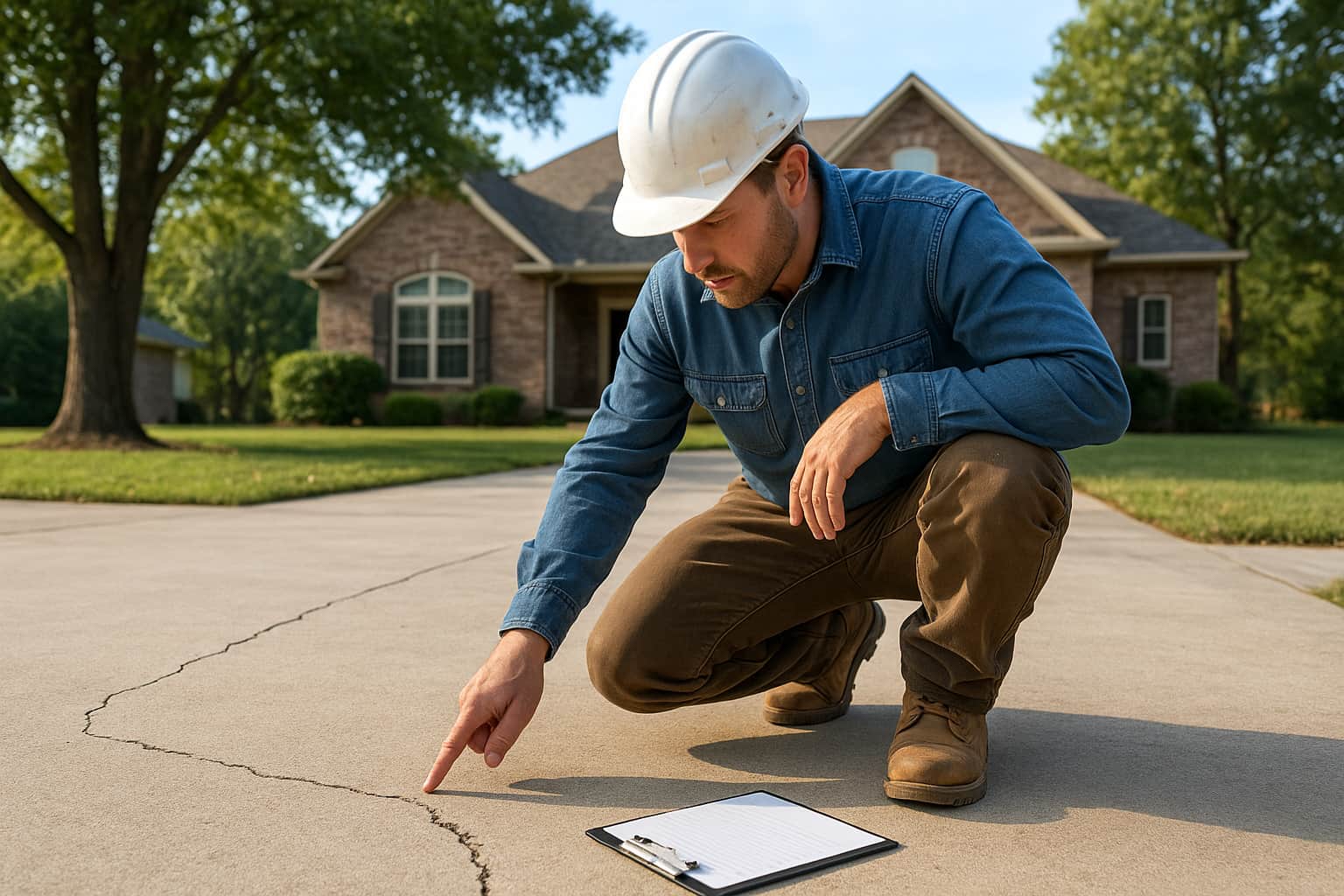
    Ready to discuss your specific situation? Reach out to AR Concrete Fayetteville for a professional assessment. We’ll walk your property, evaluate your driveway’s condition, explain exactly what we’re seeing, and help you make an informed decision that’s right for your home and budget. No pressure, no sales tactics—just honest expertise from concrete professionals who know Fayetteville’s climate and what it takes to build driveways that last.

    Signs You Need a New Driveway Fayetteville FAQs

    How do I know if my driveway needs to be replaced or just repaired?

    You need replacement rather than repairs when you notice signs like widespread alligator cracking affecting more than 25% of the surface, multiple potholes, severe sinking or heaving, persistent drainage problems, or when you’ve made several repairs that keep failing. If your driveway is 20+ years old and showing multiple problems, replacement typically makes more economic sense than continued repairs.

    What are the warning signs you need a new driveway in Fayetteville Arkansas?

    The five key warning signs you need a new driveway in Fayetteville include deep interconnected cracks that look like alligator skin, multiple or recurring potholes, standing water that persists after rain, uneven surfaces with sinking or heaving sections, and a pattern of constant repairs that don’t provide lasting results. Fayetteville’s freeze-thaw cycles make these problems worsen quickly once they appear.

    How long should a concrete driveway last in Fayetteville?

    A properly installed and maintained concrete driveway in Fayetteville should last 25 to 30 years on average, with some reaching 50 years under ideal conditions[1]. However, Fayetteville’s freeze-thaw cycles can shorten this lifespan if the driveway wasn’t installed with proper base preparation, adequate thickness, and appropriate concrete mix to resist freeze-thaw damage.

    Is it cheaper to repair or replace a concrete driveway?

    Minor repairs like crack filling cost $300-$600, while average repairs run around $1,800 and full replacement typically costs $6,400 for a standard driveway[3]. Repairs are cheaper initially, but replacement becomes more economical when damage is widespread or repairs keep failing—especially for driveways over 20 years old where additional failures are imminent.

    What causes driveways to fail faster in Arkansas?

    Arkansas driveways fail faster primarily due to freeze-thaw cycles where water in concrete pores freezes and expands by 9%, creating internal pressure that cracks the concrete[2]. Fayetteville experiences numerous freeze-thaw cycles each winter, and combined with poor initial installation, inadequate drainage, or lack of maintenance, these cycles can significantly shorten a driveway’s lifespan compared to areas with more stable temperatures.

    Signs You Need a New Driveway Fayetteville Citations

    1. A-1 Concrete Leveling. (2024). How Long Should a Concrete Driveway Last?
    2. Polytrade. (2025). What is the Freeze-Thaw Cycle in Concrete?
    3. Angi. (2025). 2025 Concrete Driveway Repair Cost
    4. A-1 Concrete Leveling. (2024). A Homeowner’s Guide to Freeze-Thaw Cycles + 5 Tips for Protecting Your Concrete
    5. 479 Concrete Fort Smith. (2025). Seasonal Challenges for Concrete? Here’s How to Defend Against Them
    6. Richfield Blacktop. (2023). Fixing Water Pooling on Your Driveway
    7. Total Foundation & Roofing. (2025). Estimating Your Concrete Repair: A Price Guide
    8. HomeGuide. (2025). How Much Does a Concrete Driveway Cost? (2025)
    9. HomeGuide. (2025). Concrete Driveway Property Value Impact
    10. Michigan Concrete Association. (2025). Concrete vs. Asphalt: How Long Does Each Last
  • Do I Need Rebar in a Residential Concrete Driveway? Your Complete Guide

    Do I Need Rebar in a Residential Concrete Driveway? Your Complete Guide

    Key Takeaways:

    • Rebar is not always required for residential driveways but is highly recommended for driveways 5 inches or thicker
    • Standard 4-inch driveways for passenger vehicles can use wire mesh or fiber mesh as cost-effective alternatives
    • Heavy vehicles, poor soil conditions, and Arkansas weather patterns increase the need for rebar reinforcement
    • Proper rebar placement in a grid pattern at 12-18 inches on center provides maximum structural support
    • The right reinforcement choice depends on your driveway thickness, vehicle loads, and soil conditions

    Most residential concrete driveways in Fayetteville, Arkansas do not strictly require rebar, but for driveways that are 5 inches or thicker, carry heavy vehicles, or sit on unstable soil, rebar significantly enhances durability and lifespan. For standard 4-inch driveways used by typical passenger vehicles, wire mesh or fiber mesh reinforcement often provides sufficient crack control and structural support.

    Understanding Rebar and Its Purpose in Concrete Driveways

    Rebar, short for reinforcing bar, is a steel rod or grid designed to strengthen concrete by providing tensile strength. While concrete excels under compression, it performs poorly under tension and stress. This is where rebar becomes critical for homeowners in Fayetteville who want their driveways to withstand both daily traffic and Arkansas’s fluctuating weather conditions.

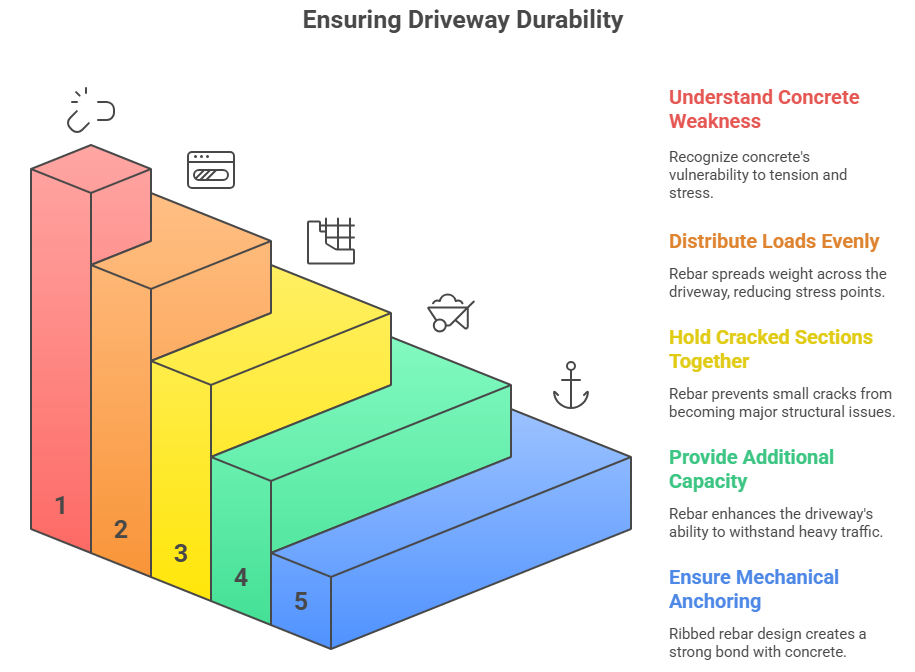
    infographic considering aspects that determine whether or not to use rebar, such as concrete loading levels, cracks and anchoring

    When you pour a concrete driveway, the material naturally wants to crack as it cures and experiences temperature changes. Rebar works by distributing loads more evenly across the entire slab and holding cracked sections together, preventing small cracks from widening into major structural problems. According to the Concrete Network, using steel reinforcement provides additional structural capacity for driveways exposed to heavy traffic, though it won’t prevent cracks entirely[1].

    For residential applications, the most common rebar size is #3 (3/8 inch diameter) or #4 (1/2 inch diameter). The ribbed surface design of rebar creates mechanical anchoring within the concrete, ensuring the two materials work together rather than slipping apart under stress[2].

    How Rebar Strengthens Your Driveway

    The science behind rebar reinforcement is straightforward but effective. Concrete has excellent compressive strength but minimal tensile strength. When vehicles drive over your driveway or when soil underneath shifts, tensile forces try to pull the concrete apart. Rebar absorbs these tensile forces, keeping your driveway intact even as it experiences daily stresses.

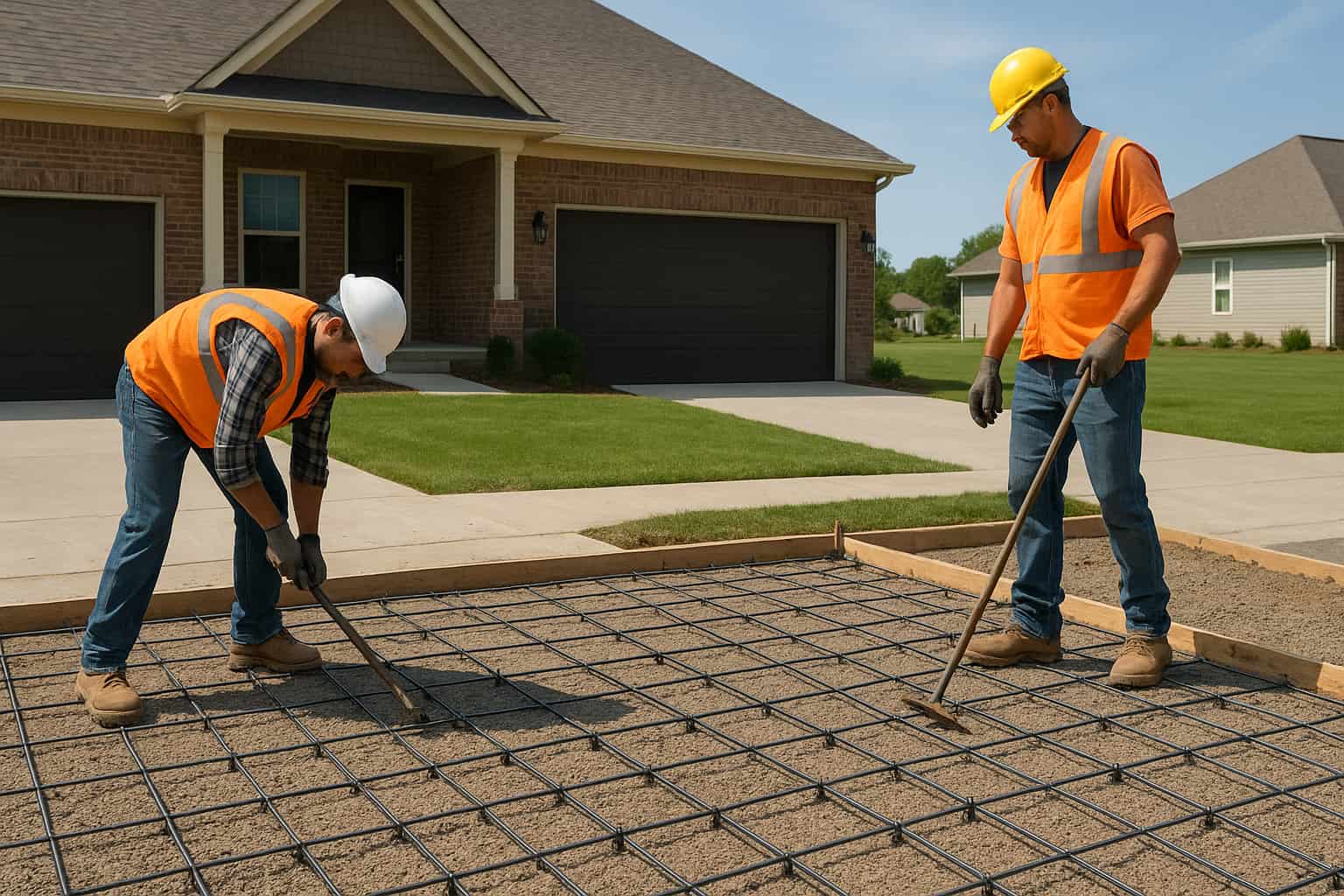
    When properly installed in a grid pattern, rebar creates an internal skeleton throughout your driveway. This interconnected framework distributes weight from concentrated points across a broader area, reducing the likelihood of stress cracks forming at weak points. Industry experts recommend placing rebar in the middle third of the concrete thickness for optimal performance[3].

    When You Need Rebar in Your Fayetteville Driveway

    Several factors determine whether your residential driveway requires rebar reinforcement. Understanding these conditions helps you make an informed decision that protects your investment.

    Driveway Thickness Requirements

    The thickness of your concrete driveway is the single most important factor in determining whether rebar is necessary. According to the Tennessee Concrete Association, increasing thickness from 4 inches to 5 inches boosts your driveway’s load-carrying capacity by nearly 50%[1]. For slabs 5 inches or thicker, rebar becomes essential for maintaining structural integrity.

    Here’s what industry standards recommend: driveways that are 4 to 5 inches thick typically perform well with wire mesh reinforcement, while driveways 5 inches or thicker should incorporate #4 rebar placed in a grid pattern at approximately 12 to 18 inches on center[4]. The International Residential Building Code sets a minimum thickness of 3.5 to 4 inches for residential driveways, but thicker slabs offer better long-term performance[5].

    Vehicle Weight and Traffic Considerations

    The types of vehicles that will use your driveway play a crucial role in reinforcement decisions. A standard 4-inch thick concrete driveway can handle vehicles weighing up to 8,000 pounds, which covers most passenger cars, SUVs, and small trucks[5]. However, if you plan to park RVs, boats, heavy-duty trucks, or trailers on your driveway, you need both increased thickness and rebar reinforcement.

    For homeowners who regularly park vehicles over 8,000 pounds, experts recommend increasing the slab thickness to 6 inches and incorporating #4 rebar throughout. This combination can support loads up to 70,000 pounds without premature cracking or structural failure[5].

    Arkansas Soil Conditions and Your Driveway Foundation

    Fayetteville’s soil conditions significantly impact whether your driveway needs rebar reinforcement. Arkansas is home to various soil types, including expansive clays that can shift and cause concrete to settle unevenly[6]. When soil beneath your driveway expands during wet periods and contracts during dry spells, it creates uneven support that stresses the concrete.

    Unstable or expansive soils, particularly clay-based soils common in Northwest Arkansas, make rebar reinforcement essential regardless of driveway thickness. The reinforcing bars help hold your slab together through soil movement, preventing the formation of major cracks that would otherwise develop in unreinforced concrete[7].

    ConditionRebar RecommendationBest For
    4-inch slab, passenger vehicles onlyWire mesh or fiber mesh sufficientStandard residential use
    5-6 inch slab, occasional heavy vehicles#4 rebar at 18″ centers recommendedHomeowners with RVs or work trucks
    Unstable soil (clay, loose sand)#4 rebar at 12-18″ centers requiredProperties with soil movement issues
    Large driveways over 20 feet in any direction#4 rebar at 12″ centers recommendedExtended or commercial-grade driveways
    Sloped driveways#4 rebar required regardless of thicknessHillside properties with drainage concerns

    Climate and Weather Impact on Driveway Durability

    Fayetteville experiences distinct seasonal changes that affect concrete performance. While Arkansas doesn’t face the extreme freeze-thaw cycles of northern states, the region still sees temperature fluctuations that cause concrete expansion and contraction throughout the year.

    During winter months, when temperatures drop and moisture in the concrete freezes, the expansion can create internal pressure. When temperatures rise, the concrete contracts. This repeated cycle, even in moderate climates like Northwest Arkansas, benefits from rebar reinforcement that helps the concrete withstand expansion and contraction without developing major cracks[8].

    Alternatives to Rebar for Residential Driveways

    While rebar provides the strongest reinforcement, several alternatives offer varying degrees of support for residential driveways. Understanding these options helps you balance cost, performance, and your specific needs.

    Wire Mesh Reinforcement

    Wire mesh, also called welded wire fabric, consists of a grid of steel wires welded at their intersections. This cost-effective option works well for residential driveways that won’t experience heavy traffic or challenging soil conditions. Wire mesh is typically embedded within the concrete slab and helps control crack spreading[9].

    For driveways 4 to 5 inches thick, wire mesh provides moderate strength at a lower price point than rebar. The Portland Cement Association confirms that wire mesh is a cost-effective solution for smaller driveways, providing sufficient tensile support without the expense of rebar installation[10]. However, wire mesh doesn’t offer the same structural support as rebar for heavier loads or unstable soil conditions.

    Fiber Mesh Concrete

    Fiber reinforcement involves mixing tiny synthetic or steel fibers directly into the concrete before pouring. These fibers, typically made from polypropylene or other synthetic materials, help prevent fine hairline cracks caused by shrinkage during the curing process[11].

    The major advantage of fiber mesh is ease of installation. Because the fibers are mixed at the plant or on-site, there’s no need for on-site placement and securing like with rebar or wire mesh. This saves labor costs and installation time. However, fiber mesh primarily addresses plastic shrinkage cracking and doesn’t provide structural capacity against heavy loads[12].

    Combining Reinforcement Methods

    For maximum driveway strength and crack resistance, some contractors recommend combining reinforcement methods. A common approach uses #4 rebar for structural strength along with fiber mesh to control surface cracking. According to concrete experts in Colorado Springs, when fiber mesh is combined with either rebar or welded wire mesh, it acts as an additional protective layer delivering unmatched reinforcement[13].

    This combination approach works particularly well for homeowners who want the ultimate protection for their investment, though it does increase material and installation costs.

    Reinforcement TypeRebarWire MeshFiber Mesh
    Primary PurposeAdds significant structural strength to bear heavy loads and major stressHolds concrete together to prevent cracks from wideningReduces plastic shrinkage cracking during curing
    Best ForDriveways with heavy vehicles, slabs over 5 inches thick, unstable soilStandard residential driveways with typical passenger carsEnhanced crack resistance, often used with other reinforcement
    InstallationTime-consuming grid construction, requires special supportsEasier to install, laid out in sheets or rollsMixed directly into concrete, no on-site installation
    Cost Range$$$$ – Most expensive due to material and labor$$ – Mid-range, cost-effective option$ – Most affordable, adds minimal cost
    Typical Lifespan25-30+ years with proper installation20-25 years under normal conditionsEnhances lifespan of other reinforcement methods

    Proper Rebar Installation for Maximum Effectiveness

    Installing rebar correctly is just as important as deciding to use it. Improper installation can reduce effectiveness and lead to premature driveway failure.

    Rebar Sizing and Spacing Guidelines

    For residential driveways in Fayetteville, #3 (3/8 inch diameter) or #4 (1/2 inch diameter) rebar is standard. The most common configuration uses #4 rebar placed in a grid pattern at 12 to 18 inches on center in both directions[2]. Some experts recommend tighter spacing of 12 inches for maximum strength, while 18-inch spacing provides adequate reinforcement at lower material costs[14].

    The rebar must be positioned in the middle third of the concrete thickness for optimal performance. This typically means placing it approximately 2 to 2.5 inches from the bottom of a 4 to 5-inch slab. Contractors use plastic chairs or concrete dobies to hold the rebar at the correct height during the pour[3].

    Critical Installation Details

    Proper rebar installation requires attention to several critical details. First, all intersecting rebar pieces should be tied together using rebar tie wire to create a unified grid structure. This prevents the bars from shifting during the concrete pour and ensures they remain at the correct depth[15].

    Second, maintain adequate concrete cover around all rebar. According to ACI (American Concrete Institute) standards, concrete exposed to weather or earth should have at least 1.5 to 2 inches of cover over the reinforcement to protect against corrosion[16]. This is particularly important in Arkansas where humidity and temperature variations can accelerate steel corrosion if the rebar is too close to the surface.

    Third, avoid driving concrete trucks or heavy equipment over installed rebar before the pour. This can bend or displace the grid, reducing its effectiveness. Professional contractors plan the pour carefully to ensure concrete can be placed without disturbing the rebar placement[17].

    Cost Considerations for Rebar vs. Alternative Reinforcement

    Budget plays a significant role in reinforcement decisions for most homeowners. Understanding the cost implications helps you make informed choices that balance protection with affordability.

    In Fayetteville, Arkansas, concrete driveway costs range from $6 to $10 per square foot for un-reinforced concrete. Adding rebar typically increases costs by $1 to $2 per square foot due to both material and labor expenses[18]. For a standard 12-foot by 40-foot driveway (480 square feet), this translates to an additional $480 to $960 for rebar reinforcement.

    Wire mesh is generally less expensive than rebar, adding approximately $0.50 to $1.00 per square foot. Fiber mesh is the most affordable option, typically adding only $0.25 to $0.50 per square foot to your project cost[11]. However, these cost savings must be weighed against the reduced structural support compared to rebar.

    When evaluating costs, consider the long-term perspective. While rebar increases initial investment, it can prevent expensive repairs or premature replacement. Industry data shows that properly reinforced driveways in Arkansas can last 25 to 30 years or more, while unreinforced or inadequately reinforced driveways may require major repairs within 10 to 15 years[19].

    Expert Insights on Driveway Reinforcement

    Professional perspectives provide valuable guidance when making reinforcement decisions. According to the American Concrete Institute, “reinforced concrete has increased durability under load, reducing maintenance needs over time”[20]. This authoritative statement underscores the value of proper reinforcement for long-term performance.

    Gabe Martel, a recognized concrete expert who has written extensively for the Journal of Light Construction, emphasizes that proper subgrade preparation is equally important as reinforcement choice. He notes that the best reinforcement in the world won’t prevent failure if the subgrade isn’t properly compacted and stable[21].

    Foundation engineers often point out that for typical residential driveways with good subgrade preparation and proper control joints, extensive rebar may not be necessary. However, they universally recommend rebar for situations involving heavy vehicles, poor soil conditions, or slabs exceeding standard thickness[22].

    Making the Right Decision for Your Fayetteville Driveway

    Deciding whether to use rebar in your residential concrete driveway depends on evaluating multiple factors specific to your property and needs. Start by assessing your driveway’s planned thickness. If you’re installing a standard 4-inch slab for typical passenger vehicle use on stable soil, wire mesh or fiber mesh will likely provide adequate reinforcement at a lower cost.

    However, if any of the following apply to your situation, rebar becomes highly recommended or necessary:

    • Your driveway will be 5 inches or thicker
    • You regularly park vehicles weighing more than 8,000 pounds
    • Your driveway exceeds 20 feet in any direction
    • Your property has clay soil or other unstable ground conditions
    • Your driveway is on a slope or experiences significant drainage challenges

    When working with professional concrete contractors in Fayetteville, they can assess your specific site conditions, soil type, and usage requirements to provide expert recommendations. A reputable contractor will evaluate your property’s unique characteristics rather than applying a one-size-fits-all approach.

    For homeowners planning to install a new driveway, investing in proper reinforcement from the start is more cost-effective than dealing with premature cracking and repairs later. The relatively modest additional cost of rebar for situations that warrant it pays dividends through decades of reliable performance.

    Conclusion

    While rebar isn’t always strictly necessary for residential concrete driveways in Fayetteville, Arkansas, it provides significant benefits for driveways that face demanding conditions. For maximum protection and longevity, especially with thicker slabs, heavy vehicles, or challenging soil conditions, #4 rebar installed in a proper grid pattern represents a wise investment in your property’s value and functionality. For standard residential driveways with typical use patterns, alternatives like wire mesh or fiber mesh can provide adequate reinforcement at lower costs. The key is honestly assessing your specific situation and working with experienced local contractors who understand Northwest Arkansas conditions to make an informed decision that protects your investment for decades to come.

    Rebar in Residential Concrete Driveway FAQs

    How much does adding rebar cost to a concrete driveway in Fayetteville?

    Adding rebar to a concrete driveway in Fayetteville typically increases costs by $1 to $2 per square foot above the base concrete cost of $6 to $10 per square foot. For a standard 480 square foot driveway, expect to pay an additional $480 to $960 for rebar installation including materials and labor.

    Can I use rebar in a 4-inch concrete driveway?

    You can use rebar in a 4-inch concrete driveway, though it’s not typically necessary for standard residential use. For 4-inch slabs, wire mesh or fiber mesh usually provides sufficient reinforcement. Rebar becomes more beneficial and is recommended for slabs 5 inches or thicker.

    Do I need rebar in a residential concrete driveway if I only park cars?

    If you only park standard passenger cars on a 4-inch concrete driveway with stable soil conditions, rebar is not strictly necessary. Wire mesh or fiber mesh reinforcement will typically provide adequate crack control for normal residential use without the added expense of rebar.

    What size rebar should I use for a residential concrete driveway?

    For residential concrete driveways, #3 (3/8 inch diameter) or #4 (1/2 inch diameter) rebar is standard. Most contractors prefer #4 rebar because it provides better structural support. The rebar should be placed in a grid pattern with spacing of 12 to 18 inches on center in both directions.

    How long does a concrete driveway with rebar last in Arkansas?

    A properly installed concrete driveway with rebar reinforcement in Arkansas typically lasts 25 to 30 years or more with regular maintenance. Factors affecting lifespan include proper installation, adequate drainage, regular sealing every 2-3 years, and the quality of the original concrete mix used.

    Rebar in Residential Concrete Driveway Citations

    1. Concrete Network – 8 Essentials for a Problem-Free Concrete Driveway
    2. Bill’s Custom Concrete – What Rebar Size Works Best in Residential Concrete Construction
    3. Renovation Headquarters – Concrete Reinforcing Bar (Rebar) Installation & Sizes
    4. Procore – Rebar Calculator
    5. Today’s Homeowner – How Thick Should Concrete Be for a Driveway
    6. Airlift Concrete Experts – How Arkansas Soil Types Affect Your Home’s Foundation
    7. HomeBlue – Concrete Driveway Cost in Fayetteville, Arkansas
    8. Bison Concrete – Perfect Concrete Rebar Spacing
    9. CA Wire – The Ultimate Guide to Wire Mesh in Concrete Driveways
    10. Concrete Captain – Should Concrete Driveways Have Rebar
    11. Cornerstone Concrete – Rebar or Fiber Mesh Concrete: Which is Better
    12. Plasticine House – Rebar in Concrete: Does Concrete Slab Need Rebar
    13. Springs Concrete – Ultimate Guide to Residential Concrete Driveway Installation
    14. Fine Homebuilding – Proper Spacing for Rebar
    15. Civil Engineer Online – ACI Guidelines for Reinforced Concrete
    16. iRebar – US Concrete Cover Specifications
    17. Garage Journal – Mesh or Rebar in Driveway Forum Discussion
    18. AR Concrete Fayetteville – Perfect Driveway Thickness for Arkansas Homes
    19. Angi – Top Concrete Driveway Pros in Little Rock, AR
    20. CM Concrete Driveways – Ultimate Guide to Reinforcement Types
    21. Fine Homebuilding – Concrete Driveway Specifications
    22. Morgan Pavement – 7 Common Questions About Concrete Driveways
  • What’s the Process for Replacing an Old Driveway? Your Complete Guide for Fayetteville Homeowners

    What’s the Process for Replacing an Old Driveway? Your Complete Guide for Fayetteville Homeowners

    Key Takeaways:

    • Replacing an old driveway typically takes 3-7 days from demolition to curing, with proper planning ensuring long-lasting results
    • Professional concrete contractors in Fayetteville can assess whether repair or full replacement is the best solution for your specific situation
    • Proper site preparation, including base installation and drainage planning, is critical for preventing future damage in Arkansas’s climate
    • Concrete driveways in Fayetteville cost between $6-$10 per square foot, with demolition adding $1.20-$1.90 per square foot to the total project cost
    • Arkansas homeowners should plan driveway replacement during moderate weather conditions to ensure optimal concrete curing and durability

    The process for replacing an old driveway involves a careful assessment of your current surface, complete removal of damaged materials, proper site preparation with grading and drainage, installation of a compacted base layer, and pouring of new concrete with professional finishing techniques. For Fayetteville homeowners, working with experienced contractors who understand Arkansas’s humid subtropical climate and soil conditions is essential for a driveway that will last 25-30 years or more.

    Understanding When Your Driveway Needs Replacement

    For homeowners in Fayetteville Arkansas dealing with a deteriorating driveway, knowing whether to repair or replace can save thousands of dollars and years of frustration. Not every crack or surface imperfection requires a full replacement, but certain warning signs indicate that patching simply won’t cut it anymore.

    Your driveway needs replacement rather than repair when you notice widespread cracking covering more than 25% of the surface, significant settling or heaving that creates uneven sections, or a failing sub-base causing repeated problems in the same areas. Arkansas’s freeze-thaw cycles and clay-heavy soils can accelerate these issues, making proper evaluation by a qualified concrete contractor essential for homeowners in the Fayetteville area.[1]

    Signs That Indicate Full Replacement is Necessary

    Professional concrete contractors look for specific indicators when determining if your driveway has reached the end of its serviceable life. Alligator cracking, where interconnected cracks create a pattern resembling reptile skin, signals that the base structure has failed beneath the surface. When your driveway shows sunken areas that collect standing water, this drainage problem often stems from foundation issues that surface repairs cannot fix.[2]

    Age plays a significant role in this decision as well. Most concrete driveways in Fayetteville last between 25 to 30 years with proper maintenance, but Arkansas’s climate conditions can shorten this lifespan considerably.[3] If your driveway is approaching or has exceeded 20 years old and shows multiple problem areas, replacement typically provides better long-term value than continued repair attempts.

    Cost Considerations for Repair vs. Replacement

    When evaluating whether to replace your old driveway in Fayetteville, understanding the financial implications helps homeowners make informed decisions. Concrete driveway installation in Fayetteville costs between $6 to $10 per square foot for standard concrete, while demolition of your existing driveway adds approximately $1.20 to $1.90 per square foot to the project.[4]

    For a typical two-car driveway measuring 24 feet by 40 feet (960 square feet), complete replacement including demolition ranges from approximately $6,900 to $11,500. While this represents a significant investment, multiple repairs over several years on a failing driveway often total more than replacement costs while never fully addressing underlying structural problems.

    The Complete Driveway Replacement Process Step-by-Step

    Understanding what happens during a driveway replacement helps Fayetteville homeowners prepare for the project timeline and make informed decisions at each stage. Professional concrete contractors follow a systematic approach that ensures your new driveway will withstand daily use and Arkansas weather conditions for decades.

    Project PhaseTimelineKey ActivitiesBest For
    Initial Assessment1-2 hoursSite inspection, measurements, drainage evaluation, permit applicationHomeowners wanting accurate project scope and cost estimates
    Demolition & Removal1 dayBreaking up old concrete, hauling debris, clearing siteAll replacement projects – creates clean slate for new installation
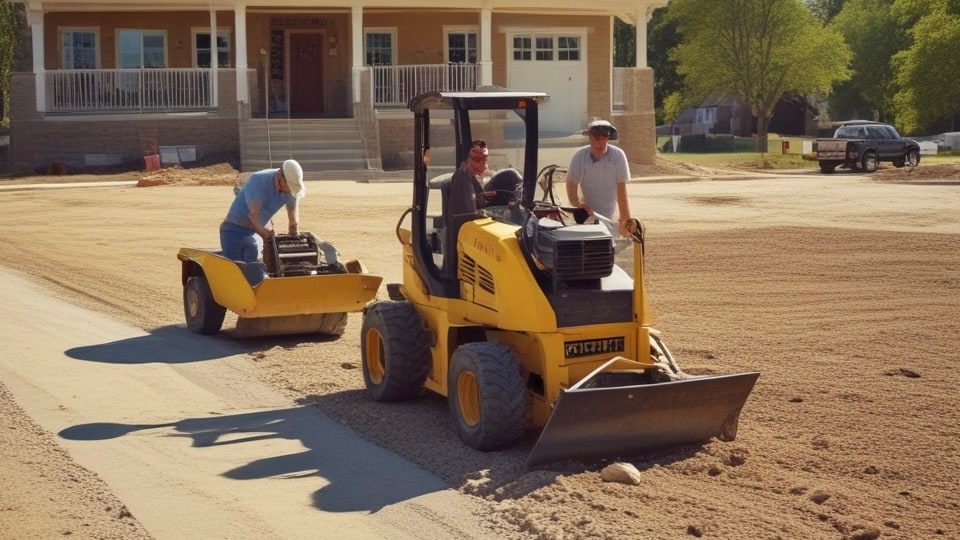
    Site Preparation1-2 daysExcavation, grading, drainage installation, base compactionCritical for Arkansas soil conditions and preventing future settling
    Concrete Installation1 dayForm installation, reinforcement placement, pouring, finishingHomeowners prioritizing smooth finish and proper water runoff
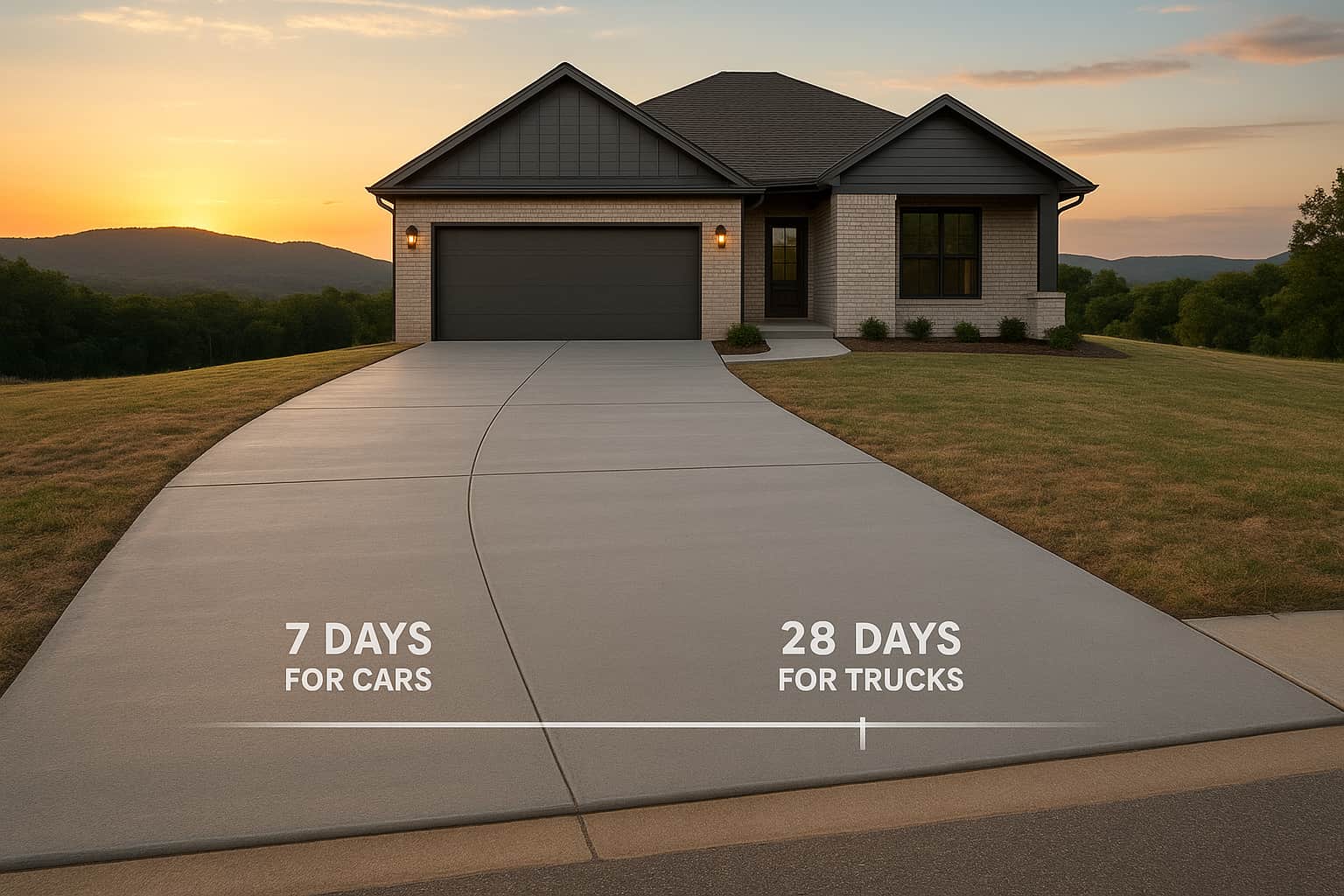
    Curing Period7 days minimumConcrete hardening, cutting control joints, sealing preparationEssential waiting period – proper curing prevents premature cracking

    Initial Assessment and Planning

    The driveway replacement process begins with a comprehensive evaluation by your concrete contractor. During this initial site visit, professionals assess your existing driveway’s condition, measure the area for accurate material estimates, and evaluate potential challenges specific to your property. For Fayetteville homes, contractors pay particular attention to soil composition, existing drainage patterns, and any grade changes that might affect water runoff.[5]

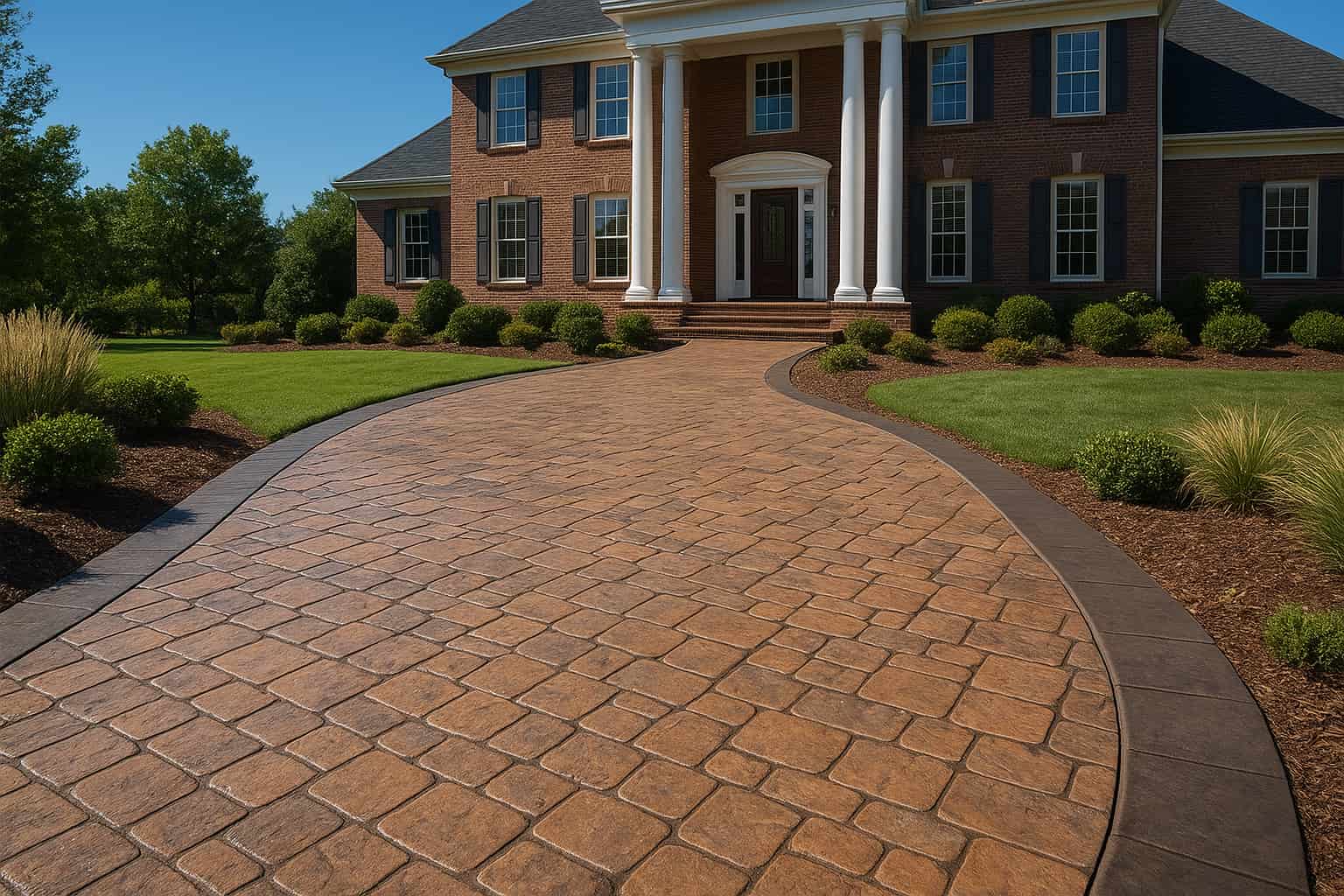
    Experienced contractors also discuss material options and design preferences during this planning phase. While standard concrete remains the most popular choice for its durability and cost-effectiveness, homeowners can explore decorative options like stamped concrete patterns that mimic natural stone or brick. Your contractor will also secure necessary permits from local Fayetteville authorities, which typically cost between $25 to $200 depending on project scope.[6]

    Demolition and Old Driveway Removal

    Once planning is complete and permits are secured, the physical work begins with demolition of your existing driveway. Professional crews arrive with specialized equipment including jackhammers for breaking up concrete thicker than 4 inches, skid steers or bobcats for loading debris, and dump trucks for hauling material away.[7]

    The demolition process for a typical residential driveway takes approximately one day for an experienced crew. Contractors break the concrete into manageable chunks, being careful to avoid damaging adjacent structures, landscaping, or underground utilities. In Fayetteville, many concrete contractors participate in recycling programs, crushing old concrete for use as aggregate base material rather than sending everything to landfills.[8]

    According to concrete industry experts, “Proper demolition sets the foundation for a successful replacement. Taking shortcuts during removal, like leaving sections of old concrete or not excavating deep enough, inevitably leads to problems with the new driveway.”[9] This professional insight underscores why working with experienced contractors matters for long-term results.

    Site Preparation and Grading

    After removing all old concrete and debris, contractors focus on preparing the foundation for your new driveway. This critical phase determines how well your driveway performs over its lifetime. The excavation depth typically ranges from 6 to 12 inches, depending on your soil conditions and the thickness of concrete planned for installation.[10]

    Proper grading creates the correct slope for water drainage, typically around 2% grade away from structures. In Arkansas’s humid subtropical climate where Fayetteville receives approximately 45 inches of rainfall annually, effective drainage prevents water from pooling on your driveway and seeping beneath the concrete where freeze-thaw damage can occur.[11] Contractors may install French drains, channel drains, or other drainage solutions if your property presents particular water management challenges.

    The subgrade (underlying soil) must be thoroughly compacted to create a stable, firm foundation. Many contractors in Fayetteville recommend soil testing for properties with expansive clay soils, which can shift and cause concrete to crack. In these situations, additional base depth or soil stabilization treatments may be necessary before proceeding.[12]

    Base Installation and Material Selection

    The base layer serves as the crucial interface between your soil and concrete, distributing weight loads and preventing settling. Professional contractors install a sub-base of crushed stone or recycled concrete aggregate, typically 4 to 6 inches deep, which provides both structural support and drainage capacity.

    Choosing the Right Base Materials

    Quality base materials make all the difference in driveway longevity. Most Fayetteville concrete contractors use either crushed limestone (often called “road base”) or recycled concrete aggregate for the sub-base layer. These materials compact well and provide excellent drainage characteristics compared to native soil.[13]

    Some contractors recommend installing a geotextile fabric layer between the soil and aggregate base, particularly in areas with poor drainage or unstable soils. This permeable fabric prevents the base material from mixing with underlying soil while still allowing water to drain through. Though this adds a modest cost to the project, it provides extra insurance against future settling issues.

    Proper Compaction Techniques

    Simply spreading base material isn’t enough – proper compaction ensures the foundation won’t settle under the weight of your vehicles. Contractors use vibrating plate compactors or roller compactors, making multiple passes over the base material. Each lift (layer) of base material should be no more than 4 inches thick before compaction to achieve maximum density.[14]

    Testing compaction levels with specialized equipment ensures the base meets engineering specifications, typically 95% of maximum density. This attention to detail during base preparation separates professional installations from amateur work and directly impacts how long your driveway remains crack-free.

    Concrete Installation and Finishing

    With proper site preparation complete, the most visible phase of your driveway replacement begins. Concrete installation requires precision timing, skilled craftsmen, and attention to weather conditions to achieve optimal results.

    Form Installation and Reinforcement

    Before any concrete arrives, contractors install forms (typically wood or metal) that define your driveway’s edges and ensure proper thickness. For residential driveways in Arkansas, 4 inches represents the minimum thickness for standard vehicles, while 5 to 6 inches is recommended for heavier trucks or RVs.[15]

    Reinforcement comes next, with contractors placing either wire mesh or rebar according to engineering specifications. Wire mesh (typically 10-gauge welded wire fabric) works well for standard residential driveways, while rebar provides additional strength for driveways subject to heavy loads or built on challenging soils. The reinforcement sits on small chairs or supports, positioning it in the middle third of the concrete slab for maximum effectiveness.[16]

    Concrete Pouring and Finishing Process

    Concrete delivery must be coordinated carefully, as the material begins setting immediately upon mixing. Professional contractors in Fayetteville typically specify 4,000 to 4,500 PSI (pounds per square inch) concrete for residential driveways, a strength rating appropriate for Arkansas’s climate conditions and typical vehicle loads.[17]

    As concrete trucks arrive, crews work systematically to pour, spread, and level the material. Skilled finishers use screeds (long straightedges) to strike off excess concrete to the proper height, then follow with bull floats to smooth the surface and embed aggregate below the surface. Timing is critical during this phase – workers must complete finishing operations before the concrete sets, typically within 2-4 hours depending on temperature and humidity conditions.[18]

    The final finish affects both appearance and functionality. Most Fayetteville contractors recommend a broomed finish, which creates subtle texture for traction when the surface is wet. This practical finish prevents slipping during Arkansas’s frequent rain while maintaining an attractive appearance. For homeowners wanting more decorative options, stamped or colored concrete adds visual interest while providing the same durability as standard finishes.

    Curing and Post-Installation Care

    Many homeowners don’t realize that concrete gains strength gradually over time through a chemical process called curing. Proper curing practices during the first week after installation significantly impact your driveway’s long-term performance and durability.

    Understanding the Curing Process

    Concrete reaches approximately 70% of its design strength within 7 days and continues gaining strength for weeks afterward. During this critical initial period, keeping the concrete moist and protected ensures proper curing. Contractors typically apply curing compounds that seal the surface and slow moisture evaporation, or they may use wet burlap or plastic sheeting to maintain moisture levels.[19]

    Temperature management matters considerably during curing, especially in Fayetteville where weather can be unpredictable. Concrete should not be poured when temperatures are expected to drop below 40°F within 24 hours, as cold weather significantly slows the curing process and can compromise final strength. Similarly, pouring in extreme heat (above 90°F) requires special precautions to prevent rapid moisture loss.[20]

    Timeline for Using Your New Driveway

    Patience pays dividends after driveway installation. While concrete may look solid after 24-48 hours, it hasn’t yet achieved sufficient strength to handle vehicle traffic safely. Most Fayetteville contractors recommend waiting at least 7 days before driving on your new driveway, and many suggest waiting a full 14 days for heavy vehicles like trucks or RVs.[21]

    Time After InstallationActivity AllowedPrecautions
    24-48 hoursLight foot traffic onlyAvoid walking on edges; keep pets and children away
    7 daysStandard passenger vehiclesDrive slowly; avoid turning wheels while stationary
    14 daysHeavy vehicles and equipmentDistribute weight evenly; avoid parking in same spot repeatedly
    28 daysFull strength achieved – normal useApply sealer after this point for optimal protection

    Weather Considerations for Arkansas Homeowners

    Fayetteville’s location in Northwest Arkansas means homeowners must account for distinct seasonal weather patterns when planning driveway replacement. Understanding these climate factors helps you schedule your project during optimal conditions for the best long-term results.

    Best Seasons for Concrete Work in Fayetteville

    Spring and fall typically offer ideal conditions for concrete work in the Fayetteville area. Moderate temperatures between 50°F and 80°F allow concrete to cure properly without extreme heat or cold complicating the process. Late April through early June and September through October generally provide stable weather windows with lower chances of temperature extremes or heavy precipitation.[22]

    Summer concrete pours require extra precautions due to Arkansas’s heat and humidity. When temperatures exceed 85°F, contractors must work quickly to prevent rapid moisture evaporation that can cause surface cracking. Experienced crews schedule summer pours for early morning hours, use evaporation retardants, and keep the concrete surface moist during initial curing.[23]

    Winter Pouring Challenges and Solutions

    While winter concrete work is possible in Fayetteville, cold weather presents challenges that require special handling. When temperatures drop below 40°F, concrete cures much more slowly, extending the timeline before you can use your driveway. In areas experiencing freeze-thaw cycles – common in Northwest Arkansas during winter months – insulating blankets may be necessary to protect fresh concrete overnight.[24]

    Professional contractors often recommend waiting for warmer weather rather than attempting winter pours unless absolutely necessary. The combination of proper curing and cold weather protection adds complexity and cost to winter projects while still carrying higher risk of problems compared to moderate-weather installations.

    Maintenance Tips for Maximum Driveway Lifespan

    Once your new driveway is installed and fully cured, proper maintenance protects your investment and extends its serviceable life. Following a few simple practices keeps your driveway looking great and performing well for decades.

    Sealing Your Concrete Driveway

    Applying a quality concrete sealer provides an extra layer of protection against moisture penetration, staining, and surface deterioration. For Fayetteville driveways, sealing is particularly important due to frequent rainfall and occasional freeze-thaw cycles. Most experts recommend applying the first coat of sealer after the concrete has cured for at least 28 days, then resealing every 2-3 years depending on traffic and weather exposure.[25]

    Sealers come in different types, with penetrating sealers soaking into the concrete to protect from within, while topical sealers form a protective barrier on the surface. Your contractor can recommend the best sealer type for your specific situation based on finish, expected use, and aesthetic preferences.

    Preventing Common Driveway Damage

    Simple preventive measures significantly reduce wear and tear on your driveway. Cleaning up oil and automotive fluid spills promptly prevents staining and chemical damage to the concrete. During winter, use plastic shovels rather than metal ones when removing snow, as metal can scratch and gouge the surface. Avoiding de-icing salts that contain chlorides protects the concrete from chemical attack – sand or kitty litter provide traction without causing damage.[26]

    Regular cleaning with a pressure washer removes dirt, grime, and organic growth that can make your driveway look aged prematurely. For Fayetteville homeowners, annual or bi-annual cleaning helps combat the algae and mildew growth that Arkansas’s humid climate encourages.

    Choosing the Right Contractor in Fayetteville

    The contractor you select makes all the difference between a driveway that serves you well for decades and one that develops problems within a few years. Knowing what to look for in a concrete contractor helps Fayetteville homeowners make confident decisions.

    Essential Contractor Qualifications

    Licensed and insured contractors protect you from liability and demonstrate professional commitment to their trade. Verify that any contractor you consider carries both general liability insurance and workers’ compensation coverage. Experience specifically with residential driveway replacement matters more than general concrete experience – ask how many driveways the contractor installs annually and request references from recent local projects.[27]

    Quality contractors provide detailed written estimates that break down costs for demolition, site preparation, materials, labor, and finishing. Be wary of unusually low bids, as they often indicate corners will be cut during installation. The old adage “you get what you pay for” applies strongly to concrete work, where proper techniques and quality materials directly impact longevity.

    Questions to Ask Before Hiring

    Interview potential contractors to gauge their expertise and professionalism. Important questions include: How thick will the concrete be? What PSI concrete will you use? How will you address drainage issues? What type of reinforcement will be installed? How long have your crews been doing this work? Do you handle permit applications? What does your warranty cover and for how long?[28]

    Pay attention not just to the answers but to how contractors respond. Professionals should explain their processes clearly, answer questions patiently, and demonstrate knowledge about local soil conditions and climate considerations specific to Fayetteville. Contractors who rush through estimates or seem reluctant to provide details about their methods may not deliver the quality work you deserve.

    Conclusion

    Replacing an old driveway represents a significant investment in your Fayetteville home, but understanding the complete process helps you make informed decisions and set realistic expectations. From initial assessment through demolition, site preparation, installation, and curing, each step contributes to a finished product that will serve you reliably for 25-30 years or more. By working with experienced contractors who understand Arkansas’s climate challenges, using quality materials, and following proper maintenance practices, you’ll enjoy a beautiful, functional driveway that enhances your property’s value and curb appeal. Ready to start your driveway replacement project? Contact AR Concrete Fayetteville today for a free consultation and discover how professional expertise makes all the difference in your project’s success.

    Replacing Old Driveway FAQs

    What’s the process for replacing an old driveway in Fayetteville?

    The process for replacing an old driveway in Fayetteville involves assessing your current driveway’s condition, obtaining necessary permits, demolishing and removing the old concrete, preparing the site with proper grading and base installation, pouring new concrete with appropriate reinforcement, and allowing sufficient curing time before use. Professional contractors complete most residential driveway replacements within 3-7 days from start to finish, though you’ll need to wait at least 7 days before driving on the new surface.[29]

    How long does it take to replace a concrete driveway?

    A complete concrete driveway replacement typically takes 3-7 days for the actual work, including one day for demolition, 1-2 days for site preparation and base installation, one day for concrete pouring and finishing, plus a minimum 7-day curing period before you can drive on it. Weather conditions, project complexity, and contractor scheduling can extend this timeline, so plan for 2-3 weeks from project start to full use.[30]

    Can I replace just part of my driveway or do I need to replace the whole thing?

    While partial replacement is possible for isolated damaged sections, it often creates visible seams and color differences between old and new concrete. If more than 25% of your driveway shows damage, or if you’re experiencing widespread settling or drainage issues, complete replacement typically provides better long-term value and aesthetic results. Your contractor can assess whether partial replacement makes sense for your specific situation.[31]

    How much does driveway replacement cost in Fayetteville Arkansas?

    Driveway replacement cost in Fayetteville ranges from $6 to $10 per square foot for standard concrete, plus $1.20 to $1.90 per square foot for demolishing and removing your old driveway. For a typical two-car driveway (24 feet by 40 feet, or 960 square feet), expect total costs between $6,900 and $11,500 including demolition, though decorative finishes like stamping or coloring will increase the price.[32]

    What’s the best time of year to replace a driveway in Arkansas?

    The best time of year to replace a driveway in Arkansas is during spring (late April through early June) or fall (September through October) when temperatures consistently stay between 50°F and 80°F. These moderate conditions allow concrete to cure properly without the extreme heat of summer or cold weather complications in winter, resulting in stronger, more durable driveways that resist cracking and other damage.[33]

    Replacing Old Driveway Citations

    1. Dube Property Maintenance – Replacing Your Driveway
    2. Concrete Concrete Inc – Essential Guide to Concrete Driveway Removal and Replacement
    3. AR Concrete Fayetteville – How Thick Should a Concrete Driveway Be in Arkansas
    4. HomeBlue – Concrete Driveway Cost in Fayetteville Arkansas
    5. Cross Country Paving – Ultimate Guide to Residential Driveway Paving
    6. Angi – How Much Does Concrete Removal Cost
    7. Betz Works – Driveway Replacement Process
    8. ConcreteDriveway.com – How to Remove and Replace Your Concrete Driveway
    9. Sioux Falls Concrete – Comprehensive Guide to Concrete Driveway Removal and Replacement
    10. Expert Asphalt – Asphalt Driveway Installation Process Step by Step Guide
    11. Razorback Concrete – 3 Ways to Protect Your Driveway from Winter Weather in Arkansas
    12. AR Concrete Fayetteville – Perfect Driveway Thickness for Arkansas Homes
    13. Wolf Paving – Complete 7 Step Process for Asphalt Pavement Installation
    14. Choose Timber – How to Properly Install a Driveway Step by Step Guide
    15. AR Concrete Fayetteville – Arkansas Concrete Driveway Thickness Guidelines
    16. Family Handyman – 8 Tips to Make Concrete Demolition Easier
    17. AR Concrete Fayetteville – Concrete PSI Requirements for Arkansas
    18. ConcreteDriveway.com – Pouring a Concrete Driveway in Winter
    19. Creative Resurfacing Solutions – How Weather Affects Your Concrete Driveway
    20. Venture Concrete Columbia – Why Concrete Driveways Are Best Choice for Cold Climates
    21. Concrete Concrete Inc – Concrete Curing Timeline and Requirements
    22. Razorback Concrete – Arkansas Seasonal Weather Considerations
    23. Creative Resurfacing Solutions – Temperature Effects on Concrete Installation
    24. ConcreteDriveway.com – Cold Weather Concrete Pouring Requirements
    25. Razorback Concrete – Concrete Sealing Recommendations for Arkansas
    26. Razorback Concrete – Winter Driveway Protection Tips
    27. HomeGuide – Concrete Removal Cost and Contractor Selection
    28. Boss Concrete – What to Know Before Hiring a Contractor
    29. Dube Property Maintenance – Complete Driveway Replacement Process
    30. Betz Works – Driveway Replacement Timeline
    31. This Old House – Driveway Repair and Replacement Options
    32. HomeBlue – Fayetteville Arkansas Concrete Driveway Pricing
    33. Angi – Best Time for Concrete Installation in Various Climates
  • What Driveway Styles Enhance Curb Appeal for Fayetteville Arkansas Homes?

    What Driveway Styles Enhance Curb Appeal for Fayetteville Arkansas Homes?

    Key Takeaways

    • Stamped concrete driveways offer the elegance of high-end materials at costs between $8-$19 per square foot, making luxury looks accessible for Arkansas homeowners
    • Paver patterns like herringbone and basket weave create visual movement and can boost property values while handling heavy vehicle traffic
    • Circular and curved driveways provide elegant flow for larger properties and can increase home value by creating grand entrances
    • Strategic lighting and contrasting borders transform ordinary driveways into welcoming focal points that enhance nighttime curb appeal
    • The right driveway style matched to your home’s architecture can recover 30-60% of installation costs when selling

    Driveway styles that enhance curb appeal combine distinctive materials, appealing patterns, and thoughtful design elements tailored to your home’s architecture. The most effective approaches include stamped concrete, modern paver layouts, natural stone accents, contrasting borders, and integrated lighting that creates an inviting entrance while boosting property value.

    Stamped Concrete Driveway Styles That Transform Your Entrance

    Stamped concrete has become one of the most popular driveway style choices for homeowners in Fayetteville Arkansas looking to enhance curb appeal without breaking the bank. This decorative technique replicates the appearance of more expensive paving materials like cobblestone, brick, slate, and natural stone at a fraction of the cost. Stamped concrete costs $8 to $19 per square foot on average, with a typical 2-car driveway ranging from $6,900 to $10,400[1]. The versatility of stamped patterns allows you to achieve virtually any aesthetic while maintaining the durability that concrete provides.

    The beauty of stamped concrete lies in its customization options. Popular patterns for Arkansas driveways include cobblestone designs that create a classic European look, ashlar slate patterns that mimic natural stone, and wood plank textures for a rustic appeal. The lower end of costs usually includes a solid-color stain, while higher costs may include two colors or hand-applied color techniques[2]. For homeowners wanting to make a statement, adding contrasting borders or custom colors can elevate the design to complement your home’s exterior perfectly.

    Understanding Stamped Concrete Pattern Choices

    When selecting a stamped concrete pattern for maximum curb appeal, consider how the design flows with your home’s architectural style. Cobblestone stamped concrete driveways are one of the easiest and most popular options, with the concrete stamped to look like rounded, separate cobblestones in straight or offset patterns[2]. The sizing of the stones can vary from uniform to mixed dimensions, creating more authenticity and visual interest. Traditional homes pair beautifully with brick or cobblestone patterns, while contemporary architecture benefits from geometric designs or larger format stones.

    The installation process significantly impacts the final appearance. Professional contractors ensure proper depth and consistency in the stamping process, which creates realistic texture and dimension. Labor makes up most of the cost, ranging from $9 to $16 per square foot, because stamping concrete is extremely labor-intensive[2]. The process involves pouring the slab, applying a release color, setting and removing the mold, washing to remove some release color, and finally adding desired colors by hand. This multi-step approach delivers the stunning results that make stamped concrete such an effective curb appeal enhancer.

    Color Options and Customization for Arkansas Homes

    Color selection plays a crucial role in how stamped concrete enhances your driveway’s curb appeal. Earth tones like tans, browns, and grays complement the natural surroundings typical of Fayetteville properties and coordinate well with most home exteriors. Single-color designs cost as little as $8 per square foot, while two-tone or multiple-color designs featuring a border can run up to $28 per square foot[3]. The investment in multi-colored designs creates depth and highlights the texture of your chosen pattern, making the driveway a true focal point.

    For Arkansas homeowners concerned about durability, stamped concrete offers excellent longevity when properly installed and maintained. The material withstands the region’s temperature fluctuations and occasional freeze-thaw cycles better than many alternatives. Regular sealing every few years protects the surface from wear and weathering, maintains color vibrancy, and prevents the exposed stones from becoming loose. This maintenance routine keeps your curb appeal investment looking fresh for decades.

    Modern Paver Patterns for Distinctive Driveway Appeal

    Paver PatternBest ForVisual ImpactDurability
    HerringboneHigh-traffic driveways with frequent vehicle useCreates dynamic zigzag movement and sophisticationExcellent – interlocking design resists shifting
    Basket WeaveTraditional and modern homes seeking classic appealStructured grid pattern makes small areas appear largerVery good – easier installation than herringbone
    Running BondSimple, elegant look with easy transitions to walkwaysClean lines create streamlined, timeless appearanceGood – straightforward installation ensures stability
    Circular/RadialCurved driveways and statement focal pointsEye-catching design creates upscale presenceExcellent when professionally installed

    Paver driveways offer unmatched versatility for homeowners wanting to enhance curb appeal through distinctive patterns and textures. Unlike poured concrete, individual pavers create opportunities for intricate designs that add visual interest and personality to your entrance. The herringbone pattern stands out as particularly effective for Arkansas driveways because it combines exceptional strength with striking aesthetics. The Herringbone pattern features rectangular blocks arranged in a pattern resembling the bones of a herring fish, making it particularly effective for areas with frequent vehicle use as it excellently handles wear and tear[4].

    Installation angles significantly impact the visual effect of paver patterns. Herringbone can be set at either 45 or 90 degrees – the 90-degree angle is straightforward while the 45-degree setup offers a more dynamic look[4]. The 45-degree herringbone creates the illusion of movement, drawing the eye along the driveway toward your home’s entrance. This subtle psychological effect makes your property feel more welcoming and inviting, a key component of strong curb appeal.

    Selecting Paver Materials for Arkansas Climate

    Material selection for paver driveways impacts both appearance and long-term performance in Fayetteville’s climate. Concrete pavers offer the most design flexibility with numerous colors, shapes, and textures available. They provide excellent durability and can be customized to match any architectural style. The herringbone pattern can be used with various materials, including brick, concrete, and natural stone, allowing flexibility to choose the perfect paver to match design preferences and budget[5].

    Brick pavers bring warmth and traditional charm to your driveway while offering excellent durability. Natural stone pavers like granite or sandstone create an upscale, timeless appearance that significantly boosts curb appeal. Each material option brings distinct advantages – concrete pavers offer the best value and design options, brick provides classic beauty, and natural stone delivers unmatched elegance. For Arkansas homeowners, selecting materials that withstand freeze-thaw cycles and maintain their appearance through seasonal changes ensures your curb appeal investment remains strong year-round.

    Permeable Pavers for Eco-Conscious Curb Appeal

    Permeable pavers have gained popularity among environmentally conscious homeowners who want attractive driveways that also manage stormwater effectively. These specialized pavers allow water to seep through the surface, reducing runoff and helping manage the drainage challenges common in Fayetteville’s rolling terrain. The eco-friendly approach aligns with growing environmental awareness while providing all the aesthetic benefits of traditional paver installations.

    Beyond environmental benefits, permeable pavers offer practical advantages for Arkansas properties. They reduce pudding and ice formation during winter months, improving safety for your family and visitors. The drainage functionality also protects your driveway’s foundation, potentially extending its lifespan and reducing maintenance costs. When installed in appealing patterns like herringbone or basket weave, permeable pavers deliver both functional and aesthetic value, making them an excellent choice for homeowners prioritizing both curb appeal and sustainability.

    Circular and Curved Driveway Designs for Elegant Appeal

    Circular driveways represent the pinnacle of elegant curb appeal, creating a grand entrance that immediately elevates your home’s perceived value. Simple circular driveways bring classic elegance to larger properties with at least 110 feet of space from street to garage, with these paved paths curving gracefully around a central landscaped area[6]. While space requirements make circular driveways more suitable for larger properties, their impact on curb appeal is undeniable. The flowing design guides visitors smoothly to your entrance while providing ample parking for multiple vehicles.

    The center island of a circular driveway presents an opportunity to create a stunning focal point. Many Fayetteville homeowners incorporate landscaping elements like ornamental grasses, seasonal flowers, or small trees that add color and dimension. Water features such as fountains or reflecting pools positioned at the center or along the driveway’s edge create focal points that add visual interest and soothing sounds[7]. These enhancements transform a functional driveway into an architectural statement that significantly boosts your home’s curb appeal and market value.

    Horseshoe and Semi-Circular Options

    For properties without sufficient space for a full circular driveway, horseshoe and semi-circular designs offer similar aesthetic benefits in more compact footprints. A horseshoe driveway creates a grand entrance with its elegant U-shaped design, typically spanning 10 to 16 feet wide and giving cars plenty of room to move smoothly through the curved path[6]. This layout works particularly well for homes set back from the street, creating an impressive approach that builds anticipation and showcases your property’s best features.

    Semi-circular driveways provide practical advantages beyond aesthetics. They eliminate the need for backing out onto busy streets, improving safety for your family. The curved design naturally slows vehicle speed, creating a more relaxed, welcoming atmosphere. When combined with thoughtful landscaping along the curve’s outer edge, semi-circular driveways frame your home beautifully, drawing attention to architectural details and creating the polished, professional appearance that defines exceptional curb appeal.

    Material Choices for Curved Driveway Success

    Curved driveways demand careful material selection and installation techniques to maintain smooth flowing lines. Stamped concrete serves as a reliable option for creating unique patterns in circular driveways, with decorative options like stamped compass medallions serving as focal points to boost curb appeal[6]. The solid surface prevents weed growth and shifting over time, maintaining the crisp edges essential for the elegant appearance curved designs provide.

    Pavers excel in curved applications because individual units can be arranged to follow gentle arcs without cutting, though tighter curves may require some custom cutting. Professional installation ensures proper bedding and edge restraints that keep curves looking sharp year after year. For maximum impact, consider using contrasting border materials along the curve’s edges to define the driveway’s shape and create visual interest that enhances overall curb appeal.

    Exposed Aggregate Concrete for Texture and Curb Appeal

    Exposed aggregate concrete delivers unique texture and visual interest that sets your driveway apart from standard concrete installations. This technique removes the top layer of cement paste to reveal decorative stones, pebbles, or gravel beneath, creating a surface with natural beauty and excellent slip resistance. Exposed aggregate concrete costs $2 to $3 more per square foot than standard concrete, adding just $1,200 to $1,800 to a typical 600-square-foot driveway[8]. This modest premium delivers distinctive curb appeal that combines practicality with aesthetic sophistication.

    The durability of exposed aggregate makes it particularly well-suited for Arkansas driveways. Exposed aggregate concrete can withstand harsh weather conditions just as well as standard concrete and better than stone, with the added slip resistance making it less likely you’ll need salt for safety[8]. This weather resistance proves valuable in Fayetteville where occasional ice and temperature fluctuations challenge concrete surfaces. The textured finish also naturally hides dirt and minor imperfections, keeping your driveway looking cleaner between maintenance sessions.

    Aggregate Selection for Personalized Appearance

    The aggregate materials you choose determine your driveway’s final appearance and personality. Natural stones like basalt, granite, quartz, and limestone offer rich colors ranging from warm earth tones to cool grays that complement various architectural styles. You can even incorporate colored glass, seashells, or other decorative materials for truly unique curb appeal. The variety of aggregate sizes allows you to control texture intensity, with smaller stones creating subtle texture and larger aggregates delivering bold, dramatic effects.

    Color consistency and stone size impact both appearance and practical performance. Well-graded aggregates with uniform sizing create smoother surfaces that remain comfortable to walk on while providing excellent traction for vehicles. Natural aggregate varies widely in color, size, and shape, with the most popular decorative aggregates being richly colored natural stones[9]. Working with experienced contractors ensures proper aggregate selection and application techniques that maximize both visual appeal and long-term durability for your Fayetteville driveway.

    Strategic Borders and Edging for Polished Curb Appeal

    Border TypeMaterialsCost ImpactVisual Effect
    Contrasting PaversBrick, stone, or colored concrete pavers$5-15 per linear foot additionalDefines edges, creates professional finished look
    Stamped BorderDifferent pattern or color in stamped concrete$6-10 per linear foot additionalFrames main driveway area, adds dimension
    Natural Stone EdgingFlagstone, granite, or limestone borders$15-30 per linear footUpscale appearance, blends with landscaping
    Planted BordersLow shrubs, ornamental grasses, ground coverVariable based on plant selectionSoftens hard edges, adds color and texture

    Adding contrasting borders or decorative edging to your driveway creates definition and polish that significantly enhances curb appeal. Borders frame your driveway, separating it visually from surrounding landscaping while adding a layer of sophistication to the overall design. Edging or borders cost around $6 per linear foot on average, with more decorative edges featuring additional colors or radical changes costing $8 to $10 per linear foot[2]. This relatively modest investment delivers outsized impact on your home’s first impression.

    Border materials should complement both your driveway surface and your home’s exterior. For stamped concrete driveways, contrasting border patterns create visual interest while maintaining material continuity. A herringbone paver driveway benefits from a soldier course border where pavers run perpendicular to the main pattern, defining edges crisply. Natural stone borders work beautifully with exposed aggregate or paver driveways, bridging the transition between hardscape and landscape elements seamlessly.

    Landscaping Integration Along Driveway Edges

    Strategic landscaping along your driveway’s borders softens hard surfaces while adding color, texture, and seasonal interest that boosts curb appeal throughout the year. Smart landscaping choices boost curb appeal and can increase home value by up to 14%, with plants like Black-Eyed Susans making perfect border plants along driveway edges[6]. Low-growing shrubs, ornamental grasses, and flowering perennials create visual boundaries without obstructing views or vehicle access.

    For Arkansas properties, select drought-tolerant native plants that thrive in local conditions with minimal maintenance. Plants should remain below 18-24 inches in height to avoid interfering with vehicle clearance and visibility. Evergreen options like dwarf boxwoods or liriope provide year-round structure, while seasonal bloomers add changing color throughout growing seasons. Proper plant spacing ensures mature growth won’t encroach on the driveway surface, maintaining both aesthetic appeal and functional clearance for vehicles.

    Integrated Lighting to Maximize Nighttime Curb Appeal

    Driveway lighting transforms your home’s curb appeal after sunset, creating welcoming ambiance while improving safety and security. Strategic lighting highlights your driveway’s design features, guides visitors safely to your entrance, and showcases your home’s architecture during evening hours. Effective driveway lighting serves multiple purposes including increased safety for guests and added curb appeal, helping to guide visitors at night while safely navigating them around your property[10]. The combination of safety and beauty delivers impressive returns on investment, leaving lasting first impressions for those visiting your home.

    Several lighting approaches work effectively for driveway applications. Bollard lights installed along the driveway edges create elegant definition while providing path illumination. Bollards are taller fixtures that serve as markers and define the edge of a driveway, with proper spacing providing optimal light without creating a runway effect[10]. For driveways flanked by mature trees, uplighting can highlight tree canopies while casting soft ambient light across the drive surface. Low-voltage LED strip lights embedded along borders create modern, sophisticated effects perfect for contemporary homes.

    LED Technology for Energy-Efficient Curb Appeal

    LED lighting technology has revolutionized driveway illumination, offering energy efficiency, longevity, and design flexibility that traditional lighting cannot match. LED fixtures consume significantly less electricity than conventional options, reducing energy costs by up to 75% while lasting 25,000 to 50,000 hours before requiring replacement. This durability makes LEDs ideal for Arkansas driveways where fixtures endure temperature fluctuations and weather exposure.

    Color temperature selection impacts the ambiance your driveway lighting creates. Warm white LEDs (2700-3000K) produce inviting, residential atmosphere similar to traditional incandescent bulbs. Cool white options (4000-5000K) deliver crisp, modern aesthetics that suit contemporary architecture. For maximum curb appeal impact, consider dimmable LED systems that allow you to adjust brightness levels for different occasions, from subtle everyday illumination to dramatic lighting for entertaining. Smart controls enable automated scheduling, ensuring your driveway showcases beautiful lighting exactly when needed without wasting energy.

    Installation Considerations for Driveway Lighting

    Proper installation ensures driveway lighting performs reliably while maintaining clean aesthetics. At McKay Lighting, a process called sleeving creates a path of wire underneath concrete or hardscapes for bollards, and if building or remodeling, it’s best to install sleeving before pouring concrete[10]. This forward planning prevents the need for surface-mounted conduit that detracts from visual appeal. For existing driveways, solar-powered LED fixtures offer attractive alternatives that eliminate wiring concerns while delivering adequate illumination.

    Fixture spacing determines how evenly your driveway is illuminated. Most professionals recommend spacing bollard lights 8 to 12 feet apart along driveway borders for optimal visibility without creating harsh spots[11]. Alternating fixtures on opposite sides prevents the runway effect while ensuring comprehensive coverage. For curved or circular driveways, fixture placement should follow the arc smoothly, maintaining consistent spacing to guide eyes along the path naturally.

    Mixed Materials for Custom Curb Appeal

    Combining different materials in your driveway design creates distinctive curb appeal that reflects your personal style while addressing practical needs. Mixed material approaches might pair stamped concrete in the main driving surface with brick paver borders, or combine exposed aggregate with natural stone accents. These custom combinations allow you to balance cost considerations with aesthetic goals, investing in premium materials for high-visibility areas while using more economical options where appropriate.

    The key to successful mixed material designs lies in thoughtful coordination. Materials should complement rather than compete, with color palettes and textures creating harmonious relationships. A concrete driveway with stone or brick accents provides a custom, unique appearance and highlights hardscape features effectively[12]. Transition zones between materials require careful detailing to prevent settling or separation that could compromise both appearance and structural integrity. Professional installation ensures proper preparation and techniques that keep mixed materials performing beautifully for decades.

    Combining Functionality with Aesthetic Appeal

    Mixed material strategies can address specific site challenges while enhancing curb appeal. For driveways with significant slope, combining textured materials in steeper sections improves traction while decorative patterns on flat areas showcase design elements. Properties with drainage concerns benefit from permeable pavers in problem areas paired with traditional concrete elsewhere, solving practical issues without sacrificing aesthetic continuity.

    Consider using premium materials strategically in high-visibility zones. The apron where your driveway meets the street makes a strong first impression – investing in distinctive pavers or natural stone here maximizes impact. Similarly, the areas immediately adjacent to your home’s entrance warrant special attention, as these spaces receive closest scrutiny from visitors. By concentrating decorative elements where they matter most, you achieve impressive curb appeal while managing project costs effectively.

    Choosing Driveway Styles to Match Your Home’s Architecture

    The most effective driveway styles complement your home’s architectural character rather than competing with it. Traditional homes with classic design elements pair beautifully with brick pavers, cobblestone-pattern stamped concrete, or herringbone layouts that echo historical paving techniques. These time-tested patterns create visual harmony that enhances your home’s authentic character. For Fayetteville properties in neighborhoods like Wilson Park with historic homes, matching your driveway style to the home’s era maintains neighborhood aesthetic cohesion while boosting individual curb appeal.

    Contemporary homes benefit from clean-lined driveway designs featuring large-format pavers, sleek stamped patterns, or polished exposed aggregate. Geometric patterns and monochromatic color schemes reinforce modern architectural principles. Mid-century modern properties often suit running bond paver patterns or simple concrete with distinct borders that emphasize horizontal lines. Ranch-style homes gain from understated elegance – neutral-toned stamped concrete or traditional brick patterns that don’t overpower the home’s modest profile.

    Color Coordination for Cohesive Curb Appeal

    Color coordination between your driveway and home exterior creates the visual unity essential for outstanding curb appeal. Survey your home’s existing colors – brick, siding, trim, and roofing – to identify tones that should be echoed or complemented in your driveway. Warm-toned homes with red brick or brown siding pair well with earth-tone concrete or pavers in taupe, tan, or terra cotta. Cool-toned exteriors featuring gray or blue elements benefit from driveway colors in charcoal, slate, or blue-gray.

    Contrast can enhance curb appeal when used thoughtfully. A light-colored home benefits from a medium to dark driveway that provides grounding and definition. Conversely, dark home exteriors pair well with lighter driveway surfaces that brighten the approach. The goal is creating balance – your driveway should feel like an integral part of your property’s design rather than an afterthought. Professional concrete contractors in Fayetteville can help you select colors and materials that achieve this harmony while meeting your practical requirements.

    Maintenance Considerations for Long-Term Curb Appeal

    Maintaining your driveway’s appearance protects your curb appeal investment and extends surface life. Different materials require varying maintenance approaches. Stamped concrete needs resealing every 2-3 years to protect the surface from wear, maintain color vibrancy, and prevent moisture penetration. The cost to seal a stamped concrete driveway is between $1 and $2 per square foot, a modest expense that preserves the attractive appearance and structural integrity of your $10,000+ investment[2]. Regular cleaning with pressure washing removes accumulated dirt, oil stains, and organic growth that detract from appearance.

    Paver driveways require different maintenance strategies. Joint sand between pavers should be replenished periodically to prevent shifting and weed growth. Sealing paver surfaces every 3-5 years enhances color, prevents staining, and makes cleaning easier. Individual damaged pavers can be replaced without disturbing surrounding areas, a significant advantage over monolithic concrete. Exposed aggregate driveways benefit from annual cleaning and resealing every three years, with minimal maintenance outside these scheduled tasks[8].

    Addressing Common Driveway Issues

    Even well-constructed driveways eventually show signs of wear. Catching and addressing issues early prevents minor problems from becoming major repairs that compromise curb appeal. Small cracks in concrete surfaces should be filled promptly to prevent water infiltration and expansion. Stamped concrete crack repair costs $1 to $3 per linear foot for minor cracks, while more extensive damage might require professional resurfacing[13]. For paver driveways, sunken or shifted sections can often be lifted and reset with fresh bedding material, restoring level surfaces and original appearance.

    Stains require prompt attention regardless of driveway material. Oil, transmission fluid, and other automotive fluids leave unsightly marks that detract from curb appeal. Commercial degreasers formulated for concrete or pavers effectively remove most stains when applied quickly. For persistent discoloration, professional cleaning services use specialized equipment and chemicals that restore original appearance without damaging surfaces. Maintaining consistent cleaning and sealing schedules keeps your driveway looking fresh and inviting, preserving the curb appeal enhancement you worked to achieve.

    Conclusion

    Your driveway represents one of the most significant opportunities to enhance your home’s curb appeal and create memorable first impressions. The styles discussed – from elegant stamped concrete and distinctive paver patterns to sophisticated circular designs and mixed materials – offer diverse approaches to transform your entrance. By selecting materials and designs that complement your home’s architecture, incorporating strategic lighting and borders, and maintaining your investment properly, you create lasting value that extends beyond mere aesthetics.

    The right driveway style increases property values, improves functionality, and expresses your personal taste while welcoming visitors to your Fayetteville home. Whether you’re drawn to the cost-effective versatility of stamped concrete, the timeless appeal of herringbone pavers, or the grandeur of a circular driveway, professional installation ensures your vision becomes reality. Take control of your home’s curb appeal today – explore these driveway style options and discover how the perfect design can transform your property’s entrance into a source of pride and pleasure for years to come.

    Driveway Styles Enhance Curb Appeal FAQs

    What is the most cost-effective driveway style that enhances curb appeal?

    Stamped concrete offers the most cost-effective way to enhance curb appeal, with costs between $8-$19 per square foot. Stamped concrete replicates expensive materials like natural stone or brick at a fraction of the cost while providing excellent durability for Arkansas weather conditions.

    How do driveway styles enhance curb appeal for resale value?

    Well-designed driveway styles enhance curb appeal by creating strong first impressions that can increase property values significantly. Professional concrete installations deliver impressive returns on investment, with homeowners often recouping 30-60% of installation costs, and well-designed driveways recovering up to 80% when selling a home.

    Which paver pattern is best for high-traffic driveways?

    The herringbone paver pattern is best for high-traffic driveways because its interlocking design provides exceptional durability and resists shifting. This pattern handles frequent vehicle use excellently while creating dynamic visual appeal that significantly enhances curb appeal.

    Do circular driveways really enhance curb appeal more than straight driveways?

    Yes, circular driveways create grand entrances that significantly enhance curb appeal by providing elegant flow and upscale presence. However, they require at least 110 feet of space from street to garage and work best for larger properties where the investment in materials and installation is justified by the dramatic improvement in curb appeal.

    How long does it take for new driveway styles to enhance curb appeal after installation?

    Driveway styles enhance curb appeal immediately after installation, though curing times vary by material. Concrete driveways require 7 days before allowing vehicles while full curing takes 28 days, but the visual impact is instant once the installation is complete and forms are removed.

    Driveway Styles Enhance Curb Appeal Citations

    1. HomeGuide. “Stamped Concrete Patio Cost.” July 16, 2025. https://homeguide.com/costs/stamped-concrete-patio-cost
    2. Fixr. “Stamped Concrete Driveway Cost (per Sq. Ft., by Size…).” https://www.fixr.com/costs/stamped-concrete-driveway-installation
    3. HomeAdvisor. “What Does Stamped Concrete Cost? [2025 Data]” https://www.homeadvisor.com/cost/patios-and-walkways/stamped-concrete-patio-install/
    4. 360 Remodeling & Building, Inc. “Top 3 Brick Paving Patterns for Driveways.” May 16, 2024. https://360remodelingandbuilding.com/blog/top-3-brick-paving-patterns-for-driveways/
    5. Accurate Pavers. “Herringbone Pattern.” June 9, 2024. https://www.accuratepavers.net/paver-pattern/herringbone-pattern/
    6. Left Coast Pavers. “Circular Driveway Paving Designs.” May 8, 2025. https://www.leftcoastpavers.com/left-coast-blog/circular-driveway-paving-designs
    7. Jersey Green Landscaping. “10 Best Circular Driveway Ideas for Your Home.” https://jerseygreenlandscaping.com/blog/10-best-circular-driveway-ideas-for-your-home
    8. Angi. “What Is Exposed Aggregate Concrete?” August 13, 2025. https://www.angi.com/articles/exposed-aggregate-concrete.htm
    9. Concrete Network. “Exposed Aggregate Concrete – Decorative Pebble Finish.” June 6, 2023. https://www.concretenetwork.com/concrete/exposedaggregate/
    10. McKay Landscape Lighting. “Driveway Lighting Ideas for Safety and Curb Appeal.” July 25, 2024. https://www.mckaylighting.com/blog/driveway-lighting-ideas-safety-curb-appeal/
    11. Best Pro Lighting. “The best driveway lights for large and long driveways.” https://bestprolighting.com/blog/news/the-best-driveway-lights-for-large-and-long-driveways
    12. SafeStep. “Driveway Paving Ideas to Enhance Your Curb Appeal.” October 1, 2024. https://safestep.pro/blog/driveway-paving-ideas-to-enhance-your-curb-appeal-with-photos/
    13. 3D Concrete KC. “Understanding Concrete Stamping Price: Costs and Factors to Consider.” March 30, 2025. https://3dconcretekc.com/2025/03/30/concrete-stamping-price-2025-cost-guide-for-patios-and-driveways/
  • Can Trees Damage a Concrete Driveway Over Time? What Arkansas Homeowners Need to Know

    Can Trees Damage a Concrete Driveway Over Time? What Arkansas Homeowners Need to Know

    Key Takeaways

    • Tree roots can cause significant damage to concrete driveways through upward pressure, cracking, and lifting sections of the slab
    • Aggressive tree species like silver maples, willows, poplars, and oaks pose the highest risk to driveways when planted too close
    • Preventive measures include proper tree placement (at least 10-20 feet away), root barriers, and improved drainage systems
    • Modern repair solutions like polyurethane foam injection offer cost-effective alternatives to complete driveway replacement
    • Arkansas homeowners should consider the region’s clay soil and weather patterns when addressing tree-related driveway damage

    Yes, trees can absolutely damage concrete driveways over time. Tree roots grow toward moisture and oxygen, often spreading horizontally just beneath the soil surface. As these roots expand and thicken, they exert tremendous pressure against and under concrete slabs, leading to cracks, uneven surfaces, and lifted sections that create both safety hazards and costly repair needs.[1]

    How Tree Roots Actually Damage Concrete Driveways

    Understanding how tree roots affect your driveway starts with knowing what drives their growth patterns. Trees are constantly searching for water and nutrients to sustain themselves. Their root systems naturally follow the path of least resistance, which often means spreading horizontally in the top 6 to 24 inches of soil where oxygen is most available.[2]

    The Mechanism Behind Root Damage

    Tree roots don’t typically break through concrete directly, but they don’t need to. As roots grow and increase in diameter even by fractions of an inch each year, they create relentless upward pressure from underneath the slab.[3] This expanding force pushes against the rigid concrete surface, causing it to crack, chip, lift, or completely separate from adjacent sections.

    For homeowners in Fayetteville and throughout Arkansas, the region’s clay-heavy soils can make this problem worse. Clay soil tends to encourage shallow, wide-spreading roots because it’s harder for roots to penetrate deeply.[4] When Arkansas experiences periods of heavy rainfall followed by drought, the soil expands and contracts, creating additional stress on both the concrete and the root systems growing beneath it.

    Why Your Driveway Attracts Tree Roots

    Your concrete driveway might inadvertently be drawing roots toward it. If water pools along the edges after storms, or if your soil stays consistently damp near the concrete, this creates an ideal environment for root growth.[5] Roots will naturally extend toward these moist areas, often establishing themselves right beneath your concrete slabs.

    Additionally, the soil underneath driveways often remains less compacted than surrounding areas, making it easier for roots to access the oxygen they need. Once roots find this comfortable environment, they continue to grow and thicken, eventually causing the visible damage you see on the surface.[6]

    Tree Species That Pose the Highest Risk to Driveways

    Not all trees threaten driveways equally. Some species have particularly aggressive or extensive root systems that make them poor choices for planting near concrete structures.

    High-Risk Tree SpeciesRoot CharacteristicsTypical Root Spread
    Silver MapleShallow, fast-growing, water-seeking2-3 times canopy width
    Willow (all varieties)Extremely aggressive, moisture-lovingUp to 40 meters (130 feet)
    Poplar/Hybrid PoplarWide-spreading, shallow lateral rootsUp to twice tree height
    Oak (some species)Deep taproot with extensive lateral growth1.5-2 times canopy width
    American ElmMoisture-seeking, invasive to pipes and concrete2 times canopy width

    Silver maples are particularly problematic because they have incredibly shallow, fast-growing roots that can crack driveways, pavements, and foundations.[7] Willow species earn their reputation as some of the worst offenders, with roots that have been documented spreading up to 40 meters in urban areas, causing havoc to pavements, drains, and roads.[8]

    Poplar and hybrid poplar trees also rank high on the problem list. These trees grow quickly and develop extensive root systems that can spread up to twice the tree’s height.[9] For homeowners in Arkansas, this means a 40-foot tall poplar could have roots extending 80 feet from the trunk, potentially affecting driveways, sidewalks, and foundations across your entire property.

    Warning Signs Your Tree Roots Are Damaging Your Driveway

    Catching root damage early can save you thousands of dollars in repair costs. Here’s what to watch for:

    Visual Indicators

    The most obvious sign is cracks running perpendicular to the driveway’s edge, especially if they align with a nearby tree.[10] These cracks often start small but widen over time as roots continue to expand. You might also notice sections of concrete that are visibly raised or uneven compared to adjacent slabs.

    Look carefully at your driveway’s edges. If you can see tree roots emerging from or growing along the edge of the driveway, that’s a strong indication that more roots are working their way underneath the surface.[11] Sometimes you’ll spot bumps or ridges forming in the concrete where roots are pushing up from below.

    Functional Problems

    Beyond what you can see, there are other telltale signs. If your driveway has developed drainage issues with water pooling in areas where it didn’t before, tree roots might be disrupting the natural slope of your driveway.[12] When you drive over your driveway slowly, listen for unusual sounds like popping or cracking, which could indicate weakened concrete caused by root pressure underneath.

    Pay attention to how your driveway feels when you walk across it. If certain sections feel spongy or unstable, or if you’re noticing tripping hazards where slabs have lifted, these are serious warning signs that shouldn’t be ignored.[13]

    Professional Repair Solutions for Tree-Damaged Driveways

    When tree roots have already damaged your concrete driveway, you have several repair options beyond complete replacement. Modern techniques can restore your driveway’s function and appearance while saving you significant time and money.

    Polyurethane Foam Injection (Polyjacking)

    This innovative solution has become the preferred method for repairing concrete damaged by tree roots in Arkansas and throughout the United States. The process involves injecting specialized polyurethane foam beneath sunken or uneven concrete slabs through small, penny-sized holes.[14]

    Here’s how it works: technicians drill small holes into the affected concrete sections and inject a two-part polyurethane foam mixture underneath. The foam expands rapidly to fill voids left by soil erosion or displacement, gently lifting the concrete back to its original position while simultaneously compacting and stabilizing the underlying soil.[15]

    The advantages are significant. The foam cures in just 15 minutes, meaning your driveway is ready for use almost immediately.[16] The polyurethane material is waterproof and won’t break down from moisture or chemicals in the soil, providing a long-lasting solution. At just 4 pounds per cubic foot compared to 120 pounds for traditional mudjacking materials, the lightweight foam won’t add stress to weakened soil.[17]

    For Fayetteville homeowners, companies like Airlift Concrete Experts and Powerlift Foundation Repair serve the Arkansas area with polyurethane foam injection services specifically designed to address the region’s soil conditions.[18]

    Root Pruning and Management

    Sometimes the best approach combines concrete repair with professional root management. A certified arborist can carefully prune problematic roots to relieve pressure on your driveway without harming the tree’s overall health.[19]

    However, this requires expertise and caution. Roots less than 1 inch in diameter can generally be pruned safely, but cutting larger roots between 1 to 3 inches requires careful assessment of the tree’s species, location, and condition.[20] Removing major structural roots can destabilize the tree and make it more likely to fall during severe weather events.[21]

    According to arborist Dr. Linda Chalker-Scott from Washington State University, “Cutting large roots can compromise tree stability and lead to gradual decline or even death of the tree. Professional assessment is essential before removing any root over 2 inches in diameter.”[22]

    Preventing Tree Root Damage: Best Practices for Arkansas Homeowners

    Prevention is always more cost-effective than repair. If you’re planning your landscape or considering new tree plantings, following these guidelines will help you avoid future problems.

    Proper Tree Placement

    The most effective prevention strategy is simply planting trees at safe distances from your driveway and other concrete structures. Small trees that grow to 25-30 feet tall should be planted at least 10 feet from driveways. Medium trees reaching 40 feet need 15-20 feet of clearance, while large trees exceeding 40 feet should be at least 20 feet away.[23]

    A helpful rule of thumb: plant trees at a distance from concrete structures equal to at least half their expected mature canopy width, plus an extra 5-10 feet as a safety margin.[24]

    Tree Size at MaturityMinimum Distance from DrivewayRecommended Arkansas-Friendly Species
    Small (up to 30 feet)10 feet minimumDogwood, Redbud, Japanese Maple
    Medium (30-50 feet)15-20 feet minimumBur Oak, Ginkgo, Serviceberry
    Large (over 50 feet)20+ feet minimumTulip Poplar (with caution), Sycamore (distant placement only)

    Installing Root Barriers

    Root barriers are physical shields installed underground to deflect roots away from concrete structures. These barriers are typically made of high-density polyethylene (HDPE) and should be installed at least 18 inches deep with the top projecting above the soil surface to be most effective.[25]

    For best results, install root barriers during tree planting or when trees are young and roots are still manageable. However, they can also be retrofitted around existing trees if root encroachment is causing problems.[26] The barriers work by redirecting root growth downward and away from driveways, though determined roots may eventually find ways around or beneath them over many years.[27]

    Drainage Management

    Improving drainage around your driveway makes the area less attractive to water-seeking roots. Ensure your property slopes away from the driveway so water doesn’t pool along the edges.[28] Consider installing French drains or other drainage systems to direct water away from both your driveway and foundation.

    For trees already established on your property, deep watering practices can encourage roots to grow deeper rather than spreading laterally near the surface. Water trees deeply but infrequently, which trains roots to seek moisture at lower depths away from your concrete surfaces.[29]

    Special Considerations for Arkansas Climate and Soil

    Arkansas’s unique environmental conditions create specific challenges for concrete driveways and tree root management. The state’s heavy clay soils, common throughout the Fayetteville area and much of northwest Arkansas, present particular concerns.

    Clay soil has a tendency to expand dramatically when wet and contract significantly during dry periods. This expansion and contraction cycle, combined with Arkansas’s humid subtropical climate that brings both heavy rains and periodic drought, creates ongoing stress on concrete structures.[30] When tree roots add their upward pressure to this natural soil movement, the combined effect accelerates driveway damage.

    The state’s freeze-thaw cycles, while less severe than northern regions, still contribute to concrete deterioration. Water that enters cracks caused by root pressure can freeze during winter cold snaps, expanding and widening those cracks further. Arkansas homeowners should be particularly vigilant about sealing small cracks before they become major problems.[31]

    Cost Comparison: Repair vs. Replacement

    Understanding your financial options helps you make informed decisions about addressing tree root damage to your driveway.

    Polyurethane foam injection typically costs between $5 to $25 per square foot, with most projects averaging $10 to $15 per square foot.[32] For a standard two-car driveway (approximately 400 square feet) with moderate damage affecting about 25% of the surface, you might expect to pay $1,000 to $1,500 for foam leveling repairs.

    In contrast, complete concrete driveway replacement usually runs $6 to $12 per square foot for basic concrete, with the total project cost reaching $3,000 to $6,000 or more for that same 400-square-foot driveway when you factor in demolition, removal, and installation.[33] Replacement also means several days of downtime while concrete cures, temporary loss of driveway access, and potential damage to surrounding landscaping during the demolition process.

    Root pruning by a certified arborist typically costs $300 to $800 depending on the tree size and root extent, while root barrier installation ranges from $200 to $500 for a typical residential application.[34]

    When to Call a Professional

    Some driveway issues require professional expertise, especially when trees are involved. You should contact a professional when you notice:

    Multiple cracks wider than 1/4 inch appearing across your driveway, sections of concrete lifted more than 1 inch above adjacent slabs, or visible roots thicker than 2 inches in diameter pushing under or through the concrete. These situations indicate significant structural issues that DIY repairs can’t adequately address.[35]

    It’s also wise to consult both a certified arborist and a concrete repair specialist before making major decisions. The arborist can assess the tree’s health and structural stability, determining whether root pruning is safe or if the tree poses a hazard. The concrete specialist can evaluate the extent of damage and recommend the most cost-effective repair strategy.[36]

    For tree removal decisions, especially with large, mature trees, always work with licensed, insured professionals. Removing large trees near driveways and homes requires specialized equipment and expertise to prevent property damage and personal injury.[37]

    Conclusion

    Tree roots can indeed cause significant damage to concrete driveways over time, but Arkansas homeowners have more options than ever to address and prevent these problems. By understanding which tree species pose the highest risks, recognizing warning signs early, and implementing preventive measures like proper tree placement and root barriers, you can protect your driveway investment while maintaining a beautiful landscape.

    When damage does occur, modern solutions like polyurethane foam injection offer effective, affordable alternatives to complete driveway replacement. The key is taking action before small cracks and minor lifting become major structural problems. Whether you’re dealing with existing damage or planning new landscaping, consulting with professionals who understand Arkansas’s unique soil conditions and climate will help ensure the best outcomes for both your trees and your concrete.

    Don’t let tree root damage compromise your home’s safety, appearance, or property value. Take control by implementing preventive strategies today, and address existing problems before they escalate into costly repairs.

    Can Trees Damage a Concrete Driveway FAQs

    Can trees damage a concrete driveway without visible roots showing?

    Yes, trees can damage a concrete driveway even when you can’t see the roots on the surface. Tree roots growing underneath your driveway exert upward pressure as they expand, causing cracks and lifting that may appear long before roots break through to the surface. Most root damage happens completely out of sight, with roots spreading 6 to 24 inches below ground level.[38]

    How long does it take for tree roots to damage a concrete driveway?

    The timeline for tree root damage to a concrete driveway varies significantly based on tree species, proximity to the driveway, and soil conditions. Fast-growing species like silver maples or willows can begin causing visible damage within 5-10 years of planting, while slower-growing trees might take 15-20 years. However, the roots are actively working beneath the surface much earlier than visible damage appears.[39]

    Will cutting tree roots stop damage to my concrete driveway?

    Cutting tree roots can temporarily relieve pressure on your driveway, but it’s not always a permanent solution and carries risks. Removing large structural roots can destabilize the tree and may lead to more aggressive root growth as the tree compensates for the loss. For best results, combine selective root pruning with root barriers and proper drainage management, always consulting a certified arborist before cutting any root over 2 inches in diameter.[40]

    Can trees damage concrete driveways in Arkansas’s clay soil more easily?

    Yes, Arkansas’s clay-heavy soil can actually make tree root damage to concrete driveways more likely. Clay soil encourages shallow, lateral root growth because it’s difficult for roots to penetrate deeply, meaning more roots spread horizontally near the surface where they’re more likely to encounter and damage concrete. Additionally, clay soil’s expansion and contraction cycle with moisture changes adds extra stress to both roots and concrete.[41]

    How much does it cost to repair a driveway damaged by tree roots?

    The cost to repair a driveway damaged by tree roots varies by repair method. Polyurethane foam injection typically costs $5-25 per square foot, averaging $10-15 per square foot for most projects, meaning a moderate repair might run $1,000-1,500. Traditional mudjacking costs slightly less at $3-6 per square foot but offers less durability. Complete concrete replacement is the most expensive option at $6-12 per square foot plus demolition and removal costs.[42]

    Can Trees Damage a Concrete Driveway Citations

    1. Christchurch Tree Services. (n.d.). “The Dangers of Planting Trees Near Concrete Structures.” https://christchurchtreeservices.co.nz/the-dangers-of-planting-trees-near-concrete-structures
    2. Gardening Know How. (2023). “Planting Trees Along Sidewalks.” https://www.gardeningknowhow.com/ornamental/trees/tgen/planting-trees-along-sidewalks.htm
    3. The Hills Arborist. (n.d.). “How to Protect Your Concrete from Invasive Tree Roots.” https://thehillsarborist.com.au/how-to-protect-your-concrete-from-invasive-tree-roots
    4. SmartLevel Concrete. (2025). “How to Prevent Tree Roots from Damaging Your Driveway.” https://smartlevelconcrete.com/prevent-tree-root-driveway-damage/
    5. SmartLevel Concrete. (2025). “How to Prevent Tree Roots from Damaging Your Driveway.” https://smartlevelconcrete.com/prevent-tree-root-driveway-damage/
    6. Pavement Solutions. (2024). “Pavement Damage from Tree Roots: Causes and Solutions.” https://www.pavementsolutions.org/pavement-damage-from-tree-roots-causes-and-solutions/
    7. Country Living UK. (2020). “Invasive Plants UK: Trees and Plants With Invasive Roots.” https://www.countryliving.com/uk/homes-interiors/gardens/a31219451/invasive-plants-roots/
    8. Country Living UK. (2020). “Invasive Plants UK: Trees and Plants With Invasive Roots.” https://www.countryliving.com/uk/homes-interiors/gardens/a31219451/invasive-plants-roots/
    9. Gardening Know How. (2021). “Invasive Tree Root Information.” https://www.gardeningknowhow.com/ornamental/trees/tgen/trees-with-invasive-roots.htm
    10. SmartLevel Concrete. (2025). “How to Prevent Tree Roots from Damaging Your Driveway.” https://smartlevelconcrete.com/prevent-tree-root-driveway-damage/
    11. Sublime Pavers. (2024). “How Do You Repair a Driveway Damaged by Tree Roots?” https://sublimepavers.com/driveway-root-damage/
    12. Sublime Pavers. (2024). “How Do You Repair a Driveway Damaged by Tree Roots?” https://sublimepavers.com/driveway-root-damage/
    13. A-1 Concrete Leveling. (2024). “Tree Roots Lifting Concrete Slabs.” https://www.a1concrete.com/concrete-repair-learning-center/tree-roots-lifting-concrete-slab
    14. Groundworks. (2025). “What Is PolyRenewal™: Concrete Lifting With Polyurethane Foam.” https://www.groundworks.com/resources/what-is-polyrenewal/
    15. Airlift Concrete Experts. (2025). “Learn About Polyurethane Injection Foam.” https://airliftconcreteexperts.com/polyurethane-injection-foam/
    16. Redeemers Group. (n.d.). “Concrete Lifting & Leveling in Tennessee, Mississippi and Arkansas.” https://www.redeemersgroup.com/concrete-leveling/polylevel-injection.html
    17. Redeemers Group. (n.d.). “Concrete Lifting & Leveling in Tennessee, Mississippi and Arkansas.” https://www.redeemersgroup.com/concrete-leveling/polylevel-injection.html
    18. Airlift Concrete Experts. (2025). “Arkansas Concrete Leveling Experts.” https://airliftconcreteexperts.com/concrete-leveling/
    19. Today’s Homeowner. (2024). “How to Get Rid of Tree Roots Under Your Driveway.” https://todayshomeowner.com/driveway/guides/tree-roots-under-driveway/
    20. Today’s Homeowner. (2024). “How to Get Rid of Tree Roots Under Your Driveway.” https://todayshomeowner.com/driveway/guides/tree-roots-under-driveway/
    21. 72 Tree Service. (2018). “Tree Roots Are Buckling My Concrete Driveway.” https://www.72tree.com/tree-roots-buckling-concrete-driveway/
    22. Washington State University Extension. (n.d.). Chalker-Scott, L. “Root Pruning and Tree Stability.” Cited in professional arboriculture literature.
    23. Arbor Day Foundation. (n.d.). “Planting the Right Tree in the Right Place.” https://www.arborday.org/perspectives/planting-right-tree-right-place
    24. Wilson Bros Gardens. (n.d.). “Distance To Space A Tree, Shrub Or Plant From A Driveway Or Walkway.” https://www.wilsonbrosgardens.com/how-far-to-space-shrub-tree-plant-from-driveway-walkway.html
    25. Iowa State University Extension. (2025). “How to Manage Trees Near Sidewalks.” https://yardandgarden.extension.iastate.edu/how-to/how-manage-trees-near-sidewalks
    26. Arbor Aeration. (2023). “What Are Tree Root Barriers?” https://arboraeration.com/vertical-root-barrier/what-are-tree-root-barriers/
    27. Iowa State University Extension. (2025). “How to Manage Trees Near Sidewalks.” https://yardandgarden.extension.iastate.edu/how-to/how-manage-trees-near-sidewalks
    28. SmartLevel Concrete. (2025). “How to Prevent Tree Roots from Damaging Your Driveway.” https://smartlevelconcrete.com/prevent-tree-root-driveway-damage/
    29. Sublime Pavers. (2024). “How Do You Repair a Driveway Damaged by Tree Roots?” https://sublimepavers.com/driveway-root-damage/
    30. Groundworks. (n.d.). “Concrete Lifting & Leveling in Paragould, AR.” https://www.groundworks.com/service-areas/concrete-lifting-paragould-ar/
    31. Arbor Management. (2025). “Tree Root Problems Near Driveway.” https://arbor-mgmt.com/tree-root-problems-near-driveway/
    32. EPP Concrete. (2024). “How to Level Concrete Slabs Using Polyurethane Foam Injection.” https://eppconcrete.com/level-concrete-slabs-using-polyurethane-foam-injection/
    33. General contractor industry averages, 2024-2025.
    34. Industry standard pricing, certified arborist services, 2024-2025.
    35. A-1 Concrete Leveling. (2024). “Tree Roots Lifting Concrete Slabs.” https://www.a1concrete.com/concrete-repair-learning-center/tree-roots-lifting-concrete-slab
    36. Alpha Foundations. (2025). “Tree Roots Breaking Concrete? Here’s What to Do.” https://www.alphafoundations.com/resources/concrete-lifting/tree-roots-breaking-concrete/
    37. Trees Unlimited NJ. (2025). “How to Stop Invasive Tree Roots from Damaging Your Property.” https://treesunlimitednj.com/stop-invasive-aggressive-tree-roots-damaging-property/
    38. Fix My Foundation. (2024). “How Tree Roots Damage Concrete.” https://www.fixmyfoundation.com/resources/concrete-lifting/tree-roots-damaging-concrete/
    39. Airlift Concrete Experts. (2025). “Tree Roots Causing Concrete Cracks.” https://airliftconcreteexperts.com/tree-roots-causing-concrete-cracks/
    40. 72 Tree Service. (2018). “Tree Roots Are Buckling My Concrete Driveway.” https://www.72tree.com/tree-roots-buckling-concrete-driveway/
    41. Groundworks. (n.d.). “Concrete Lifting & Leveling in Paragould, AR.” https://www.groundworks.com/service-areas/concrete-lifting-paragould-ar/
    42. EPP Concrete. (2024). “How to Level Concrete Slabs Using Polyurethane Foam Injection.” https://eppconcrete.com/level-concrete-slabs-using-polyurethane-foam-injection/
  • How Long Should I Wait to Drive on a New Concrete Driveway? What’s the Drying Time?

    How Long Should I Wait to Drive on a New Concrete Driveway? What’s the Drying Time?

    Key Takeaways

    • Wait at least 7 days before driving regular passenger cars on your new concrete driveway to allow it to reach approximately 70% strength
    • Heavy vehicles like RVs and trucks require a full 28-30 days wait time before driving on new concrete to prevent permanent damage
    • Foot traffic is generally safe after 24-48 hours once the surface is firm enough to walk on without leaving marks
    • Arkansas homeowners should account for local weather conditions, especially temperature and humidity, which significantly affect concrete curing time
    • Proper curing methods like keeping concrete moist for the first week dramatically improve strength and prevent surface cracks

    For standard passenger cars, you should wait at least 7 days before driving on a new concrete driveway in Fayetteville, Arkansas. By this stage, the concrete will have achieved roughly 70% of its design strength, making it safe for light vehicle traffic.[1] However, for heavier vehicles such as RVs, large trucks, or commercial equipment, you must wait the full 28 to 30 days for the concrete to reach complete curing and maximum durability.[2]

    Understanding the Concrete Curing Process

    Many homeowners confuse concrete curing with drying, but these are two completely different processes. Drying simply refers to moisture evaporating from the surface, while curing is the chemical process that gives concrete its strength and durability. This is crucial to understand because rushing the process can compromise your driveway’s long-term performance.

    What Happens During Concrete Curing

    The curing process is a chemical reaction between cement, water, and aggregates that transforms wet concrete into a hardened, durable surface capable of supporting heavy loads. During curing, compounds called tricalcium silicate and dicalcium silicate bond with water molecules to form calcium silicate hydrate and calcium hydroxide, which provide the concrete its tensile and compressive strength.[3] This hydration process generates heat as a byproduct, which is why managing moisture and temperature during the first week is so important.

    According to the American Concrete Institute (ACI) Committee 301, a minimum curing period should allow concrete to attain 70% of its specified compressive strength, which typically occurs around seven days.[4] However, concrete continues to gain strength for months and even years after installation, with most of the critical strength development happening in the first 28 days.[5]

    Why Proper Curing Matters for Fayetteville Driveways

    Arkansas’s climate presents unique challenges for concrete curing. Fayetteville experiences humid subtropical weather with hot summers and occasional winter freeze-thaw cycles, especially in the higher elevations of Northwest Arkansas. These temperature fluctuations make proper curing even more critical. If concrete doesn’t have enough time to develop tensile strength before facing temperature stress or vehicle weight, it can crack due to shrinkage or develop permanent surface damage like tire impressions.

    Professional concrete contractors in Fayetteville understand that the region’s clay-based soils and seasonal weather patterns require careful attention to curing protocols. A driveway that isn’t properly cured may look fine initially but can develop problems within months, including surface scaling, cracking, and reduced load-bearing capacity.

    Timeline for Driving on Your New Concrete Driveway

    The safe timeline for using your new concrete driveway depends on both the type of activity and the weight involved. Here’s a detailed breakdown homeowners in Fayetteville should follow:

    Time PeriodActivity AllowedImportant Notes
    24-48 hoursLight foot trafficWalk carefully, avoid scuffing or twisting feet, keep pets and wheeled toys away[6]
    7-10 daysPassenger vehicles (cars, small pickups)Concrete has reached 70% strength, avoid parking near edges, no sharp turns[7]
    28-30 daysHeavy vehicles and normal useFull strength achieved, safe for trucks, RVs, and regular use[8]

    Safe for Foot Traffic: 24-48 Hours

    After the initial 24 to 48 hours, your concrete driveway surface should be firm enough for careful walking. However, you still need to be cautious during this early stage. The surface remains vulnerable to permanent marking, so you should walk normally without scuffing, dragging your feet, or making sharp pivoting movements. Keep bikes, rollerblades, skateboards, and pets away from the concrete for at least three days to avoid leaving impressions in the still-curing surface.[9]

    For Fayetteville homeowners, weather conditions during these first two days are particularly important. If temperatures are below 50°F or above 85°F, you may need to extend the foot traffic wait time slightly, as extreme temperatures affect the initial setting process.

    Driving Passenger Vehicles: 7-10 Days Minimum

    The seven-day mark is when most homeowners in Arkansas can safely begin driving passenger cars on their new concrete driveway. By this point, the concrete has typically reached approximately 70% to 80% of its ultimate compressive strength, which is sufficient to support vehicles weighing up to 8,000 pounds without causing surface damage.[10]

    However, even after seven days, you should still take some precautions:

    Avoid driving or parking close to the edges of your driveway, as these areas are the weakest and most prone to cracking. Don’t make sharp turns or sudden stops on the surface, especially during the first two weeks. Avoid parking in the exact same spot repeatedly, as concentrated weight on newer concrete can create slight depressions. If Arkansas weather has been particularly cold or wet during the curing period, consider waiting an extra two to three days before regular use.

    Heavy Vehicle Use: Full 28-30 Days Required

    Never drive heavy vehicles like trucks, RVs, trailers, or construction equipment on concrete that hasn’t fully cured for at least 28 days. Concrete needs this full month to reach its design strength and develop the internal structure necessary to handle concentrated heavy loads without permanent damage.[11]

    Heavy vehicles can cause several types of damage to incompletely cured concrete, including tire impressions that create permanent grooves, surface cracking from excessive weight distribution, structural weakness that reduces overall driveway lifespan, and edge damage where the weight exceeds the concrete’s current capacity. For Fayetteville homeowners who regularly park larger vehicles, working with professional concrete contractors to install a thicker driveway (5-6 inches instead of the standard 4 inches) provides extra protection and peace of mind.

    Factors That Affect Concrete Driveway Curing Time

    While the general timeline provides good guidance, several factors specific to your Fayetteville property can significantly impact how quickly your concrete driveway cures.

    Temperature and Weather Conditions

    Temperature plays the most critical role in concrete curing speed. The ideal temperature range for concrete curing is between 50°F and 85°F, with 68-77°F being optimal for the first week.[12] Arkansas’s climate means you’ll encounter different scenarios depending on the season:

    Summer heat (above 85°F) causes water to evaporate too quickly, potentially weakening the concrete’s final strength. This rapid moisture loss can lead to plastic shrinkage cracks and reduced durability. When pouring concrete during Fayetteville’s hot summer months, contractors should work during cooler morning hours and implement aggressive moisture retention methods.

    Cold weather (below 50°F) dramatically slows the chemical hydration process. When temperatures drop below 40°F, curing can nearly stop, and if concrete freezes before gaining sufficient strength, ice crystals can permanently damage the internal structure. In Fayetteville’s occasional cold snaps, especially in January and February, contractors may need to use insulating blankets or extend the wait time to 10-14 days before allowing any vehicle traffic.[13]

    Rain can be both helpful and harmful. Light rain after the initial 24 hours can actually benefit curing by maintaining surface moisture. However, heavy rain within the first few hours after pouring can weaken the surface, cause pitting, and create an uneven finish. Arkansas’s frequent spring thunderstorms make timing concrete pours particularly important.

    Concrete Mix Design and Quality

    Not all concrete is created equal. The specific mix design your contractor uses significantly impacts curing time and final strength. Modern concrete mixes can be customized for Arkansas’s specific conditions:

    Standard Portland cement mixes typically require the full seven-day period to reach 70% strength. High-early-strength concrete uses special additives or different cement types to achieve faster strength gain, potentially allowing light vehicle traffic after just three to five days. However, these mixes cost more and still require the full 28 days for complete curing.

    Air-entrained concrete, which is common in Arkansas to resist freeze-thaw damage, contains microscopic air bubbles that provide space for water expansion during freezing. This type of mix is essential for Fayetteville driveways but doesn’t significantly change the curing timeline.[14]

    The water-cement ratio in your mix also matters tremendously. Professional contractors know that lower water content creates stronger concrete but requires more careful moisture management during curing. Excess water weakens the concrete and can extend curing time.

    Driveway Thickness and Size

    Thicker concrete driveways don’t cure faster, but they do provide more structural strength at any given point in the curing process. For Fayetteville homes, the standard residential driveway thickness is four inches for regular passenger cars, but many contractors recommend five to six inches for homes with larger vehicles or challenging soil conditions.

    The size and layout of your driveway also matter. Larger driveways may have variations in how quickly different sections cure, especially if some areas receive more direct sunlight than others. Sloped driveways in Fayetteville’s rolling terrain require extra attention to ensure proper curing across different elevations.

    Proper Curing Methods Used

    How your contractor maintains the concrete during the crucial first week dramatically affects both curing time and final quality. Professional contractors in Arkansas typically use one or more of these curing methods:

    Water curing involves keeping the surface consistently moist through periodic spraying or ponding. This is the most effective method but requires daily attention. Curing compounds are liquid membranes that seal in moisture and are applied immediately after finishing. These are popular for residential driveways because they require less maintenance. Wet burlap or curing blankets keep moisture in contact with the concrete surface. Plastic sheeting prevents moisture loss but must be properly secured to avoid leaving marks on the surface.

    According to PNA Construction Technologies, keeping concrete surfaces wet for seven days remains the best way to cure concrete properly.[15] This practice is particularly important during Fayetteville’s dry, windy spring days when moisture evaporates rapidly.

    Best Practices for New Concrete Driveway Care

    Following professional best practices during the curing period helps ensure your Fayetteville driveway reaches its full potential and lasts for decades.

    Care ActivityWhen to Do ItWhy It Matters
    Keep surface moistFirst 7 daysPrevents rapid drying and maximizes strength development
    Avoid heavy objectsFirst 28 daysPrevents permanent impressions and structural damage
    Apply sealerAfter 28 daysProtects against moisture, stains, and freeze-thaw damage
    Avoid deicing chemicalsFirst winter seasonPrevents surface scaling and chemical damage during vulnerable period

    Maintaining Proper Moisture During Curing

    For the first week after installation, keeping your concrete driveway properly moisturized is the single most important thing you can do. The concrete needs continuous access to water to complete the hydration process that creates its strength. Here’s how to do it effectively:

    Lightly mist the surface three to four times daily, especially during hot or windy weather. Don’t create standing pools of water or spray so hard that you disturb the surface. If using a curing compound, your contractor should apply it immediately after finishing. These compounds form a thin membrane that traps moisture inside the concrete. For Arkansas’s variable spring weather, wet burlap or specialized curing blankets can maintain consistent moisture without daily attention.

    Avoid letting the surface completely dry out between watering sessions, as repeated wet-dry cycles create stress that can lead to surface cracking. This is particularly important during Fayetteville’s low-humidity days in late summer.

    Protecting Edges and Corners

    The edges and corners of your driveway are the most vulnerable areas and the last to reach full strength. Even after the seven-day mark when you can drive on the main surface, avoid driving near the edges for at least two weeks. Never park with your tires on or near the edge, as this concentrates weight at the weakest point.

    If your driveway meets grass or landscaping, be careful when mowing or using equipment near the edges during the first month. Impacts from lawn mowers, edgers, or even aggressive weed trimmers can chip fresh concrete edges.

    Dealing with Arkansas Weather Challenges

    Fayetteville’s weather requires specific attention during concrete curing. During summer heat, work with your contractor to pour early in the morning when temperatures are cooler. Ensure aggressive moisture retention through frequent misting or covering. Consider using additives that help retain water in the mix.

    During cooler months, protect against unexpected cold snaps with insulating blankets if temperatures may drop below 40°F. Extend the wait time before driving if temperatures have been consistently below 50°F. Never pour concrete if freezing temperatures are predicted within 48 hours.

    For Northwest Arkansas’s freeze-thaw conditions, ensure your contractor uses air-entrained concrete, which provides microscopic spaces for water expansion. This addition is crucial for preventing spalling and surface damage during Fayetteville’s winter months.[16]

    When to Apply Sealer

    After the 28-day curing period, applying a quality concrete sealer protects your driveway investment. Sealers defend against moisture penetration, reduce staining from oil and other substances, minimize damage from freeze-thaw cycles, and extend the overall lifespan of your driveway. For Arkansas concrete driveways, both penetrating sealers and film-forming acrylics work well, depending on your desired appearance and maintenance preferences.

    According to Foundation Armor, Arkansas homeowners should consider resealing their driveways every one to three years depending on exposure and sealer type to maintain maximum protection against the region’s weather conditions.[17]

    Signs Your Concrete Isn’t Ready for Vehicles

    Even if you’ve waited the recommended time, certain signs indicate you should wait longer before driving on your new driveway:

    Visible moisture on the surface suggests the curing process is still very active. While some moisture is normal during the first few days, excessive wetness after a week may indicate weather has slowed curing. Soft spots or areas that feel less solid than others when you press firmly with your hand mean those sections haven’t developed uniform strength. Discoloration with lighter or darker patches can indicate uneven curing caused by moisture variation across the surface. Surface coolness compared to the surrounding air temperature, especially more than three to four days after pouring, may mean internal moisture is still evaporating and the curing process is ongoing.

    If you notice any of these signs after the typical waiting period, contact your contractor for guidance. It’s always better to wait an extra few days than to risk permanent damage to your investment.

    Professional Installation Makes a Difference

    While this guide provides detailed information about concrete curing timelines, working with experienced Fayetteville concrete contractors ensures your driveway is properly installed, cured, and ready for use. Professional contractors bring several advantages:

    They understand local soil conditions in Northwest Arkansas, including the challenging clay soils common in Fayetteville. They use properly formulated concrete mixes rated at 4000-4500 PSI, which is appropriate for Arkansas’s climate. They implement correct curing methods from day one, dramatically improving final strength and durability. They can assess your specific needs based on vehicle weight, driveway size, and site conditions. They provide accurate timelines based on current weather and your particular installation.

    According to industry data, professionally installed concrete driveways in Arkansas typically last 25-30 years or longer with proper maintenance, while DIY installations often experience premature problems due to improper curing or installation techniques.[18]

    Common Mistakes to Avoid

    Arkansas homeowners sometimes make these mistakes that can compromise their new driveway:

    Driving Too Soon

    The most common and damaging mistake is not waiting long enough before driving on new concrete. Even if the surface looks and feels solid after three or four days, the internal chemical processes are still developing the strength needed to support vehicle weight without damage. Those few extra days of patience make a tremendous difference in your driveway’s long-term durability.

    Ignoring Weather Forecasts

    Failing to account for Arkansas’s weather patterns when scheduling concrete work leads to problems. Pouring concrete right before a cold snap, heat wave, or rainy period compromises curing quality. Professional contractors watch weather forecasts carefully and may recommend postponing installation if conditions aren’t favorable.

    Inadequate Edge Protection

    Many homeowners don’t realize that driveway edges need extra protection during curing. Allowing vehicles, equipment, or heavy foot traffic near edges during the first two weeks can cause chips and cracks that become permanent problems.

    Skipping the Sealer

    After waiting patiently for 28 days, some homeowners skip the sealing step to save money. This is shortsighted. Quality sealers cost a fraction of driveway repair or replacement costs and provide years of protection against Arkansas’s weather, preventing much more expensive problems down the road.

    Long-Term Maintenance for Fayetteville Driveways

    Once your driveway has fully cured and you’re using it regularly, following these maintenance practices keeps it looking great and functioning well for decades:

    Clean regularly using mild soap and water. Remove oil stains promptly, as petroleum products can deteriorate concrete over time. Avoid harsh chemicals, especially acids and chlorine-based cleaners. During winter, use sand for traction instead of deicing salts for the first year. Reseal every one to three years to maintain protection. Address small cracks promptly before they expand. Keep gutters and drainage directing water away from the driveway to prevent undermining.

    Arkansas’s freeze-thaw cycles, while less severe than in northern states, still create stress on concrete over time. Regular resealing and prompt attention to minor issues prevents small problems from becoming major repairs.[19]

    Conclusion

    Understanding how long to wait before driving on your new concrete driveway protects your investment and ensures decades of reliable service. For Fayetteville, Arkansas homeowners, the key timelines are simple: wait 24-48 hours for foot traffic, seven to ten days for passenger vehicles, and the full 28 to 30 days for heavy vehicles. These waiting periods allow the concrete to develop the strength needed to handle daily use without damage.

    Arkansas’s climate and soil conditions make proper curing even more important. By working with professional contractors who understand local conditions, following proper curing procedures during the first week, and avoiding the temptation to use your driveway too early, you’ll enjoy a beautiful, durable driveway that enhances your property value and serves your family reliably for 25 to 30 years or more. The patience you exercise during these first crucial weeks pays dividends through decades of trouble-free performance.

    If you’re planning a concrete driveway installation in Fayetteville or have questions about your specific situation, contact experienced local contractors who can provide guidance tailored to your property’s unique needs and Arkansas’s distinctive climate conditions.

    How Long to Wait to Drive on New Concrete Driveway FAQs

    Can I walk on my new concrete driveway after 24 hours?

    Yes, you can typically walk on your new concrete driveway after 24 to 48 hours, but you should walk carefully and avoid scuffing, dragging your feet, or making sharp pivoting movements that could leave marks. The surface should be firm enough to support foot traffic without visible impressions, but it’s still in early stages of curing and remains vulnerable to damage.

    How long should I wait to drive on a new concrete driveway in Arkansas?

    You should wait at least 7 days before driving passenger cars on a new concrete driveway in Arkansas, as the concrete will have reached approximately 70% of its strength by this time. For heavy vehicles like trucks or RVs, wait the full 28 to 30 days to allow complete curing and prevent permanent damage to the surface.

    What happens if I drive on new concrete too soon?

    Driving on new concrete before it has adequate strength can cause permanent tire impressions, surface cracking, structural weakness that shortens the driveway’s lifespan, and edge damage from concentrated weight. These problems are often impossible to repair without replacing affected sections, making patience during the curing period crucial.

    Does cold weather affect how long I should wait to drive on new concrete?

    Yes, cold weather significantly extends concrete curing time because temperatures below 50°F slow the chemical hydration process that creates strength. During Arkansas’s winter months, you should wait 10 to 14 days instead of 7 days before driving on new concrete, and consider using insulating blankets if temperatures drop below 40°F to protect the curing process.

    How can I tell if my concrete driveway is ready for vehicles?

    Your concrete driveway is ready for vehicles when it has no visible surface moisture, feels uniformly firm across all areas when you press with your hand, shows consistent color throughout with no significant light or dark patches, and has passed the minimum recommended time of 7 days for passenger cars or 28 days for heavy vehicles. When in doubt, wait a few extra days to ensure proper curing.

    How Long to Wait to Drive on New Concrete Driveway Citations

    1. Richfield Concrete – How Long Should You Wait Before Driving on New Concrete
    2. Sudlow Concrete – When Can You Drive on Concrete
    3. Richfield Concrete – Chemical Processes in Concrete Curing
    4. The Constructor – Curing of Cement Concrete – Time and Duration
    5. WOTAIchem – How Long Does Concrete Take To Cure
    6. G&G Concrete – How Long Is the Cure Time for a Concrete Driveway
    7. Matt The Driveway Guy – Essential Guide: How Long Before You Can Drive on New Concrete
    8. Unicon – How Long Before You Can Drive on Concrete
    9. G&G Concrete – Foot Traffic Guidelines
    10. Erickson Asphalt – What is the Curing Time for a Concrete Driveway
    11. Smart Surfacing Solutions – Dos and Don’ts After a New Driveway
    12. Renovated – Concrete Curing Time Charts for Homeowners and DIYers
    13. Concrete Driveway – Pouring a Concrete Driveway in Winter: What You Need to Know
    14. Razorback Concrete – 3 Ways to Protect Your Driveway from Winter Weather in Arkansas
    15. Concrete Network – Concrete Curing Time: How Long Does Concrete Take To Dry
    16. 479 Concrete Fort Smith – Seasonal Challenges for Concrete
    17. Foundation Armor – Concrete Sealers in Arkansas
    18. AR Concrete Fayetteville – How Thick Should a Concrete Driveway Be in Arkansas
    19. Sam The Concrete Man – How to Take Care of a Concrete Driveway
  • What Are Common Issues with New Concrete Driveways?

    What Are Common Issues with New Concrete Driveways?

    Key Takeaways

    • New concrete driveways commonly develop cracks within the first few months due to shrinkage, settlement, or improper curing practices
    • Surface flaking and spalling occur when freeze-thaw cycles combine with deicing salts or inadequate sealing during the first year
    • Poor soil compaction and drainage issues lead to sinking sections that create puddles and trip hazards over time
    • Proper installation practices including balanced concrete mix, adequate curing time, and professional sealing significantly reduce problem likelihood
    • Early detection and repair of minor issues prevents costly replacements and extends driveway lifespan to 25-30 years

    Common issues with new concrete driveways typically emerge within the first year after installation and include cracking from shrinkage or settlement, surface flaking and spalling from freeze-thaw damage, sinking due to poor soil compaction, staining from unsealed surfaces, and drainage problems that accelerate deterioration. Understanding these issues helps homeowners in Fayetteville Arkansas protect their investment and maintain beautiful, functional driveways despite the region’s challenging climate conditions.

    Understanding Why New Concrete Driveways Develop Problems

    When you invest in a new concrete driveway for your Fayetteville home, you expect it to last for decades. However, many homeowners notice issues appearing within just months of installation. These problems don’t necessarily mean your contractor did poor work. Even properly installed concrete can develop certain issues due to the material’s natural behavior and environmental factors unique to Northwest Arkansas.

    New concrete goes through significant changes during its first year. The curing process continues for weeks after installation, and during this time the material remains vulnerable to weather conditions, improper use, and installation errors. Understanding that concrete shrinks as it cures helps explain why some cracking is normal, while recognizing which problems signal serious concerns allows you to take corrective action before minor issues become major repairs.

    The Arkansas climate presents particular challenges for concrete driveways. Northwest Arkansas experiences temperature fluctuations throughout the year, occasional freeze-thaw cycles in winter, and periods of heavy rainfall that test drainage systems. Clay soils common in the Fayetteville area expand and contract with moisture changes, placing additional stress on concrete slabs. Professional contractors account for these local conditions, but homeowners should understand what problems might still develop.

    Cracking: The Most Common Issue with New Concrete Driveways

    Cracks represent the most widespread problem affecting new concrete driveways. While seeing cracks in your recently poured driveway can feel alarming, not all cracks indicate serious problems. Understanding the different types of cracks helps you determine when to worry and when to simply monitor the situation.

    Plastic Shrinkage Cracks

    Plastic shrinkage cracks appear within the first few hours after concrete placement, often before finishing work is complete. These cracks form when surface moisture evaporates faster than bleed water can rise to replace it. In Fayetteville, hot summer days with low humidity and wind create ideal conditions for rapid evaporation. According to concrete industry experts, plastic shrinkage cracking occurs when the concrete is still in a plastic state and has essentially zero tensile capacity[3].

    These cracks typically run parallel to each other, remain shallow, and don’t extend to slab edges. While they’re primarily cosmetic, they can allow water penetration if left unsealed. Professional contractors prevent plastic shrinkage cracks by using windbreaks, applying evaporation retardants, misting the surface, and avoiding concrete placement during extreme weather conditions.

    Drying Shrinkage Cracks

    Drying shrinkage cracks develop after the concrete hardens as it gradually loses moisture over weeks and months. Concrete typically shrinks about one-eighth inch per twenty feet of length[1]. These cracks tend to be wider and deeper than plastic shrinkage cracks and may extend through the full depth of the slab.

    Control joints are designed to manage drying shrinkage by creating intentional weak points where cracks form in controlled locations. When contractors install control joints promptly and at proper spacing, shrinkage cracks occur beneath these joints where they’re less noticeable and easier to seal. Problems arise when control joints are spaced incorrectly, cut too late, or omitted entirely.

    Settlement Cracks

    Settlement cracks occur when the ground beneath the driveway wasn’t properly compacted or prepared before concrete placement. Arkansas’s clay soils require careful preparation because they shrink and swell with moisture changes. If soil beneath your driveway settles unevenly, the concrete above must bridge unsupported areas, creating stress that exceeds the material’s tensile strength.

    These cracks often appear wider at the top than bottom and may coincide with visible sinking or tilting of concrete sections. Proper driveway thickness combined with adequate base preparation helps prevent settlement cracks, but they can still develop if underground water erodes soil or if heavy vehicles exceed the driveway’s design load.

    Structural Cracks

    Structural cracks indicate the concrete mix lacked sufficient strength for its intended use or that reinforcement was inadequate. These are the most serious type of cracking because they compromise the driveway’s integrity. Structural cracks typically appear wider than one-eighth inch, may show vertical displacement where one side sits higher than the other, and often worsen over time.

    In Fayetteville, residential concrete driveways should use concrete with a compressive strength of 4000-4500 PSI[4]. Lower strength concrete may crack under normal vehicle loads, especially if the subgrade wasn’t properly prepared. Proper reinforcement using welded wire mesh or rebar helps prevent structural cracks from widening even if they do form.

    Problem TypeWhen It AppearsSeverity LevelBest Solution
    Plastic Shrinkage CracksFirst 24-72 hoursLow (Cosmetic)Monitor and seal if wider than 1/8 inch
    Drying Shrinkage CracksWeeks to months after installationLow to MediumSeal cracks; ensure control joints were properly placed
    Settlement Cracks3-12 months typicallyMedium to HighConcrete leveling or replacement if severe
    Structural CracksVariable timingHighProfessional evaluation; likely requires replacement
    Surface SpallingAfter first winter seasonMediumResurfacing or repair; improve sealing practices
    Sinking/Settlement6 months to several yearsMedium to HighConcrete lifting (mudjacking or polyurethane injection)

    Flaking, Scaling, and Spalling: Surface Deterioration Issues

    Surface deterioration problems collectively known as flaking, scaling, and spalling cause concrete to peel, chip, or break away in layers. These issues particularly affect new driveways in climates like Northwest Arkansas where freeze-thaw cycles occur during winter months. Unlike cracking, which can be purely cosmetic, surface deterioration progressively worsens and compromises the concrete’s protective surface layer.

    What Causes Surface Flaking and Scaling

    Scaling occurs when thin layers of concrete peel off the surface, creating a rough, flaky texture. This problem commonly develops during the first winter after installation when freeze-thaw cycles begin. Water enters the concrete’s porous structure through the surface. When temperatures drop below freezing, this water expands by approximately nine percent[6]. The expansion creates pressure within the concrete’s capillaries, and repeated freeze-thaw cycles gradually break apart the surface layer.

    Deicing salts significantly accelerate scaling damage. Rock salt and calcium chloride lower water’s freezing point, creating more freeze-thaw cycles. These chemicals also draw additional moisture into the concrete through osmotic pressure[7]Professional contractors recommend avoiding all deicing salts on new concrete for at least the first year, and preferably using concrete-safe alternatives like calcium chloride rather than rock salt afterward.

    Installation practices also contribute to scaling problems. Adding excess water to the concrete mix weakens the surface. Sprinkling water on the surface during finishing to extend working time creates a weak “cream” layer that easily flakes away. Inadequate curing allows the surface to dry too quickly, creating microscopic cracks that facilitate water penetration.

    Understanding Spalling

    Spalling represents more severe surface deterioration than scaling. Spalled concrete shows pits, craters, or depressions where larger chunks have broken away, often exposing the coarse aggregate stones within the mix. This damage typically extends deeper into the concrete than scaling and creates more pronounced surface irregularities.

    The freeze-thaw mechanism causes spalling just as it causes scaling, but spalling indicates either more severe exposure conditions or concrete with greater vulnerability to damage. Factors that increase spalling risk include inadequate air entrainment in the concrete mix, insufficient curing time before exposure to freezing temperatures, excess water in the mix creating a porous surface, and premature sealing that traps moisture within the concrete.

    In Fayetteville, where winter temperatures occasionally drop below freezing but aren’t consistently cold, concrete faces particularly challenging conditions. The repeated cycling between freezing and thawing creates more stress than steady cold temperatures. Driveways that don’t receive adequate sunlight, like those shaded by homes or trees, remain wet longer and experience more freeze-thaw cycles.

    Prevention and Treatment

    Preventing surface deterioration starts with proper installation practices. Contractors should use concrete mixes with appropriate air entrainment for freeze-thaw resistance, maintain correct water-cement ratios, cure the concrete properly for at least seven days, and apply quality penetrating sealers after the concrete fully cures.

    For homeowners, protection involves keeping deicing salts away from the surface, ensuring good drainage so water doesn’t pond on the driveway, resealing the surface every few years, and promptly removing snow and ice with plastic shovels rather than metal tools that can chip the surface.

    Once scaling or spalling occurs, repair options include filling small areas with concrete patching compounds, resurfacing larger affected areas with concrete overlay, or replacing severely damaged sections. Early treatment prevents deterioration from progressing deeper into the concrete structure.

    Sinking and Settlement: When Your Driveway Develops Low Spots

    Sinking occurs when sections of your driveway settle lower than surrounding areas, creating uneven surfaces, trip hazards, and areas where water collects. This problem typically develops gradually over months or years, though it can appear rapidly if soil erosion is severe.

    Causes of Driveway Sinking

    Poor soil compaction during construction represents the most common cause of sinking. When contractors don’t adequately compact the subgrade before pouring concrete, soil continues settling under the concrete’s weight. Arkansas’s clay soils require particularly thorough compaction because they’re more prone to settlement than sandy or rocky soils. Research indicates that up to seventy percent of concrete failures link to foundation and soil preparation problems[10].

    Soil erosion from water creates voids beneath concrete slabs. In Fayetteville’s rolling terrain, water runoff from rain can wash soil from beneath driveways, especially at edges and where drainage is inadequate. Improperly directed downspouts, broken plumbing lines, and poor grading all contribute to erosion problems. Even properly compacted soil erodes away when water consistently flows beneath it.

    Tree roots growing beneath driveways can lift some sections while causing others to settle as roots draw moisture from soil. Mature trees near driveways may have root systems extending fifty feet or more, easily reaching beneath concrete slabs[11]. As roots extract water from soil during dry periods, the soil compacts and settles. During wet periods, the same soil expands, creating cyclical movement that stresses concrete.

    Recognizing Settlement Problems

    Early recognition of settlement allows for easier, less expensive repairs. Watch for cracks that widen over time, gaps developing between the driveway and garage floor or foundation, water puddle forming in areas that previously drained well, one side of a crack sitting higher than the other, and sections that rock or feel unstable when vehicles drive over them.

    Settlement often begins at driveway edges where soil support is weakest. Sections near utility trenches or other excavations also commonly settle because backfilled soil rarely achieves the same compaction as undisturbed soil. Areas subjected to heavy vehicle loads, like where trash trucks or delivery vehicles regularly park, experience accelerated settlement.

    Fixing Sunken Concrete

    Modern concrete lifting methods offer effective solutions for sunken driveways without complete replacement. Mudjacking, also called slabjacking, involves drilling holes through the concrete and pumping a mixture of soil, cement, and other materials beneath the slab to fill voids and lift the concrete. This traditional method works well for many applications though the added weight can contribute to future settlement.

    Polyurethane foam injection, sometimes called PolyLevel, uses expanding foam to fill voids and lift concrete. The foam weighs much less than mudjacking materials, sets up quickly, and provides water resistance. While more expensive than mudjacking, polyurethane injection often provides longer-lasting results.

    Severely sunken sections or areas with extensive cracking may require replacement. Professional contractors can evaluate whether lifting makes sense or whether replacement offers better long-term value.

    Staining and Discoloration Problems

    New concrete driveways often show staining and discoloration issues that affect appearance without necessarily compromising structural integrity. These problems frustrate homeowners who expected pristine gray surfaces but instead see dark spots, rust marks, or uneven coloring.

    Oil and Automotive Fluid Stains

    Motor oil, transmission fluid, antifreeze, and other automotive fluids easily stain unsealed concrete. New driveways are particularly vulnerable before homeowners apply protective sealers. Oil penetrates concrete’s porous structure quickly, and older stains become nearly impossible to remove completely.

    Prevention involves parking vehicles with known leaks elsewhere until repairs are made, placing cardboard or drip pans beneath vehicles when leaks occur, cleaning spills immediately with absorbent materials like cat litter or sawdust, and applying quality penetrating sealers that fill concrete’s pores and resist stain penetration.

    Inconsistent Color and Curing Marks

    Discoloration from inconsistent curing practices shows as lighter or darker patches across the driveway surface. This occurs when some areas dry faster than others, variations in concrete mix consistency exist, or finishing techniques vary across the surface. While primarily cosmetic, discoloration can be quite noticeable and difficult to correct.

    Surface darkening commonly occurs where concrete stays wet longer, such as in shaded areas or low spots where water collects. Efflorescence, a white chalky deposit, forms when water carries soluble salts to the surface where they crystallize. This typically fades over time but can be persistent in areas with ongoing moisture problems.

    Rust Stains

    Rust stains from metal objects, fertilizers containing iron, or irrigation water with high iron content create orange or brown spots that mar concrete’s appearance. Steel reinforcing materials like rebar or wire mesh typically sit well below the surface and don’t cause staining unless concrete is cracked or chipped.

    Removing rust stains requires specialized cleaners containing oxalic acid or similar compounds. For stubborn stains, professional cleaning services may be necessary. Prevention involves keeping metal objects off the driveway, using plastic-coated rather than bare metal lawn furniture, and avoiding iron-containing fertilizers near concrete edges.

    Drainage and Water-Related Problems

    Proper drainage is critical for concrete driveway longevity. Water represents concrete’s primary enemy, contributing to cracking, spalling, settlement, and other deterioration. New driveways should be designed and constructed with drainage in mind, but problems still develop when grading is inadequate or drainage patterns change over time.

    Standing Water and Puddles

    Water ponding on driveway surfaces accelerates deterioration through several mechanisms. Standing water provides a constant source of moisture for freeze-thaw damage. Wet concrete remains vulnerable to salt damage. Algae and mildew growth on wet surfaces creates slippery conditions and unsightly discoloration.

    Concrete driveways in Fayetteville should be sloped at least one-quarter inch per foot to ensure water runs off rather than collecting in low spots[2]. Settlement can reverse drainage patterns, creating puddles where water previously flowed away. Even small depressions collect water that accelerates deterioration in those areas.

    Poor Grading Around the Driveway

    Ground sloping toward the driveway channels water beneath the slab edges, where it erodes soil and creates settlement problems. Gutters and downspouts discharging near driveways concentrate water flow, accelerating erosion. Correcting drainage problems involves extending downspouts away from driveways, regrading soil to direct water away from concrete edges, installing French drains or swales to manage heavy runoff, and sealing cracks promptly so water can’t penetrate beneath the slab.

    In Northwest Arkansas’s rolling terrain, managing water runoff requires particular attention. Professional contractors design drainage systems that work with the landscape rather than fighting against it. Homeowners should maintain these drainage features, keeping them clear of debris and ensuring they continue functioning as designed.

    Less Common but Notable Problems

    Pop-outs

    Pop-outs appear as small conical depressions where pieces of concrete have broken away from the surface, usually exposing a piece of aggregate. These occur when aggregate particles near the surface contain substances that expand when wet, creating enough pressure to pop off the overlying concrete. Clay lumps and certain types of soft stone commonly cause pop-outs.

    While primarily cosmetic, numerous pop-outs detract from appearance and can allow water penetration. Quality concrete mixes use aggregate tested to ensure it won’t cause pop-outs. Once pop-outs occur, they can be filled with patching materials for appearance, though preventing them requires using proper aggregate in the original mix.

    Dusting

    Dusting occurs when concrete surfaces produce chalky powder, especially when swept or subjected to traffic. This indicates weak surface concrete resulting from improper curing, excess water in the mix, finishing the surface before bleed water evaporates, or carbonation of the concrete surface.

    Dusting doesn’t typically threaten structural integrity but creates cleaning difficulties and poor appearance. Treating dusting involves applying concrete hardeners or densifiers that penetrate the surface and react chemically to strengthen it. Severe cases may require grinding off the weak surface layer and applying an overlay.

    Crazing

    Crazing creates fine, shallow cracks forming a spider-web pattern across the concrete surface. These cracks rarely extend deeper than one-eighth inch and result from rapid drying of the surface during finishing, overworking the surface during finishing, or adding excess water to improve workability.

    Crazing is primarily cosmetic and doesn’t affect concrete’s structural performance. The fine cracks can allow water and dirt penetration, potentially leading to discoloration. Sealing crazed surfaces helps protect against moisture intrusion and improve appearance.

    When to Worry and When to Relax

    Not all problems require immediate intervention. Understanding which issues demand urgent attention versus which can be monitored helps homeowners make informed decisions and avoid unnecessary expenses.

    Problems Requiring Immediate Professional Attention

    Contact professional contractors promptly when you observe cracks wider than one-quarter inch or showing vertical displacement, rapid settlement creating trip hazards or drainage problems, extensive spalling affecting large surface areas, structural movement or separation from the foundation, or water flowing beneath the slab through cracks or gaps.

    These problems won’t improve on their own and typically worsen over time. Early professional intervention often prevents simple issues from becoming expensive replacements.

    Issues You Can Monitor

    Some problems develop slowly and don’t require immediate action. Monitor rather than immediately repair hairline cracks less than one-eighth inch wide, minor surface crazing without associated damage, small individual pop-outs, light discoloration or staining that doesn’t worsen, and isolated small areas of surface dusting.

    Keep records including photographs showing problem locations and severity. Monitor these issues over several months. If they remain stable, they may never require repair. If they worsen, documentation helps professionals assess the rate of deterioration and recommend appropriate solutions.

    Preventive Maintenance Pays

    Regular maintenance prevents many problems or catches them early when repairs are simpler and less expensive. Develop a maintenance routine including cleaning the surface regularly to remove dirt, debris, and potential staining agents, sealing the concrete every two to three years with quality penetrating sealers, promptly repairing small cracks before they widen, maintaining proper drainage around the driveway, avoiding harsh deicing chemicals, and periodically inspecting for new problems.

    Maintenance TaskFrequencyWhy It Matters
    Clean surfaceMonthlyRemoves staining agents before they penetrate
    Inspect for cracksQuarterlyEarly detection prevents minor issues from becoming major
    Apply sealerEvery 2-3 yearsProtects against moisture, stains, and freeze-thaw damage
    Clean drainage systemsTwice yearlyPrevents water accumulation and soil erosion
    Remove deicing chemicalsAfter each usePrevents chemical damage to concrete surface
    Professional inspectionEvery 3-5 yearsExpert evaluation catches developing problems early

    Conclusion

    Common issues with new concrete driveways don’t have to become permanent problems. While cracking, spalling, settlement, and other concerns frequently appear during the first year, understanding their causes empowers you to protect your investment. Most problems result from installation errors, inadequate curing, or poor maintenance rather than inherent concrete defects. In Fayetteville Arkansas, where clay soils and temperature fluctuations challenge concrete performance, working with experienced local contractors who understand regional conditions makes a crucial difference. Take control of your driveway’s future through prompt attention to developing problems, regular maintenance, and professional repairs when needed. Your concrete driveway can provide 25 to 30 years of reliable service when you address issues early and maintain it properly.

    Common Issues with New Concrete Driveways FAQs

    How long should I wait before sealing a new concrete driveway?

    You should wait at least 28 days before sealing a new concrete driveway to allow complete curing[5]. Concrete continues gaining strength for about a month after pouring, and premature sealing can trap moisture that weakens the surface and causes problems like spalling.

    Are hairline cracks in new concrete normal?

    Yes, hairline cracks less than one-eighth inch wide are normal in new concrete driveways and typically result from shrinkage during curing[5]. These cracks are usually cosmetic and don’t compromise structural integrity, though they should be monitored to ensure they don’t widen over time.

    What are common issues with new concrete driveways in Arkansas?

    Common issues with new concrete driveways in Arkansas include cracking from shrinkage and settlement, spalling from freeze-thaw cycles, sinking due to clay soil compaction problems, and staining from automotive fluids on unsealed surfaces. Arkansas’s climate and soil conditions require proper installation practices to minimize these problems.

    When should I be concerned about cracks in my new driveway?

    You should be concerned about cracks wider than one-quarter inch, cracks showing vertical displacement where one side is higher than the other, or cracks that widen rapidly over days or weeks. These indicate structural problems or serious settlement that requires professional evaluation and likely repair.

    Can I use salt on my new concrete driveway?

    You should avoid using any deicing salts on new concrete for at least the first year after installation. After that period, use concrete-safe alternatives like calcium chloride rather than rock salt, apply minimal amounts, and rinse away residue promptly to prevent surface damage.

    Common Issues with New Concrete Driveways Citations

    1. Concrete Network – Concrete Shrinkage Cracks: Why They Happen & How to Fix Them
    2. Angi – What Causes Driveways to Crack?
    3. For Construction Pros – Plastic Shrinkage Cracking in Concrete: Causes and Prevention
    4. Richfield Concrete – Why Is My New Concrete Driveway Cracking? (+ How to Stop Cracking)
    5. A-1 Concrete Leveling – Why Your New Concrete Is Cracking (and When to Worry)
    6. Concrete Network – Spalled Concrete Driveway – Fixes & Solutions
    7. Brickform – How to Prevent Salt Damage to Concrete
    8. Family Handyman – Spalling Concrete: How to Fix Spalling Concrete in Your Driveway
    9. A-1 Concrete Leveling – What Causes Concrete Spalling (and What Actually Fixes It)
    10. Alpha Foundations – 3 Reasons Your Concrete Is Sinking: What to Do About It
    11. SmartLevel Concrete Ohio – Why Is My Concrete Driveway Sinking?
    12. Cesar’s Concrete – The reasons why your concrete driveway is cracking
    13. Go Level Up – Concrete Spalling: How to Identify and Fix the Issue
    14. A-1 Concrete Leveling – How Natural Soil Compaction Causes Concrete to Settle
  • What Type of Driveway Is Best for Heavy Vehicle Traffic?

    What Type of Driveway Is Best for Heavy Vehicle Traffic?

    Key Takeaways:

    • Reinforced concrete driveways are the strongest choice for heavy vehicles, supporting loads over 30,000 pounds when properly installed with 5-6 inch thickness and steel reinforcement
    • Concrete offers 25-30 year lifespan with minimal maintenance, while asphalt requires more frequent upkeep and lasts 15-20 years
    • Proper installation with adequate base preparation and PSI ratings of 4,000-5,000 is critical for long-term durability in Arkansas’s climate
    • Heavy-duty permeable pavers provide excellent drainage and load distribution but come at a premium cost
    • Arkansas homeowners should consider both vehicle weight and local climate factors when selecting driveway materials

    For homeowners in Fayetteville, Arkansas who regularly park trucks, RVs, work vehicles, or heavy equipment, reinforced concrete driveways are the best choice because they provide superior load-bearing capacity, exceptional durability, and the longest service life. When properly designed with adequate thickness and steel reinforcement, concrete can handle the constant stress of heavy vehicles without cracking or settling.

    Understanding Heavy Vehicle Weight Requirements

    Before choosing a driveway material, you need to understand exactly what your driveway will support. Different vehicles place very different demands on your driveway surface. Standard passenger cars typically weigh between 3,000 and 4,000 pounds, which most driveways can handle easily.[1] However, heavy-duty pickup trucks can weigh 6,000 to 8,000 pounds, while large RVs and commercial vehicles often exceed 20,000 to 30,000 pounds.[2]

    The frequency of use matters just as much as the weight itself. A driveway that sees one heavy delivery truck per week has different needs than one supporting daily commercial vehicle traffic. If you regularly park vehicles weighing more than 10,000 pounds, your driveway thickness should be at least 5 to 6 inches with proper reinforcement.[3]

    Why Reinforced Concrete Is the Top Choice for Heavy Loads

    Concrete stands out as the premier choice for heavy vehicle traffic because of its exceptional compressive strength and structural integrity. A properly installed concrete driveway can support enormous weight without deforming or developing structural damage over time.

    Concrete Strength and Load Capacity

    The strength of concrete is measured in PSI, which stands for pounds per square inch. For driveways supporting heavy vehicles, you want concrete with a minimum compressive strength of 4,000 to 5,000 PSI.[4] This high-strength mix ensures your driveway can bear the weight of trucks and RVs without cracking under pressure. Standard residential concrete at 3,000 PSI works fine for cars, but heavy vehicles demand more robust materials.[5]

    When you combine proper thickness with high PSI ratings, the results are impressive. A 5-inch concrete driveway with 4,000 PSI concrete can typically support 12,000 to 15,000 pounds per square foot.[6] Increase that to 6 inches, and you can handle weights ranging from 12,000 to 16,000 pounds or more, making it suitable for heavy-duty trucks, large RVs, and construction equipment.[7]

    The Critical Role of Steel Reinforcement

    Concrete alone is strong in compression but weak in tension. That’s where steel reinforcement comes in. Adding steel rebar or wire mesh to your concrete driveway helps distribute loads evenly across the surface and prevents cracks from forming when heavy vehicles drive over it.[8] The steel creates a composite material that resists both compression and tension forces.

    For driveways supporting heavy vehicles in Fayetteville, we typically recommend using rebar placed in a grid pattern throughout the slab. This reinforcement is essential in areas with clay soils or where Arkansas’s occasional freeze-thaw cycles could cause ground movement. The investment in proper reinforcement pays off by extending your driveway’s service life from 20 years to 30 years or more.[9]

    Best Driveway for Heavy Vehicle Traffic: Material Comparison

    MaterialLoad CapacityLifespanMaintenanceBest For
    Reinforced Concrete30,000+ lbs25-30 yearsLowFrequent heavy trucks, RVs, work vehicles
    Asphalt20,000-25,000 lbs15-20 yearsModerate to HighBudget-conscious projects, moderate heavy use
    Heavy-Duty PaversHigh (varies)20-25 yearsLow to ModerateModerate traffic, superior aesthetics
    Permeable PaversModerate to High15-25 yearsLowExcellent drainage, moderate loads

    Asphalt Driveways for Heavy Vehicles

    Asphalt is a popular alternative to concrete, especially for homeowners looking for a more budget-friendly option. The initial installation cost of asphalt is typically lower than concrete, which makes it attractive for large driveway projects. However, when it comes to supporting heavy vehicles, asphalt has some significant limitations you should consider.

    Load Capacity and Performance

    Even when installed with thickened layers of 75 to 100 millimeters and a solid base, asphalt can deform in high temperatures or develop ruts over time under heavy loads.[10] While asphalt can handle loads up to 20,000 to 25,000 pounds, its flexibility becomes a disadvantage with repeated stress from large vehicles.[11] Arkansas summers can be brutal, and the heat causes asphalt to soften, making it more susceptible to rutting and permanent deformation where heavy vehicles park.

    Maintenance Requirements

    Asphalt requires regular sealing every three to four years to prevent deterioration and extend its lifespan.[12] This ongoing maintenance adds to the total cost of ownership over time. Heavy vehicles accelerate wear on asphalt surfaces, meaning you might need to reseal even more frequently. The expected lifespan of asphalt is about 15 to 20 years, which is roughly half that of a well-maintained concrete driveway.[13]

    For homeowners in Fayetteville who need a driveway for occasional heavy vehicle use and want to minimize upfront costs, asphalt can be a reasonable choice. However, if you regularly park heavy trucks or RVs, the additional maintenance and shorter lifespan make concrete a better long-term investment.

    Heavy-Duty Permeable Pavers: A Premium Alternative

    Interlocking concrete pavers and permeable paver systems represent another strong choice for driveways supporting heavy vehicles. These systems combine excellent load-bearing capacity with superior drainage and attractive aesthetics.

    How Pavers Handle Heavy Loads

    High-strength pavers designed for heavy vehicles are typically 70 to 80 millimeters thick and feature an interlocking design that provides excellent stability.[14] When properly installed over a well-compacted base, pavers distribute weight effectively across the entire surface. This means the load from your heavy vehicle spreads out rather than concentrating in one spot, which reduces the risk of cracking or settling.

    One major advantage of pavers is their repairability. If a section gets damaged, you can replace individual paver units without tearing up the entire driveway. This flexibility makes pavers particularly appealing for homeowners who want a long-lasting solution that’s easy to maintain.

    Permeable Pavers for Drainage

    Arkansas receives considerable rainfall, especially in spring and fall. Permeable pavers allow water to drain through the surface and into the ground below, which helps prevent water pooling and reduces runoff problems.[15] This drainage capability is particularly valuable in Fayetteville, where proper water management protects your driveway foundation from erosion and settling.

    The main drawback of pavers is cost. Heavy-duty paver systems are often the most expensive driveway option, and installation requires professional expertise.[16] However, if you value aesthetics and want a driveway that handles heavy vehicles while looking great, pavers are worth considering.

    Critical Installation Factors for Heavy Vehicle Driveways

    The material you choose matters, but how it’s installed matters even more. Even the strongest concrete will fail if the installation shortcuts critical steps. Here’s what makes the difference between a driveway that lasts 30 years and one that cracks within five.

    Base Preparation and Soil Compaction

    The sub-base is the foundation of your driveway. It must be properly excavated, graded, and compacted to provide a stable foundation that distributes the load of heavy vehicles.[17] In Fayetteville, we often encounter clay soils that expand and contract with moisture changes. Poor base preparation on these soils leads to settling and cracking, no matter how thick or strong your concrete is.

    A properly compacted gravel base layer provides crucial support and prevents surface damage over time.[18] For heavy vehicle driveways, we typically recommend a base layer of at least 4 to 6 inches of crushed gravel, compacted in layers to achieve maximum density. This investment in proper base work pays dividends for decades.

    Adequate Thickness for Heavy Loads

    For driveways supporting heavy vehicles, thickness is non-negotiable. Commercial driveways require a thicker layer of material than residential driveways designed for passenger vehicles. For Arkansas homes, the ideal concrete thickness is 4 inches for standard cars but should be increased to 5 or 6 inches for heavy trucks and RVs.[19]

    Some contractors try to save money by using the minimum thickness, but this is a false economy. The cost difference between 4-inch and 6-inch concrete is relatively small compared to the cost of replacing a failed driveway. Increasing thickness by just one inch can boost your driveway’s strength by 50%.[20]

    Proper Drainage Design

    Water is concrete’s enemy. Proper grading and drainage are essential to prevent water from undermining your driveway’s foundation, which can lead to settling and cracking.[21] Your driveway should slope away from your home at a rate of at least 1/4 inch per foot to ensure water runs off rather than pooling.

    In areas with poor drainage, consider installing drainage solutions alongside your driveway. French drains or channel drains can capture and redirect water before it causes problems. This is particularly important in Fayetteville, where heavy spring rains can saturate the ground and create hydrostatic pressure beneath your driveway.

    Arkansas Climate Considerations for Heavy Vehicle Driveways

    Fayetteville’s humid subtropical climate presents unique challenges for concrete driveways. While we don’t experience the severe freeze-thaw cycles of northern states, northwestern Arkansas does see occasional winter freezing that can affect concrete durability.

    Freeze-Thaw Cycle Protection

    When water seeps into concrete pores and freezes, it expands and creates pressure that can cause cracking and spalling.[22] Arkansas experiences a humid subtropical climate with mild to cool winters, but parts of northwest Arkansas do see occasional freeze-thaw cycles that impact concrete driveways.[23] The Ozark region in particular can experience multiple freezing and thawing periods throughout winter.

    To protect against freeze-thaw damage, use air-entrained concrete with a PSI rating of 4,500 or higher.[24] Air entrainment creates tiny air bubbles throughout the concrete that provide space for ice to expand without cracking the surrounding material. This is especially important for driveways supporting heavy vehicles, where any existing stress is magnified by the weight bearing down on the surface.

    Sealing for Long-Term Protection

    Applying a quality concrete sealer helps prevent water from penetrating the surface and provides protection against Arkansas’s seasonal weather extremes.[25] Seal your concrete driveway every two to three years to maintain its water resistance. For heavy vehicle driveways, this maintenance step is critical because the weight of trucks and RVs can accelerate surface wear and create microcracks that allow water intrusion.

    Concrete vs. Asphalt: Which Is Better for Arkansas Heavy Vehicle Driveways?

    FactorConcreteAsphalt
    Initial CostHigher upfront investmentLower initial cost
    Lifespan25-30 years with proper care15-20 years
    Heat PerformanceMaintains strength in hot weatherSoftens in Arkansas summer heat
    Load CapacitySuperior (30,000+ lbs)Good (20,000-25,000 lbs)
    MaintenanceMinimal (seal every 2-3 years)Regular (seal every 3-4 years)
    Repair CostsHigher per repair, less frequentLower per repair, more frequent
    Best UseDaily heavy vehicle trafficOccasional heavy use, budget priority

    Expert Insights on Heavy Vehicle Driveways

    According to the American Concrete Institute, “For driveways that will support heavier loads, such as RVs or commercial vehicles, 4,000 PSI concrete is excellent for commercial driveways and spaces that experience frequent heavy traffic. This higher strength ensures that the driveway can handle the increased load and usage without significant wear and tear, extending its lifespan and reducing maintenance costs.”[26]

    This expert guidance reinforces what we see in practice every day. The extra investment in high-strength concrete pays for itself by reducing repairs and extending your driveway’s service life. When you’re parking vehicles worth tens of thousands of dollars, it makes sense to invest in a driveway that protects that investment.

    Cost Considerations for Heavy Vehicle Driveways

    When comparing driveway options, look beyond the initial installation cost to calculate the total cost of ownership over the driveway’s lifespan. Here’s how different materials stack up for a typical 20-foot by 40-foot driveway over 30 years:

    Reinforced concrete requires a higher upfront investment but offers the lowest total cost when you factor in its longer lifespan and minimal maintenance requirements. Asphalt seems cheaper initially, but the need for regular resealing and earlier replacement increases long-term costs. Heavy-duty pavers have the highest upfront cost but offer excellent durability and easy repairs.

    For most Fayetteville homeowners with heavy vehicles, reinforced concrete provides the best value. The initial cost difference between standard and heavy-duty construction is modest compared to the cost of premature failure and replacement.

    Making Your Decision: Which Driveway Is Right for You?

    Choosing the best driveway for heavy vehicle traffic depends on your specific situation. Consider these factors when making your decision:

    If you regularly park commercial trucks, large RVs, or heavy equipment, reinforced concrete is your best choice. The superior load capacity and long lifespan justify the higher initial investment. For homeowners in Fayetteville who experience occasional heavy vehicle traffic and prioritize lower upfront costs, commercial-grade asphalt can work, but expect more maintenance and a shorter lifespan. If aesthetics matter as much as performance and budget allows, heavy-duty permeable pavers offer excellent drainage and attractive appearance alongside strong load capacity.

    The most important factor is proper installation. Even the best materials will fail without adequate base preparation, proper thickness, and quality workmanship. Working with experienced concrete contractors who understand Arkansas soil conditions and climate challenges ensures your driveway performs as expected for decades.

    Conclusion

    For Fayetteville homeowners who need a driveway that can handle heavy vehicle traffic, reinforced concrete stands out as the superior choice. With proper installation featuring adequate thickness, high PSI ratings, and steel reinforcement, a concrete driveway can support vehicles weighing 30,000 pounds or more while lasting 25 to 30 years with minimal maintenance. While asphalt offers a lower initial cost and permeable pavers provide excellent drainage and aesthetics, concrete delivers the best combination of load capacity, durability, and long-term value for heavy-duty applications.

    The key to success lies in proper installation. Work with experienced contractors who understand the importance of base preparation, adequate thickness, and quality materials suited to Arkansas’s climate. By investing in a properly constructed concrete driveway now, you’ll enjoy decades of reliable performance that protects both your property and your valuable vehicles.

    Ready to install a driveway that can handle your heavy vehicles? Contact AR Concrete Fayetteville for a free consultation and learn how we can design and build a driveway solution tailored to your specific needs.

    Best Driveway for Heavy Vehicle Traffic FAQs

    What is the minimum concrete thickness for a driveway with heavy vehicles?

    The minimum concrete thickness for a driveway supporting heavy vehicles should be 5 inches, though 6 inches is recommended for vehicles over 20,000 pounds. This thickness must be combined with proper reinforcement using steel rebar or wire mesh and a PSI rating of at least 4,000 to provide adequate load-bearing capacity.[27]

    How much weight can a 6-inch concrete driveway hold?

    A properly designed and installed 6-inch concrete driveway can support weights ranging from 12,000 to 16,000 pounds or more, making it suitable for heavy-duty trucks, large RVs, and construction equipment. The actual capacity depends on concrete strength (PSI), reinforcement quality, and base preparation.[28]

    Is concrete or asphalt better for heavy vehicle traffic?

    Concrete is better for heavy vehicle traffic because it offers superior load-bearing capacity (30,000+ pounds vs. 20,000-25,000 pounds for asphalt) and a longer lifespan of 25-30 years compared to asphalt’s 15-20 years. Concrete also performs better in hot weather and requires less maintenance over time.[29]

    What type of driveway is best for heavy vehicle traffic in Arkansas?

    For Arkansas homeowners with heavy vehicles, reinforced concrete driveways are the best choice due to their superior durability in the state’s humid subtropical climate. The concrete should be 5-6 inches thick with 4,000-5,000 PSI strength and include steel reinforcement to handle both heavy loads and occasional freeze-thaw cycles in northwest Arkansas.[30]

    How long does a concrete driveway for heavy vehicles last?

    A properly installed concrete driveway designed for heavy vehicle traffic can last 25 to 30 years or more with regular maintenance. This longevity requires adequate thickness (5-6 inches), high-strength concrete (4,000+ PSI), steel reinforcement, proper base preparation, and sealing every 2-3 years to protect against water damage.[31]

    Best Driveway for Heavy Vehicle Traffic Citations

    1. Legacy General Services – Concrete Driveways Load Capacity and Thickness Considerations
    2. Cesar’s Concrete – Is a Concrete or Asphalt Driveway Better for Heavy Vehicles?
    3. Today’s Homeowner – How Thick Should Concrete Be for a Driveway?
    4. Concrete Network – What is Concrete PSI? Compressive Strength Explained
    5. TRUEGRID Pavers – Choosing Concrete PSI for a Driveway
    6. Biondi Paving – How Much Weight Can A 5 Inch Concrete Driveway Hold
    7. How Much Concrete – How Much Weight Can A Concrete Driveway Hold?
    8. Urban Builders & Remodeling – Load-Bearing Basics: Determining the Weight Limit of Your Concrete Driveway
    9. Arnold Ready Mix – Maximize the Weight Capacities of Concrete Driveways
    10. Classic Stone Driveways – Best Driveway Material for Heavy Vehicles
    11. Richfield Blacktop – Heavy Vehicles and Their Long-Term Impact on Asphalt Driveways
    12. Angi – Concrete vs. Asphalt in Cold Climates
    13. Michigan Concrete Association – Concrete vs Asphalt
    14. JL Driveways – Understanding Different Types of Driveway Materials and Their Benefits
    15. Resin Driveways Exeter – The Weight Bearing Capacity of Resin Driveways
    16. NS Driveways Redhill – How to Choose the Right Driveway Material for Heavy Vehicles
    17. Creative Ideas – Concrete Driveways Load Capacity and Thickness Considerations
    18. Legacy General Services – Base Preparation and Compaction
    19. AR Concrete Fayetteville – Perfect Driveway Thickness for Arkansas Homes
    20. Today’s Homeowner – Concrete Thickness Impact on Strength
    21. Creative Ideas – Drainage Design Considerations
    22. A-1 Concrete Leveling – Freeze-Thaw Cycle and Effects on Concrete
    23. AR Concrete Fayetteville – Arkansas Climate Considerations
    24. Concrete Network – Air-Entrained Concrete for Freeze Protection
    25. Razorback Concrete – Protecting Your Driveway from Winter Weather in Arkansas
    26. TRUEGRID Pavers – PSI Requirements for Heavy Vehicle Traffic
    27. Today’s Homeowner – Minimum Thickness for Heavy Loads
    28. How Much Concrete – 6-Inch Driveway Weight Capacity
    29. Cesar’s Concrete – Concrete vs Asphalt Performance Comparison
    30. AR Concrete Fayetteville – Best Practices for Arkansas Driveways
    31. Arnold Ready Mix – Concrete Driveway Longevity Factors
  • Can You Add Drainage Solutions to a Concrete Driveway?

    Can You Add Drainage Solutions to a Concrete Driveway?

    Key Takeaways

    • You can add drainage solutions to existing concrete driveways through retrofitting or install them during new construction
    • Channel drains and trench drains are the most common solutions for collecting surface water before it reaches your garage
    • Proper installation requires cutting the concrete with specialized diamond-blade saws and maintaining correct slope for water flow
    • French drains work best for subsurface water issues alongside driveways rather than on sealed concrete surfaces
    • Professional installation ensures proper grading, cutting precision, and connection to approved discharge points

    Yes, you can successfully add drainage solutions to a concrete driveway, whether during initial construction or retrofitted to existing slabs. The right drainage system prevents standing water, surface cracking, foundation erosion, and garage flooding by directing water away from your property through channel drains, catch basins, or French drains installed alongside your driveway.

    Understanding Why Concrete Driveways Need Drainage Solutions

    Homeowners in Fayetteville Arkansas face unique challenges with concrete driveways due to the region’s weather patterns. Arkansas experiences both intense summer thunderstorms and freeze-thaw cycles during winter months. When water pools on your driveway or flows toward your home, it creates several serious problems that drainage solutions can prevent.

    Standing water on concrete surfaces doesn’t just create puddles. Over time, water penetrates small cracks in the concrete, and when temperatures drop below freezing, that water expands. This freeze-thaw cycle causes the cracks to widen and eventually leads to significant damage.[1] The water can also erode the soil underneath your driveway, causing sections to sink or settle unevenly.

    Poor drainage affects more than just your driveway. Water flowing toward your home can seep into your foundation, weakening the structural integrity of your house. It can damage siding, create moisture problems in basements, and even lead to mold growth inside your home.[2] Standing water also creates safety hazards, with slippery surfaces that increase the risk of falls, especially during Arkansas’s humid months when algae and mildew grow quickly.

    How Water Damages Concrete Over Time

    Concrete might seem solid, but it’s actually porous. Water enters through tiny channels and pores in the surface. In Fayetteville’s climate, where temperatures can swing dramatically between seasons, this water freezes and thaws repeatedly. Each freeze-thaw cycle puts stress on the concrete from the inside, gradually breaking down its structure.

    The soil conditions around Fayetteville add another layer of complexity. Clay-heavy soils common in northwest Arkansas don’t drain well naturally. When water can’t permeate the ground, it sits on your driveway surface or flows along the concrete. Without a proper drainage system, this water has nowhere to go except into cracks or toward your foundation.

    Common Drainage Solutions for Concrete Driveways

    Several proven drainage options work well for Arkansas homeowners. The best choice for your property depends on where water collects, your driveway’s slope, and where you can discharge the water.

    Drainage TypeBest ForInstallation ComplexityTypical Cost Range
    Channel/Trench DrainSurface water flowing down driveway toward garageModerate to High$30-$100 per linear foot
    Catch Basin with GrateSpecific low spots with pooling waterModerate$200-$500 per basin
    French DrainSubsurface water issues alongside drivewayModerate$20-$50 per linear foot
    Slot DrainHigh-traffic areas needing discreet drainageHigh$50-$150 per linear foot

    Channel Drains and Trench Drains

    Channel drains, also called trench drains or linear drains, are the most popular choice for concrete driveway drainage. These systems consist of a long, narrow channel that runs across or along your driveway with a grate covering the top. They’re particularly effective at intercepting water before it reaches your garage door or flows toward your home’s foundation.

    The installation process involves cutting a trench directly into your concrete using a water-cooled circular saw with a diamond-impregnated blade.[3] The cut typically needs to be at least 6 inches deep and wide enough to accommodate the drain channel plus 2-4 inches of concrete on each side for secure anchoring. After removing the cut section, contractors set the drain channel in place and surround it with fresh concrete.

    The key to effective channel drain performance is proper slope. The drain must pitch downward at a rate of about 1 inch for every 10 feet of length to ensure water flows freely.[4] Without adequate slope, water can pool inside the drain itself, defeating the entire purpose of the system.

    Modern channel drain systems come in several materials. Plastic or polymer drains work well for residential applications and cost less than other options. Heavy-duty polymer concrete drains offer excellent durability and resistance to chemicals from de-icing salts. For driveways supporting heavy vehicles, metal-reinforced systems provide the necessary load-bearing capacity.[5]

    Catch Basins for Targeted Water Collection

    When water collects in a specific spot on your driveway, a catch basin might be your best solution. These drainage structures feature a grate at the surface level that connects to a collection box underneath. The box captures debris and sediment while allowing water to flow through pipes to your designated discharge point.

    Installing a catch basin requires cutting and excavating a portion of your concrete driveway. The size of the basin depends on how much water you need to manage, but most residential installations use 12-inch square basins.[6] The basin connects to solid PVC pipe that carries water away to a storm drain, dry well, or other approved discharge location.

    Catch basins work especially well at the bottom of sloped driveways where gravity naturally directs water to a low point. They’re also effective at driveway aprons near street gutters or at corners where multiple slopes meet. You can combine catch basins with French drains or trench drains for comprehensive drainage coverage.[7]

    French Drains for Subsurface Water Management

    French drains address a different type of drainage problem. Rather than collecting surface water from your concrete driveway, they manage subsurface water and groundwater that causes soil saturation. A French drain consists of a gravel-filled trench with a perforated pipe that redirects water underground.

    For driveway applications, French drains typically run alongside the concrete rather than cutting through it. This positioning allows them to intercept groundwater before it pushes up against your driveway or foundation. The installation involves digging a trench 8-18 inches deep, lining it with permeable landscape fabric, adding drainage gravel, placing perforated pipe with holes facing downward, and covering with more gravel before backfilling.[8]

    French drains work best in areas with persistently soggy soil or where groundwater levels rise seasonally. They’re not the right choice for sealed concrete surfaces because they need to collect water through the soil, not from a paved surface. However, combining a French drain with a catch basin creates an effective system where the catch basin collects surface water and feeds it into the French drain for dispersal.[9]

    Step-by-Step: Adding Drainage to an Existing Concrete Driveway

    Retrofitting drainage into an existing concrete driveway requires careful planning and execution. While experienced DIY enthusiasts can handle some drainage projects, the specialized tools and expertise required make professional installation worth considering for most homeowners.

    Planning Your Drainage Project

    Start by identifying where water collects on your driveway. After a heavy rain, go outside and mark the areas where puddles form or where water flows toward your home. These observations tell you where your drainage system needs to intercept water. Take photos to document the problem areas from multiple angles.

    Next, determine where the collected water can go. You need a discharge point that’s lower than your drain and away from your home’s foundation. Options include connecting to a municipal storm drain system (with proper permits), directing water to a dry well or soakaway system, or daylighting to a lower area of your property where water can naturally disperse.[10]

    Check local regulations before starting work. Some Arkansas jurisdictions have specific requirements for driveway drainage, including restrictions on where water can be discharged. You may need permits for connecting to storm sewer systems. It’s always better to verify requirements upfront than to deal with code violations later.

    Tools and Materials Needed

    Professional-quality concrete drainage installation requires specialized equipment. A water-cooled circular saw with a diamond-impregnated blade is essential for making clean, straight cuts through concrete. Renting this equipment from a tool rental center costs around $100-$200 per day, but buying one outright runs several thousand dollars.

    You’ll also need shovels for excavation, a sledgehammer and brick chisel for removing broken concrete, a 4-foot level for checking slope, rebar or stakes for securing the drain during installation, and materials for mixing and pouring concrete. The drain system itself includes the channel sections, grates, end caps, outlet connections, and PVC pipe for the discharge line.[11]

    The Installation Process

    Begin by marking straight lines on your concrete where the drain will go. Use a chalk line or marking paint to create clear guides. When you’re ready to cut, make sure the diamond blade stays wet throughout the process to prevent overheating and extend blade life. Cut along your marked lines to the required depth, typically 6-8 inches.[12]

    After cutting, use a sledgehammer and pry bar to remove the cut section of concrete. A jackhammer makes this work faster but creates more noise and vibration. Once you’ve removed the concrete, dig the trench to the proper depth, checking your slope with a long level. The bottom should be smooth and compacted.

    Prepare the channel drain by attaching end caps and outlet fittings according to the manufacturer’s instructions. Most systems use PVC glue for secure connections. Set the drain in the trench, checking that it sits at the correct height relative to the surrounding concrete surface. The top of the drain should be flush with or slightly lower than the driveway surface.

    Many professional installers temporarily remove the grates and cover the channel with plywood during the concrete pour. This protects the channel from debris and helps maintain proper alignment. Drive rebar through slots in the drain body to anchor it in place. Mix and pour concrete around the drain, working it carefully to avoid air pockets. Use a trowel to smooth the concrete flush with the existing driveway.[13]

    Allow at least 24 to 72 hours for the concrete to cure before driving on it. The exact curing time depends on weather conditions, with hot, dry weather requiring longer curing times. After the concrete hardens, remove any protective coverings and install the grates.

    Comparing DIY Installation vs. Professional Services

    The decision between DIY installation and hiring professionals comes down to several factors. While you can potentially save money doing the work yourself, the reality of concrete drainage installation involves significant challenges that many homeowners underestimate.

    When DIY Makes Sense

    DIY installation might work for homeowners who have experience with concrete work, own or can rent the necessary equipment, and have a relatively simple drainage problem. If you’re installing a single catch basin in an accessible location or adding a short run of channel drain, the project could be manageable with the right preparation.

    You’ll need physical ability to operate heavy equipment, cut and remove concrete, and mix and pour fresh concrete. The work is physically demanding, and mistakes can be expensive to correct. Even small errors in slope calculation can render your drainage system ineffective, leaving you with cut concrete and no improvement in water management.

    Benefits of Professional Installation

    Professional concrete contractors bring specialized expertise that ensures your drainage system works correctly from day one. They own the expensive cutting equipment and know how to use it safely and effectively. Pros can calculate the correct slope, size your drainage system appropriately, and connect everything to code-compliant discharge points.[14]

    Most importantly, professional installers guarantee their work. If problems arise with the installation, they’ll return to fix them. This warranty protection gives you peace of mind that your investment is protected. Professionals also carry insurance, protecting you from liability if someone gets injured during the work or if something goes wrong.

    The cost difference between DIY and professional installation often isn’t as large as people expect. When you factor in tool rental, materials, your time, and the risk of mistakes, professional installation frequently delivers better value. Companies like AR Concrete Fayetteville can assess your specific situation and recommend the most cost-effective solution for your property. Learn more about proper driveway construction in our guide on how thick a concrete driveway should be in Arkansas.

    Key Considerations Before Installation

    Determining Proper Water Flow and Discharge Points

    Water always flows downhill, and your drainage system must work with gravity. Before installing any drain, map out the path water will take from collection point to discharge. Walk your property during a rainstorm to see natural water flow patterns. This real-world observation often reveals drainage issues that aren’t obvious when the ground is dry.

    The discharge point must be lower than your drain’s starting point and far enough from structures to prevent water problems elsewhere. Never discharge water onto a neighbor’s property without permission. If you can’t identify a good natural discharge point, you may need to install a dry well or soakaway system to collect and gradually release water into the soil.[15]

    Understanding Slope Requirements

    The industry standard calls for drainage systems to slope at least 1 inch for every 10 feet of length. Some situations require more aggressive slopes, especially for longer runs or areas with heavy water flow. Too little slope means water moves slowly or pools in the drain. Too much slope can cause water to rush through too quickly, potentially overwhelming the discharge point.

    Checking slope during installation is critical. Even if the drain channel itself is pre-sloped by the manufacturer, the overall installation must maintain proper pitch from start to finish. Use a long level and measure carefully. Small errors multiply over distance.

    Material Selection for Arkansas Weather

    Arkansas’s climate puts demands on drainage materials. Summer heat, winter cold, freeze-thaw cycles, and exposure to de-icing chemicals all affect long-term durability. Polymer concrete channel drains resist temperature extremes better than basic plastic options. Stainless steel or galvanized grates hold up better than lightweight plastic grates, especially in driveways that see vehicle traffic.[16]

    The grate design matters too. Slots or holes must be small enough to prevent debris from clogging the system but large enough to allow good water flow. Heelproof grates prevent shoes or small wheels from getting caught. For residential driveways, look for grates rated for vehicle traffic, typically Class B or higher load ratings.

    Maintenance Requirements for Driveway Drainage Systems

    Even the best-designed drainage system needs regular maintenance to keep working effectively. Leaves, dirt, debris, and sediment gradually accumulate in channels and pipes. Without cleaning, these materials block water flow and can cause your system to fail.

    Inspect your drains at least twice yearly, ideally in spring and fall. Remove leaves and visible debris from grates. Flush the system with a garden hose to check water flow. If water backs up or drains slowly, you have a partial blockage that needs attention. For channel drains, remove the grates and clean out accumulated sediment with a shop vacuum or hose.

    Catch basins need periodic cleaning of the collection box. Most designs include a sediment trap at the bottom that captures debris before it enters the outlet pipe. Clean this trap at least annually to prevent clogs. Check that grates sit properly and haven’t shifted or become damaged from vehicle traffic.

    French drains require less frequent maintenance but can develop problems if tree roots penetrate the perforated pipe or if sediment gradually clogs the gravel. If you notice soggy areas returning near your French drain, the system may need professional cleaning or replacement of damaged sections.[17]

    Cost Factors and Budgeting for Drainage Solutions

    Several variables affect the total cost of adding drainage to your concrete driveway. Linear footage is the primary factor – more drain length means higher material and labor costs. The type of drain system you choose also impacts price, with basic plastic channel drains costing less than heavy-duty polymer concrete or slot drain systems.

    Cutting and removing existing concrete adds significant labor costs to retrofit projects. If your driveway has thick reinforced concrete or challenging access for equipment, expect higher quotes. The discharge point location matters too. Running pipe 100 feet to reach a storm drain costs more than discharging 20 feet away to a dry well.

    Permit fees, site conditions, and whether you need to connect to municipal systems all affect the final bill. Get multiple quotes from licensed contractors, making sure each quote specifies exactly what work is included. The lowest bid isn’t always the best value if it skimps on important details or uses inferior materials.

    For typical residential projects in Fayetteville, budget $1,500 to $5,000 for professional installation of a channel drain system across a standard two-car driveway. Complex projects with multiple drains, long pipe runs, or difficult site conditions can run higher. Simple catch basin installations might cost $800 to $1,500 including excavation and pipe connection.[18]

    Conclusion

    Adding drainage solutions to your concrete driveway protects one of your home’s most important surfaces while preventing water damage to your foundation and garage. Whether you choose channel drains, catch basins, French drains, or a combination of systems, proper installation ensures effective water management for years to come. Arkansas homeowners face unique challenges from heavy rainfall and freeze-thaw cycles, making good drainage not just helpful but essential.

    Take action now to protect your driveway investment. Start by assessing where water collects on your property after heavy rain. Contact AR Concrete Fayetteville for a professional evaluation of your drainage needs and a customized solution that works with your property’s specific conditions. Don’t wait for minor water issues to become major repair bills – proper drainage installed today saves thousands in future repair costs.

    Drainage Solutions to a Concrete Driveway FAQs

    Can you add drainage solutions to a concrete driveway after it’s already poured?

    Yes, you can retrofit drainage solutions to an existing concrete driveway. Professional contractors use specialized diamond-blade saws to cut trenches directly into the concrete, then install channel drains or catch basins and seal them with fresh concrete. The key is ensuring proper slope and secure connections to discharge points.[19]

    How long does it take to install a driveway drainage system?

    Most residential driveway drainage installations take one to three days to complete. Simple catch basin installations might finish in a single day, while extensive channel drain systems with long pipe runs can take several days. The concrete requires 24 to 72 hours of curing time before you can drive on it.[20]

    Will cutting my concrete driveway for drainage weaken it?

    When done properly with reinforcement and correct concrete placement, adding drainage doesn’t significantly weaken your driveway. Professional installers use rebar or concrete anchors to reinforce the area around the drain, and they carefully control the concrete pour to ensure solid bonding with the existing slab. Poor installation can cause problems, which is why professional expertise matters.[21]

    Can I connect my driveway drain to the street storm sewer?

    Connection to municipal storm sewers typically requires permits and must follow local codes. Many jurisdictions allow these connections for driveway drainage but prohibit connecting them to sanitary sewer lines. Check with your local building department before installation. Some areas require backflow prevention devices or specific connection methods.[22]

    What’s the best drainage solution for a steep driveway?

    Steep driveways work best with channel drains installed at strategic points to intercept water before it gains too much speed. Install drains near the top of the slope, at mid-points, and at the bottom near the garage or street. Multiple smaller drains often work better than a single large one on steep slopes. The drains must handle fast-moving water, so proper sizing and grating are critical.[23]

    Drainage Solutions to a Concrete Driveway Citations

    1. Slot Drain Systems – Driveway Drainage Solutions
    2. Slot Drain Systems – How Water Affects Foundations
    3. This Old House – How to Install a Channel Drain
    4. Me & Reegs – Channel Drain Installation Guide
    5. Richfield Blacktop – Drainage Solutions for Concrete Driveways
    6. Lowe’s – Catch Basin Installation Guide
    7. A-1 Concrete – Catch Basins vs French Drains
    8. KG Landscape – French Drain Installation Guide
    9. A-1 Concrete – Combining Drainage Systems
    10. Lowe’s – Outdoor Drainage Solutions
    11. LTEC Drains – Concrete Installation Guide
    12. This Old House – Cutting and Installation Process
    13. Dura Trench – Residential Driveway Drain Installation
    14. Slot Drain Systems – Professional Installation Benefits
    15. Epp Concrete – Drainage System Planning
    16. Richfield Blacktop – Material Selection
    17. KG Landscape – Drainage System Maintenance
    18. Drainage Kits – Driveway Drainage System Costs
    19. This Old House – Retrofitting Existing Driveways
    20. LTEC Drains – Installation Timeline
    21. Dura Trench – Concrete Reinforcement Methods
    22. Lowe’s – Storm Sewer Connections
    23. Drainage Kits – Steep Driveway Solutions