Key Takeaways
- Wait at least 7 days before starting light construction work like wood framing on a new concrete slab, when the concrete reaches approximately 70% of its design strength
- Allow the full 28-day curing period for maximum strength and durability before placing heavy equipment, permanent fixtures, or finished flooring on your slab
- Arkansas homeowners face unique timing considerations due to temperature fluctuations and humidity levels that can significantly affect concrete curing rates
- Professional testing of concrete strength through field-cured cylinders provides the most accurate determination of when your specific slab is ready for building loads
- Proper curing methods during the first 7 days are essential to achieving the specified strength your construction project requires
Understanding When You Can Build on a New Concrete Slab
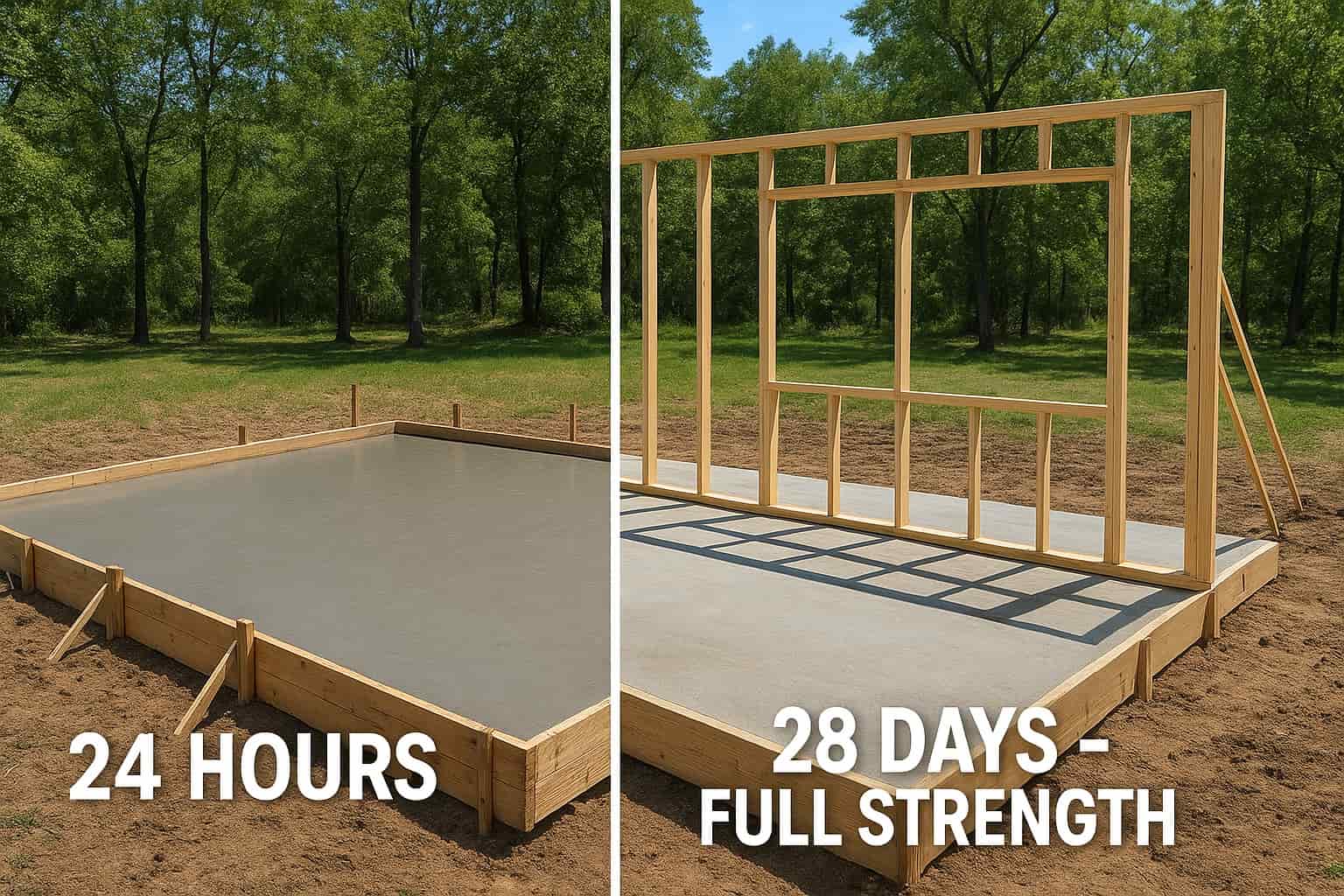
For most standard residential concrete slabs, you should wait at least 7 days before starting light construction activities such as wood framing, while waiting the full 28 days before applying heavy loads or installing finished flooring provides maximum strength and long-term durability. The time required before building depends fundamentally on understanding the difference between concrete “setting” and “curing,” along with the specific requirements of your construction project.
Understanding concrete strength development over time helps homeowners and contractors make informed decisions about when it’s safe to proceed with construction while avoiding costly mistakes from premature loading. Concrete gains approximately 70% of its ultimate strength within the first 7 days under proper curing conditions, with the remaining 30% developing gradually over the next three weeks.[1] This strength timeline directly impacts your project schedule and determines when various construction activities can safely begin on your new slab.
| Time After Pour | Concrete Strength | Permitted Activities | Restrictions |
|---|---|---|---|
| 24-48 hours | Initial set complete | Careful foot traffic, formwork removal | No vehicle traffic, no construction loads |
| 3-7 days | 65-75% of design strength | Light wood framing, basic construction | Avoid heavy equipment, concentrated loads |
| 28 days | 100% of specified strength | All construction activities, heavy loads, flooring installation | None – full strength achieved |
The Science Behind Concrete Curing and Strength Development
Setting Versus Curing: Critical Differences
Concrete gains strength through a chemical process called hydration, which requires moisture and time rather than simply drying out. Setting is the initial hardening that typically occurs within 24 to 48 hours after placement, when concrete can support foot traffic without leaving permanent marks.[2] During this initial period, bleed water rises to the surface as the concrete mixture settles, and the material transitions from a plastic state to a solid form.
Curing represents the much longer process where concrete develops its full compressive strength and durability through continued hydration. This chemical reaction involves water molecules binding with cement particles to form a dense, crystalline matrix that gives concrete its remarkable strength characteristics.[3] The curing process is generally considered complete at 28 days for standard concrete mixes, when the material reaches its full specified strength for design purposes.
How Concrete Gains Strength Over Time
After concrete is placed, it increases in strength very quickly during the first 3 to 7 days of the curing period. Concrete that is properly moist-cured for 7 days develops approximately 50% more strength than uncured concrete placed under identical conditions.[4] The strength development follows a predictable pattern that construction professionals use to schedule subsequent building activities.
At the 3-day mark, concrete has developed approximately 30% to 40% of its 28-day strength, which remains too early for most structural loads.[5] By day 7, properly cured concrete typically reaches about 65% to 70% of its final strength, making it suitable for light construction activities.[6] The remaining strength continues developing gradually, with concrete reaching about 95% to 99% of its ultimate strength by 28 days and continuing to gain small amounts of strength for months or even years afterward.
Recommended Waiting Periods for Different Construction Activities
Light Construction and Wood Framing (7 Days Minimum)
For homeowners planning residential construction in Fayetteville, the 7-day milestone represents when light-frame construction activities can typically begin safely. At this point, concrete has reached approximately 75% of its cured strength, providing sufficient support for wood stud walls and basic framing operations without risking structural damage.[7] However, contractors should still avoid placing heavy equipment or concentrated loads on the slab during this period.
Light construction activities appropriate for the 7-day period include setting treated bottom plates on concrete slabs, constructing wood-framed walls, and beginning basic carpentry work. Northwest Arkansas contractors commonly use this timeline for residential projects, allowing construction to proceed while minimizing schedule delays. The specific timing may vary based on concrete mix design, curing conditions, and project requirements, making consultation with your concrete supplier or structural engineer essential for project-specific guidance.
Heavy Equipment and Machinery Placement (14-28 Days)
Heavy construction equipment, concentrated loads, and permanent fixtures require waiting closer to the full 28-day curing period. Industrial slabs generally require concrete to reach a minimum compressive strength of 4,000 to 6,000 PSI before supporting heavy machinery and equipment loads.[8] For residential applications with typical 3,000 to 4,000 PSI concrete, the 28-day mark ensures the slab has developed sufficient capacity to handle significant weight without cracking or structural distress.
Equipment like forklifts, scissor lifts, concrete mixers, and material storage racks create point loads that concentrate significant weight onto small footprint areas. These concentrated forces can exceed the capacity of partially cured concrete, causing localized failures or widespread cracking that compromises the slab’s long-term performance. Arkansas building codes and industry standards emphasize waiting for full strength development before subjecting slabs to such demanding conditions.
Flooring Installation Timeline (28-90 Days)
Installing finished flooring presents unique challenges that extend beyond basic strength considerations to include moisture management. Most flooring manufacturers specify waiting periods of 60 to 90 days after concrete placement before installing tile, hardwood, carpet, or vinyl flooring systems.[9] This extended timeline allows sufficient time for excess moisture within the slab to evaporate, preventing adhesive failures and flooring damage from trapped moisture vapor.
Professional moisture testing using ASTM F2170 relative humidity testing methods should be conducted before any flooring installation to verify the slab has dried sufficiently. For glue-down flooring systems, concrete slabs should typically achieve relative humidity levels of 75% or lower, while non-glue-down systems may tolerate up to 85% relative humidity.[10] The Arkansas climate, with its humidity variations throughout the year, can significantly affect concrete drying times and may require extended waiting periods compared to arid regions.
Factors That Affect Your Concrete Slab’s Curing Time
Arkansas Climate Considerations
Fayetteville’s climate presents specific challenges for concrete curing that directly impact how quickly your slab reaches sufficient strength for building. Concrete cures best between 50°F and 80°F, with temperature and humidity playing critical roles in the hydration process.[11] Hot, dry conditions common during Arkansas summers can cause concrete to dry too quickly and not cure properly, leading to a weaker slab with increased potential for cracking.
Cold conditions during winter months significantly slow down the chemical hydration reaction, extending curing times and requiring protective measures to maintain appropriate concrete temperatures. At 50°F, concrete requires roughly 14 days to reach 70% strength, while at 70°F it takes only seven days to achieve the same strength level.[12] Northwest Arkansas experiences temperature fluctuations that demand careful attention to curing methods and timeline adjustments based on seasonal conditions.
High humidity can slow evaporation rates and extend the time required for concrete to dry sufficiently for flooring installation, while low humidity increases surface evaporation and raises the risk of plastic shrinkage cracking. Arkansas contractors must account for these climate factors when scheduling construction activities and determining appropriate waiting periods for building on new slabs.
Concrete Mix Design and Additives
The specific concrete mixture used for your slab directly affects how quickly it gains strength and when construction can safely proceed. Some concrete mixes incorporate additives such as accelerators or high-early-strength cement that enable the concrete to reach adequate strength in a matter of hours or a few days.[13] These specialty mixes provide faster turnaround times for projects with tight schedules but require verification through strength testing rather than relying solely on standard timelines.
Standard residential concrete in Fayetteville typically uses mixes designed for 3,000 to 4,000 PSI compressive strength at 28 days. The water-to-cement ratio affects both the rate of strength gain and the ultimate strength the concrete will achieve. Lower water-cement ratios generally produce stronger concrete but may require more careful curing to prevent surface cracking. Your concrete supplier can provide specific information about the mix design and its expected strength development curve for accurate planning purposes.
Proper Curing Methods and Their Impact
Maintaining appropriate moisture levels during the critical first 7 days dramatically affects concrete strength development and determines whether your slab will achieve its specified design strength. Proper curing methods include keeping the slab moist through water ponding, continuous wet burlap coverage, impermeable cover sheets, or application of liquid membrane-forming curing compounds.[14] These techniques preserve the water necessary for continued hydration reactions rather than allowing it to evaporate prematurely.
Water curing by flooding the slab area or maintaining wet burlap for at least 7 days provides the most effective strength development. Some builders on tight schedules implement 3-day water curing, which achieves approximately 80% of the benefit of 7-day water curing, though extended curing remains preferable for maximum strength.[15] Arkansas contractors should plan concrete pours strategically, potentially scheduling placement at the end of the week to allow weekend water curing without disrupting the construction schedule.
Professional Testing: The Definitive Answer for Your Project
Field-Cured Cylinder Testing
The most reliable method for determining when your specific concrete slab has achieved sufficient strength for construction involves testing field-cured cylinders poured at the same time as your slab. Professional testing laboratories cast cylindrical specimens from the fresh concrete during placement, cure them alongside the actual slab under identical conditions, and then test them at various ages to measure actual strength development.[16]
Standard practice calls for testing cylinders at 7 days and 28 days, with the 7-day results providing early indication of whether the concrete is developing as expected. If 7-day strength is significantly below expectations, it serves as a red flag indicating potential problems with the mix design, curing conditions, or placement procedures. Through research and empirical data collection, projection of 28-day strength from 7-day test results provides estimated values very close to actual measured 28-day performance.[17]
When to Consult Engineering Professionals
Complex projects, unusual loading conditions, or situations involving heavy equipment placement warrant consultation with structural engineers or licensed design professionals. These experts can specify the required in-place concrete strength for safe formwork removal, construction load application, and permanent fixture installation based on actual project demands rather than general guidelines.[18] Their analysis accounts for factors like slab thickness, reinforcement details, soil conditions, and specific equipment weights.
Projects involving post-tensioned slabs, elevated slabs, or specialty applications require professional oversight to ensure concrete has reached sufficient strength before stressing operations or construction loading begins. Your concrete supplier, structural engineer, or local building authority can provide specific requirements and recommend appropriate testing protocols to verify readiness for your intended construction activities. Investing in professional guidance prevents costly mistakes and ensures your project proceeds safely.
Cost Considerations for Concrete Slab Construction in Arkansas
Understanding the financial investment in your concrete slab helps homeowners plan appropriately for both the initial construction and the required waiting period before building activities can commence. Concrete slab costs in Fayetteville typically range from $6 to $12 per square foot installed, with a typical 30-by-30-foot slab for driveways or building foundations costing $5,400 to $10,800 on average in 2025.[19] These prices include materials, labor, site preparation, and basic finishing work.
Thickness significantly impacts pricing, with 4-inch slabs suitable for light residential use costing less than 6-inch slabs required for heavier loads or garage floors. Northwest Arkansas contractors charge $3 to $5 per square foot for labor, which includes concrete form creation, site grading, concrete placement, finishing work, and basic curing procedures.[20] Additional costs arise from reinforcement materials like rebar or wire mesh, which strengthen the slab and reduce cracking potential.
Proper planning that accounts for curing time can actually reduce overall project costs by preventing expensive repairs or premature replacement. Rushing construction activities before concrete achieves adequate strength often leads to cracking, spalling, or structural failures that require costly remediation. Investing in appropriate curing methods and adhering to recommended timelines protects your financial investment and ensures your slab performs as intended for decades of service.
Arkansas-Specific Building Code Requirements
Arkansas follows the International Residential Code (IRC) with state-specific amendments that establish minimum requirements for residential concrete slabs. While specific requirements can vary by municipality, most Arkansas jurisdictions require a minimum 4-inch thickness for residential concrete slabs and specify minimum compressive strength requirements.[21] For Fayetteville specifically, the city’s municipal code contains additional requirements regarding slab drainage, connection to structures, and proper reinforcement details.
Building codes require concrete to be maintained above 50°F and kept moist for specified minimum periods, typically 7 days for standard Portland cement concrete. High-early-strength concrete mixes may permit reduced curing periods down to 3 days, provided testing confirms adequate strength development. The codes also address protection requirements for concrete placed during cold weather, when special measures must be taken to maintain appropriate curing temperatures and prevent freezing damage.
Loading or use of concrete slabs should be delayed for a minimum of 48 hours after concrete placement according to building code provisions.[22] When slabs are used for material storage after this minimum period, contractors should exercise caution to prevent impact loading that could damage partially cured concrete. Compliance with local building codes protects both structural integrity and legal liability, making it essential to verify specific requirements with Fayetteville’s building department before construction.
| Concrete Strength (PSI) | Typical Applications | Waiting Period for Light Framing | Waiting Period for Heavy Loads |
|---|---|---|---|
| 3,000 PSI | Residential slabs, patios, walkways | 7 days (70% strength) | 28 days (100% strength) |
| 4,000 PSI | Driveways, garage floors, light commercial | 7 days (70% strength) | 28 days (100% strength) |
| 5,000+ PSI | Heavy equipment, industrial applications | 5-7 days (70% strength) | 28 days (100% strength) |
Common Mistakes to Avoid When Building on New Concrete
Starting Construction Too Soon
The most common and costly mistake homeowners and contractors make involves beginning construction activities before concrete has developed adequate strength. Starting framing, equipment placement, or heavy material storage prematurely can lead to cracking, reduced slab strength, or compromised structural durability that persists throughout the building’s lifetime. These failures often don’t appear immediately but manifest over time as the structure experiences normal loads and environmental stresses.
Pressure from construction schedules or project deadlines tempts contractors to accelerate timelines, but the consequences of premature loading far exceed any schedule savings. A manufacturing facility that initially underestimated dynamic loads and opted for minimal curing time experienced widespread slab cracking within months, necessitating costly repairs that could have been avoided by waiting the full curing period.[23] Arkansas contractors serving Fayetteville homeowners should resist schedule pressure and adhere to industry-standard curing periods.
Inadequate Moisture Control During Curing
Failing to maintain proper moisture levels during the initial curing period prevents concrete from achieving its specified design strength. When bleed water evaporates from the concrete surface faster than it rises from within the mixture, plastic shrinkage cracking occurs that weakens the slab permanently.[24] Arkansas’s variable humidity and temperature conditions make active curing measures essential rather than simply allowing concrete to cure naturally.
Low humidity and high winds greatly affect surface evaporation rates, particularly during spring and summer months in Northwest Arkansas. To minimize plastic shrinkage cracking, contractors should keep concrete surfaces moist by applying moisture with fog sprayers until final curing methods can be applied.[25] Neglecting these moisture control practices during hot weather or windy conditions compromises long-term slab performance regardless of how long you wait before building.
Ignoring Site-Specific Conditions
Generic timelines provide useful guidelines, but every project involves unique factors that may require adjusted waiting periods. Soil conditions beneath the slab, local climate during the curing period, specific concrete mix used, and intended building loads all influence when construction can safely proceed. Poor soil compaction or inappropriate soil types can lead to differential settlement or instability regardless of how strong the concrete becomes.[26]
Arkansas’s expansive clay soils, particularly the Porters Creek Clay formations common in Fayetteville, present special challenges for concrete slab construction. These soil conditions require thorough site preparation, proper drainage design, and potentially extended monitoring periods before heavy construction loads are applied. Consulting with local geotechnical engineers familiar with Northwest Arkansas conditions ensures your specific site receives appropriate treatment and timeline recommendations.
Best Practices for Building on Your New Concrete Slab
Document Everything
Maintaining comprehensive records of concrete placement, curing procedures, test results, and timeline decisions protects both contractors and homeowners. Documentation should include placement date, weather conditions, concrete mix design, curing methods employed, cylinder test results, and dates when various construction activities commenced. This information proves invaluable if questions arise about construction quality or if warranty issues develop later.
Arkansas building inspectors may request documentation demonstrating compliance with code requirements for curing times and strength achievement. Professional testing reports showing field-cured cylinder results provide objective evidence that concrete achieved specified strength before construction loads were applied. Digital photographs documenting curing methods and site conditions supplement written records and help resolve potential disputes about construction practices.
Plan Your Construction Schedule
Strategic planning that accounts for concrete curing time keeps projects moving efficiently while respecting necessary waiting periods. Consider scheduling concrete placement early in the week to allow weekend curing time, or at the end of construction phases to permit curing during periods when other activities can proceed. Northwest Arkansas contractors can work on site preparation, utility installation, or structural steel erection while concrete cures, maximizing productivity without compromising slab integrity.
For projects involving multiple concrete pours, stagger placement dates to create a rolling schedule where some slabs are curing while construction proceeds on others. This approach maintains project momentum and worker productivity while ensuring each slab receives appropriate curing time before loading. Communication between concrete suppliers, framing crews, and project managers facilitates coordination that respects both schedule goals and quality requirements.
Use Professional Contractors
Experienced concrete contractors familiar with Arkansas construction conditions understand local soil characteristics, climate challenges, and building code requirements. Professional contractors implement proper curing procedures, conduct appropriate testing, and provide accurate guidance about when construction can safely proceed. Their expertise prevents costly mistakes and ensures your slab achieves its design strength and intended performance characteristics.
AR Concrete Fayetteville specializes in residential concrete installation throughout Northwest Arkansas, with deep understanding of local conditions that affect curing times and construction scheduling. Our team conducts thorough site assessments, uses high-quality materials meeting ASTM standards, and provides transparent guidance about appropriate timelines for your specific project. By combining technical expertise with commitment to quality workmanship, we ensure your concrete slab provides reliable support for your building project.
Conclusion
Determining when you can build on a new concrete slab requires balancing project schedule demands with the physical realities of concrete strength development. The 7-day milestone provides a reliable starting point for light construction activities like wood framing, while waiting the full 28 days ensures maximum strength and durability for heavy equipment, permanent fixtures, and finished flooring installation. Arkansas homeowners face unique considerations due to local climate conditions, soil characteristics, and code requirements that influence optimal timing decisions.
Professional testing through field-cured cylinders offers the most accurate method for determining your specific slab’s readiness, removing guesswork and providing objective data for construction planning. Proper curing methods during the critical first week, attention to moisture management throughout the process, and consultation with experienced professionals ensure your investment achieves specified performance standards. By understanding these factors and following industry best practices, Fayetteville homeowners can confidently proceed with construction at appropriate times while protecting their long-term investment in quality concrete work.
How Long Before Building on Concrete Slab FAQs
Can you walk on concrete after 24 hours?
Yes, concrete is typically hard enough to walk on carefully after 24 to 48 hours when it has completed its initial set. However, you should avoid placing any construction loads, heavy equipment, or building materials on the slab during this period, as it has only achieved a small fraction of its ultimate strength and remains vulnerable to surface damage and cracking from premature loading.
How long before you can drive on a new concrete driveway in Arkansas?
You should wait at least 7 days before driving passenger vehicles on a new concrete driveway in Arkansas, when the concrete reaches approximately 75% of its design strength under proper curing conditions. For heavy vehicles like trucks or RVs, waiting closer to 14 days provides additional safety margin, while the full 28-day curing period ensures maximum durability for your driveway investment, particularly given Arkansas’s climate conditions and temperature fluctuations.
Does hot weather speed up concrete curing time?
Hot weather accelerates the initial chemical reactions in concrete, causing it to set faster, but this acceleration can actually reduce long-term strength if the concrete dries too quickly and hydration cannot proceed properly. High temperatures common during Arkansas summers require extra attention to curing methods such as fog spraying, wet burlap coverage, or curing compounds to maintain adequate moisture levels, as rapid drying can lead to weaker concrete and increased cracking potential despite the faster initial set.
Can I install flooring immediately after concrete reaches 28-day strength?
No, achieving 28-day strength addresses compressive capacity but not moisture content for flooring installation. Most flooring manufacturers require waiting 60 to 90 days after concrete placement and conducting ASTM F2170 relative humidity testing before installation to verify the slab has dried sufficiently, with acceptable moisture levels typically at 75% relative humidity or lower for glue-down systems, as excess moisture trapped in concrete can cause adhesive failures, warping, and permanent flooring damage.
What happens if you build on concrete too soon?
Building on concrete before it achieves adequate strength can cause cracking, surface spalling, reduced load capacity, and compromised structural durability that persists throughout the building’s lifetime. Premature loading creates stress concentrations that exceed the partially cured concrete’s capacity, resulting in damage that may not appear immediately but manifests over time as cracks propagate and structural integrity deteriorates, often requiring expensive repairs or even slab replacement to correct the underlying problems created by inadequate curing.
How Long Before Building on Concrete Slab Citations
- HeatAuthority. (2024). “Concrete Curing Time Chart: Achieving Maximum Compressive Strength.” Available at: https://heatauthority.com/blogs/news/concrete-curing-time-chart-achieving-maximum-compressive-strength
- Concrete Network. (2010). “Concrete Curing Time: How Long Does Concrete Take To Dry?” Available at: https://www.concretenetwork.com/curing-concrete/
- Converge. (2023). “Can humidity affect concrete curing time?” Available at: https://www.converge.io/blog/concrete-humidity
- Concrete Network. (2010). “Concrete Curing Time: How Long Does Concrete Take To Dry?” Available at: https://www.concretenetwork.com/curing-concrete/
- Bangur Cement. (n.d.). “Strength of Concrete Timeline: 3, 7, and 28 Days Guide.” Available at: https://www.bangurcement.com/blog/concrete-strength-timeline-3-7-28-days
- HeatAuthority. (2024). “Concrete Curing Time Chart: Achieving Maximum Compressive Strength.” Available at: https://heatauthority.com/blogs/news/concrete-curing-time-chart-achieving-maximum-compressive-strength
- Powerblanket. (2025). “Concrete Curing Time: How Long & Best Practices.” Available at: https://www.powerblanket.com/blog/concrete-curing-time/
- Evenson Concrete Systems. (2025). “The Ultimate Guide to Industrial Slabs: Strength, Durability, and Performance.” Available at: https://www.evensonconcrete.com/news/industrial-slabs
- MFMA. (n.d.). “Concrete Slab Moisture Content.” Available at: https://www.maplefloor.org/en/concrete-slab-moisture-content/
- MFMA. (n.d.). “Concrete Slab Moisture Content.” Available at: https://www.maplefloor.org/en/concrete-slab-moisture-content/
- Express Concrete. (2025). “How Weather Affects Ready Mix Concrete Setting.” Available at: https://expressconcreteltd.com/how-does-the-weather-affect-the-setting-time-of-ready-mix-concrete/
- Express Concrete. (2025). “How Weather Affects Ready Mix Concrete Setting.” Available at: https://expressconcreteltd.com/how-does-the-weather-affect-the-setting-time-of-ready-mix-concrete/
- Advance Roofing. (2024). “Concrete Curing Charts for Managing Temperature, Moisture and Time.” Available at: https://advanceroofingllc.com/blogs/concrete-curing-temperature-chart-optimizing-strength-and-durability/
- UpCodes. (n.d.). “Concrete for Slabs – Florida Building Code.” Available at: https://up.codes/s/concrete-for-slabs
- Concrete Network. (2010). “Concrete Curing Time: How Long Does Concrete Take To Dry?” Available at: https://www.concretenetwork.com/curing-concrete/
- Cement Equipment. (2020). “28 days strength – Concrete.” Available at: https://www.cementequipment.org/main-category/concrete/28-days-strength/
- National Precast Concrete Association. (2023). “The 28-Day Myth.” Available at: https://precast.org/blog/28-day-myth/
- American Concrete Institute. (2016). “ACI 306R-16: Guide to Cold Weather Concreting.” Available at: https://www.concrete.org/Portals/0/Files/PDF/University/306R-16_excerpt.pdf
- HomeGuide. (2025). “How Much Does a Concrete Slab Cost? (2025).” Available at: https://homeguide.com/costs/concrete-slab-cost
- This Old House. (2025). “How Much Does a Concrete Slab Cost? (2025 Prices).” Available at: https://www.thisoldhouse.com/foundations/concrete-slab-cost
- ICCSAFE. (n.d.). “The Strength of Concrete.” Available at: https://shop.iccsafe.org/media/wysiwyg/material/9090S12-sample.pdf
- UpCodes. (n.d.). “Concrete for Slabs – Florida Building Code.” Available at: https://up.codes/s/concrete-for-slabs
- For Construction Pros. (n.d.). “Understanding Concrete Slab Load Capacity.” Available at: https://www.forconstructionpros.com/concrete/equipment-products/flatwork-accessories/article/22936789/steele-solutions-inc-understanding-concrete-slab-load-capacity
- Graniterock. (n.d.). “Weather And How To Minimize Its Effects On Concrete.” Available at: https://www.graniterock.com/technical_reports/weather-and-how-to-minimize-its-effects?category_id=89
- Graniterock. (n.d.). “Weather And How To Minimize Its Effects On Concrete.” Available at: https://www.graniterock.com/technical_reports/weather-and-how-to-minimize-its-effects?category_id=89
- For Construction Pros. (n.d.). “Understanding Concrete Slab Load Capacity.” Available at: https://www.forconstructionpros.com/concrete/equipment-products/flatwork-accessories/article/22936789/steele-solutions-inc-understanding-concrete-slab-load-capacity
Leave a Reply