Key Takeaways
- Concrete slabs heave and settle primarily due to soil movement beneath the surface, triggered by moisture changes, temperature fluctuations, and soil composition
- Arkansas homeowners face unique challenges from expansive Porters Creek Clay soils that can swell up to 10% when saturated
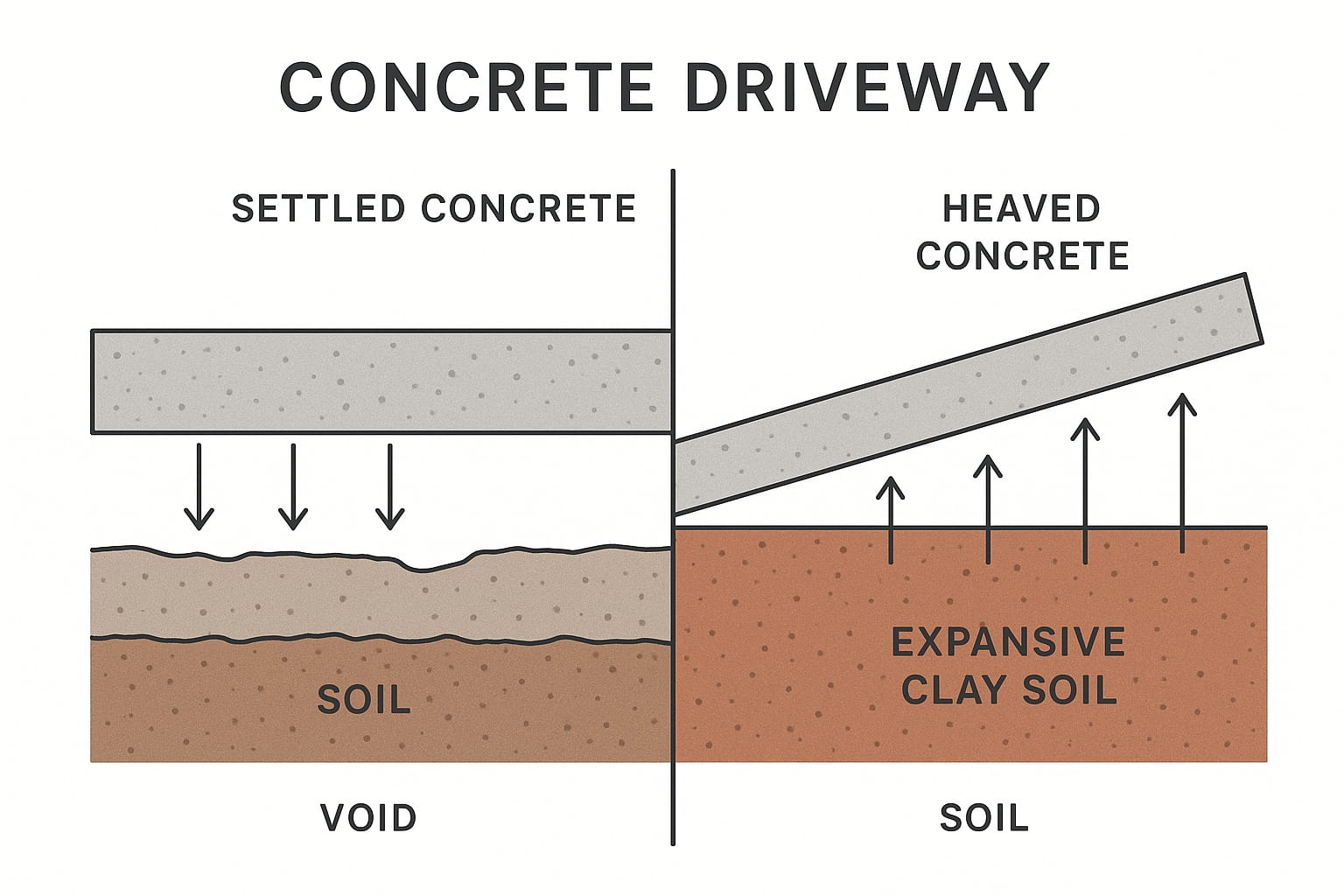
- Settling occurs when soil loses its ability to support the slab’s weight, causing downward movement from poor compaction, erosion, or shrinkage
- Heaving happens when forces push the slab upward, typically from expanding clay soils, frost action, or tree root growth
- Professional repair methods like mudjacking ($3-$6 per square foot) and polyurethane foam leveling ($5-$25 per square foot) can restore slabs without full replacement
- Prevention requires proper soil preparation, effective drainage systems, and understanding Northwest Arkansas’s specific climate patterns
Understanding Concrete Slab Movement in Fayetteville
Concrete slabs move in two primary directions: downward (settling) or upward (heaving). Both types of movement stem from changes in the soil beneath your concrete, and the direction depends on whether the soil is losing or gaining volume. Understanding the specific cause is vital because the solutions for heaving and settling differ significantly and require professional diagnosis.
For Fayetteville homeowners, soil-related concrete issues are particularly common due to the region’s expansive clay soils and seasonal climate variations. The Porters Creek Clay formation, which outcrops in a continuous belt through parts of Arkansas, contains highly expansive soils that shrink and swell according to moisture content.[1] When these clays absorb water, they can expand significantly, and when they dry out, they contract, creating voids beneath concrete slabs.
What Causes Concrete Slabs to Settle?
Settlement is the downward movement of a concrete slab when the soil beneath it weakens, erodes, or compacts. This gradual sinking creates a concave appearance and often produces cracks that widen over time. Several factors contribute to slab settlement in Northwest Arkansas:
Poor Soil Compaction Before Installation
If the ground beneath your concrete patio or driveway wasn’t properly compacted before pouring, the soil will naturally consolidate over time under the slab’s weight. According to ACI 360R-10 guidelines, proper subgrade preparation can reduce settling by up to 30%.[2] The soil beneath must be mechanically compacted to achieve adequate density and prevent future consolidation.
Professional contractors use plate compactors to achieve proper soil density, but inadequate compaction remains one of the most common causes of premature slab failure. Without this critical step, even well-designed concrete will eventually sink as the loose soil beneath compresses.
Soil Washout and Erosion
Poor drainage, heavy rainfall, or plumbing leaks can wash away the soil supporting your concrete slab, creating voids underneath. Fayetteville receives an average of 45 inches of rainfall annually, making proper drainage design essential for long-term concrete performance. When water channels beneath a slab, it carries soil particles away, leaving empty spaces that cause the concrete to lose support and settle.
Arkansas’s rolling topography compounds drainage challenges. Without proper grading and water management systems, rainwater can pool near foundations and work its way beneath concrete surfaces, gradually eroding the supporting soil.
Drying and Shrinking Soil
During drought conditions, clay-rich soils—particularly the expansive clays common throughout Arkansas—shrink significantly. The Porters Creek Clay can lose substantial volume as it dries, creating gaps beneath slabs that allow them to settle.[1] This shrinkage is especially pronounced during hot, dry summers when soil moisture levels drop dramatically.
Expansive soils like those in Fayetteville can experience volume changes exceeding 10% between wet and dry conditions.[3] This massive shift creates unstable support conditions for concrete, leading to differential settlement where some areas sink more than others.
Heavy Loads and Excessive Weight
Concrete slabs designed for light residential use can settle when subjected to loads they weren’t built to handle. Parking heavy equipment, RVs, or commercial vehicles on driveways designed for passenger cars compresses the soil beneath, accelerating settlement in areas not engineered for such loads.
The American Concrete Institute recommends minimum slab thicknesses based on expected loads: 4 inches for standard residential driveways and 6 inches for areas supporting heavier vehicles.[4] When actual loads exceed design specifications, settlement becomes far more likely.
What Causes Concrete Slabs to Heave?
Heaving is the upward movement of concrete slabs caused by forces pushing up from underneath. This creates a convex shape or raised edges, often accompanied by sudden cracking. The movement can be more dramatic than settling, especially after freeze-thaw cycles or heavy precipitation.
Expansive Clay Soils in Arkansas
Soils with high clay content absorb significant amounts of water and expand considerably. The Porters Creek Clay of the Midway Group, which outcrops intermittently from Malvern to near Batesville in Arkansas, is highly expansive and can force concrete foundations to crack.[1] These clays contain minerals that allow water molecules to squeeze into their chemical structure, causing dramatic volume increases.
Three feet of expansive soil can generate enough swell pressure to lift a 37-ton truck 2 inches.[5] This immense upward pressure easily pushes concrete slabs upward, creating serious structural problems. When clay soils in Northwest Arkansas become saturated during wet seasons, they can exert thousands of pounds per square foot of upward force on overlying concrete.
Frost Heave in Northwest Arkansas
While Arkansas doesn’t experience the extreme winter conditions of northern states, frost heave still occurs in Fayetteville. The city typically sees its first freeze around October 26th, with the last freeze occurring around April 16th.[6][7] During this period, freeze-thaw cycles can damage concrete through a process where water in the soil freezes and expands by nearly 9% in volume.
When temperatures drop below freezing, water trapped in soil pores freezes and creates “ice lenses” beneath the surface that push concrete upward. As temperatures rise and the ground thaws, the slab may not return to its original position, leading to permanent damage and displacement. Because concrete is porous like a sponge, water absorbed into the concrete itself can also freeze and expand, causing the pores to “pop” and creating larger voids that accommodate more water in subsequent cycles.[8]
Tree Root Growth and Pressure
Growing tree roots searching for moisture can exert significant pressure on concrete slabs, causing them to lift and crack as the roots expand. Large trees planted too close to concrete installations create persistent upward pressure as their root systems grow and mature. This is particularly problematic during dry periods when roots aggressively seek water sources, often finding moisture beneath concrete slabs.
Roots from trees like oak, willow, and poplar can extend two to three times the tree’s canopy width, making seemingly distant trees potential culprits in concrete heaving.
Underground Water Accumulation
Excess moisture from heavy rainfall, snowmelt, plumbing leaks, or poor drainage can saturate the soil and cause it to expand, pushing slabs upward. This is especially problematic in poorly drained areas or where water pools near concrete surfaces. Northwest Arkansas’s high humidity and substantial rainfall create conditions where moisture management becomes critical for concrete longevity.
| Factor | Settling Risk | Heaving Risk | Arkansas Impact |
|---|---|---|---|
| Poor Soil Compaction | High | Low | Common with rushed installations |
| Expansive Clay Soils | Medium | Very High | Porters Creek Clay widespread |
| Frost-Thaw Cycles | Medium | Medium | Oct-April freeze period |
| Poor Drainage | High | High | 45″ annual rainfall |
| Tree Root Growth | Low | High | Common in established neighborhoods |
| Soil Erosion | Very High | Low | Rolling topography increases risk |
Recognizing the Signs: Settling vs. Heaving
Identifying whether your concrete is settling or heaving helps determine the appropriate repair approach. Settlement typically occurs gradually and creates characteristic downward displacement patterns, while heaving can be more sudden, especially after freeze-thaw cycles or heavy rain.
Settlement Warning Signs
Settlement creates a concave depression where the slab sinks below its original level. Cracks may widen progressively over time as the slab continues to drop. Water pooling on the surface indicates low spots where settlement has occurred. Gaps between the slab and adjacent structures, such as foundation walls or steps, signal that the concrete has moved downward. The movement is usually gradual and may be localized to specific areas or widespread depending on the underlying cause.
Heaving Indicators
Heaving produces a convex shape where the slab lifts upward, sometimes creating raised edges or a peaked appearance. Cracks often appear suddenly as the slab is pushed up with significant force. The concrete may tilt or slope upward rather than creating level surfaces. After freeze-thaw cycles, you might notice the slab has risen but hasn’t returned to its original position when temperatures warm. These changes can occur relatively quickly compared to the gradual nature of settlement.
Professional Repair Solutions and Costs
Both heaving and settling require professional intervention, but the repair methods differ significantly. Understanding your options helps you make informed decisions about restoring your concrete.
Mudjacking for Settled Concrete
Mudjacking, also called slabjacking, lifts settled concrete back to its original position by pumping a specialized slurry mixture underneath to fill voids and raise the slab. The process involves drilling small holes (typically 1.5-2 inches) in the sunken slab and injecting a mixture of water, soil, sand, and cement under high pressure.[9]
Cost: $3-$6 per square foot, with most projects ranging from $662 to $1,866 total.[10][11] A typical 200 square foot driveway section costs $650-$1,300 to mudjack. Contractors typically charge minimum fees of $300-$700 for small jobs.
Mudjacking typically requires 1-3 days of curing time before the slab can support weight. The technique works well for slabs 4 inches or thicker that have settled due to soil issues but remain structurally sound.[12]
Polyurethane Foam Leveling
Polyurethane foam leveling (polyjacking) represents a more modern approach that injects lightweight, expanding foam beneath the slab. The foam cures in just 15-30 minutes, allowing immediate use of the repaired area.[13] This method creates less disruption, requires smaller injection holes (typically 5/8 inch), and adds minimal weight to already compromised soil.
Cost: $5-$25 per square foot, with projects ranging from $1,015 to $8,100.[14][15] A 200 square foot section costs approximately $1,500-$3,200 for foam jacking. While polyurethane costs 20-50% more than mudjacking, it offers superior durability, lighter weight, faster curing, and less invasive installation.[16]
Addressing Heaving Concrete
Heaving requires a different approach. First, the underlying cause must be identified and corrected. This might involve improving drainage, removing problem tree roots, or addressing soil expansion issues. In some cases, the affected section must be removed, the soil properly prepared, and the concrete replaced.
For frost heave, ensuring adequate drainage and proper subbase materials that resist frost action can prevent recurrence. For expansive clay issues common in Arkansas, soil stabilization techniques or deeper foundation systems may be necessary.
Preventing Future Slab Movement in Northwest Arkansas
Prevention starts with proper installation techniques tailored to local soil conditions. Professional contractors familiar with Arkansas’s Porters Creek Clay and regional climate patterns can implement strategies that minimize future problems.
Soil Preparation and Compaction
Proper soil compaction before installation is non-negotiable. The subgrade should be mechanically compacted to at least 95% of maximum density. A well-compacted granular base layer (typically 4-6 inches of crushed stone) provides stable support and facilitates drainage.[2]
For areas with known expansive clay, deeper excavation and replacement with non-expansive fill material may be warranted. Some installations benefit from geotextile fabric layers that prevent soil migration while allowing water drainage.
Drainage System Design
Effective drainage is critical in Arkansas’s wet climate. Proper grading should direct water away from concrete slabs at a slope of at least 1-2%. Gutters and downspouts must discharge water at least 10 feet away from concrete installations.
For areas prone to water accumulation, French drains or other subsurface drainage systems may be necessary. The goal is to prevent water from pooling near or beneath concrete, thereby minimizing both erosion (which causes settling) and soil saturation (which causes heaving).
Control Joints and Reinforcement
Proper jointing techniques allow for thermal expansion and contraction without causing random cracking. According to ACI guidelines, control joints should be spaced at intervals of 2-3 times the slab thickness in feet (for a 4-inch slab, joints should be spaced 8-12 feet apart).[17]
Reinforcement options include welded wire mesh, rebar, or fiber reinforcement. While these don’t prevent slab movement, they help control cracking and maintain slab integrity when minor movement occurs. Studies show that slabs with proper reinforcement experience 40% fewer cracks.[18]
When to Call a Professional
Early intervention prevents minor issues from becoming major problems. Contact a professional concrete contractor when you notice cracks wider than 1/4 inch, uneven surfaces creating trip hazards, water pooling where it previously drained properly, or visible gaps between the slab and adjacent structures.
Professional evaluation can determine whether you’re dealing with settling or heaving, identify the underlying cause, and recommend appropriate solutions. Many contractors offer free inspections and estimates, making it easy to understand your options without financial commitment.
| Repair Method | Cost Per Sq Ft | Cure Time | Longevity | Best For |
|---|---|---|---|---|
| Mudjacking | $3-$6 | 1-3 days | 8-10 years | Large areas, budget-conscious repairs |
| Polyurethane Foam | $5-$25 | 15-30 minutes | Decades | Quick repairs, weak soil, high-visibility areas |
| Replacement | $8-$18 | 7-28 days | 20-30 years | Severely damaged slabs, structural issues |
Conclusion
Concrete slab heaving and settling result from soil changes beneath your concrete, influenced by moisture, temperature, and soil composition. Arkansas homeowners face unique challenges from expansive Porters Creek Clay soils, seasonal freeze-thaw cycles, and substantial rainfall that can trigger both settling and heaving. Understanding the difference between these two types of movement—settling from soil loss or compression versus heaving from soil expansion or frost action—is essential for choosing the right repair approach.
Professional repair methods like mudjacking and polyurethane foam leveling can restore settled slabs at a fraction of replacement costs, while heaving requires addressing the underlying pressure source. Prevention through proper soil preparation, effective drainage, and appropriate reinforcement saves money and extends the life of your concrete installations. If you notice signs of slab movement, contact AR Concrete Fayetteville for a professional evaluation and customized solution tailored to Northwest Arkansas’s unique conditions.
Why Concrete Slabs Heave or Settle FAQs
How do I know if my concrete slab is settling or heaving?
Settling creates a downward, concave depression where the slab sinks below its original level, while heaving produces an upward, convex shape where the slab lifts or tilts upward. Settlement typically occurs gradually with widening cracks over time, whereas heaving can happen more suddenly, especially after freeze-thaw cycles or heavy rain.[19]
Why do concrete slabs heave or settle in Arkansas specifically?
Arkansas’s expansive Porters Creek Clay soils can swell up to 10% when saturated and shrink significantly when dry, creating the pressure differences that cause heaving and the voids that cause settling. Combined with Northwest Arkansas’s freeze-thaw cycles from late October through mid-April and 45 inches of annual rainfall, these conditions create perfect scenarios for slab movement.[1][6]
Can concrete slab settling be fixed without replacement?
Yes, mudjacking and polyurethane foam leveling can effectively lift settled concrete back to its original position without full replacement. Mudjacking costs $3-$6 per square foot and works well for most residential applications, while polyurethane foam leveling costs $5-$25 per square foot and offers faster curing and longer-lasting results.[10][14]
What’s the main difference between mudjacking and foam jacking?
Mudjacking uses a heavy cement-based slurry mixture to fill voids and lift concrete, requiring 1-3 days to cure and costing less upfront, while foam jacking uses lightweight polyurethane foam that cures in 15-30 minutes, costs 20-50% more, but provides superior long-term durability and adds minimal weight to already compromised soil.[16][20]
How can I prevent my concrete slab from heaving or settling?
Prevention requires proper soil compaction to at least 95% maximum density before installation, effective drainage systems that direct water at least 10 feet away from concrete, appropriate control joint spacing (2-3 times the slab thickness in feet), and understanding your local soil conditions to implement suitable base preparation techniques.[2][17]
Why Concrete Slabs Heave or Settle Citations
- Arkansas Geological Survey. “Expansive Soils in Arkansas.” https://www.geology.arkansas.gov/geohazards/expansive-soils.html
- American Concrete Institute. “ACI 360R-10: Guide to Design of Slabs-on-Ground.” 2010. https://www.concrete.org/portals/0/files/pdf/previews/360r-10web.pdf
- Concrete Repairman LLC. “Dealing with Expansive Clay Soils.” August 31, 2024. https://www.concreterepairman.com/expansive-clay-soils/
- Concrete Captain. “Essential Standards For Concrete Slabs: Ensure Durability And Safety In Your Projects.” June 5, 2025. https://concretecaptain.com/standards-for-concrete-slabs/
- HydroGuard Foundations. “Expansive Soils: A Hidden Disaster.” 2018. https://hydroguardfoundations.com/2018/09/20/expansive-soils-a-hidden-disaster/
- 5 News Online. “Did we see our first freeze earlier than normal this year?” https://www.5newsonline.com/article/weather/frost-climatology-arkansas-fayetteville-fortsmith/527-3c74e237-bea2-489a-a30f-bb47becc28b7
- KNWA FOX24. “Weather Blog: Last Frost/Freeze Climatology For NW Arkansas & the River Valley.” April 19, 2021. https://www.nwahomepage.com/weather/weather-blog/weather-blog-last-frost-freeze-climatology-for-nw-arkansas-the-river-valley/
- A-1 Concrete Leveling. “A Homeowner’s Guide to Freeze-Thaw Cycles.” December 3, 2024. https://www.a1concrete.com/concrete-repair-learning-center/concrete-freeze-thaw-cycles
- American Concrete Institute. “ACI RAP Bulletin 11: Slabjacking.” 2010. https://www.concrete.org/portals/0/files/pdf/rap-11.pdf
- HomeGuide. “How Much Does Mudjacking Cost? (2025).” 3 weeks ago. https://homeguide.com/costs/mudjacking-cost
- Angi. “How Much Does Mudjacking Cost? [2025 Data].” October 15, 2025. https://www.angi.com/articles/how-much-does-mudjacking-cost.htm
- Fixr. “Concrete Leveling Cost | Mudjacking Cost.” https://www.fixr.com/costs/concrete-leveling
- Angi. “How Much Does Polyurethane Concrete Lifting Cost? [2025 Data].” 1 month ago. https://www.angi.com/articles/polyurethane-concrete-lifting-cost.htm
- A-1 Concrete Leveling. “Concrete Leveling Costs: The Ultimate Guide [2025 Prices].” September 10, 2025. https://www.a1concrete.com/concrete-repair-learning-center/concrete-leveling-costs
- A-1 Concrete Leveling. “Foam Concrete Lifting Costs: Everything You Need To Know About Polyjacking Costs.” March 6, 2024. https://www.a1concrete.com/concrete-repair-learning-center/foam-concrete-lifting-costs-everything-you-need-know-about-polyjacking-costs
- Slab-Jack Kings. “How Much Does Polyurethane Concrete Lifting Cost?” July 1, 2020. https://slabjackkings.com/articles/how-much-does-polyurethane-concrete-lifting-cost/
- American Concrete Institute. “ACI 302.1R-15: Guide to Concrete Floor and Slab Construction.” 2015. http://www.concrete.org/Portals/0/Files/PDF/302.1R-15_Chapter5.pdf
- Concrete Foundations Association. Referenced in Concrete Captain. “Essential Standards For Concrete Slabs.” June 5, 2025. https://concretecaptain.com/standards-for-concrete-slabs/
- Superior Grouting. “Concrete Leveling Costs in 2024.” https://www.superiorgrouting.com/blog/concrete-leveling-costs-in-2024-a-comprehensive-guide/
- HomeAdvisor. “How Much Does Concrete Leveling or Mudjacking Cost in 2025?” https://www.homeadvisor.com/cost/foundations/level-concrete-slabs/
Leave a Reply