Key Takeaways:
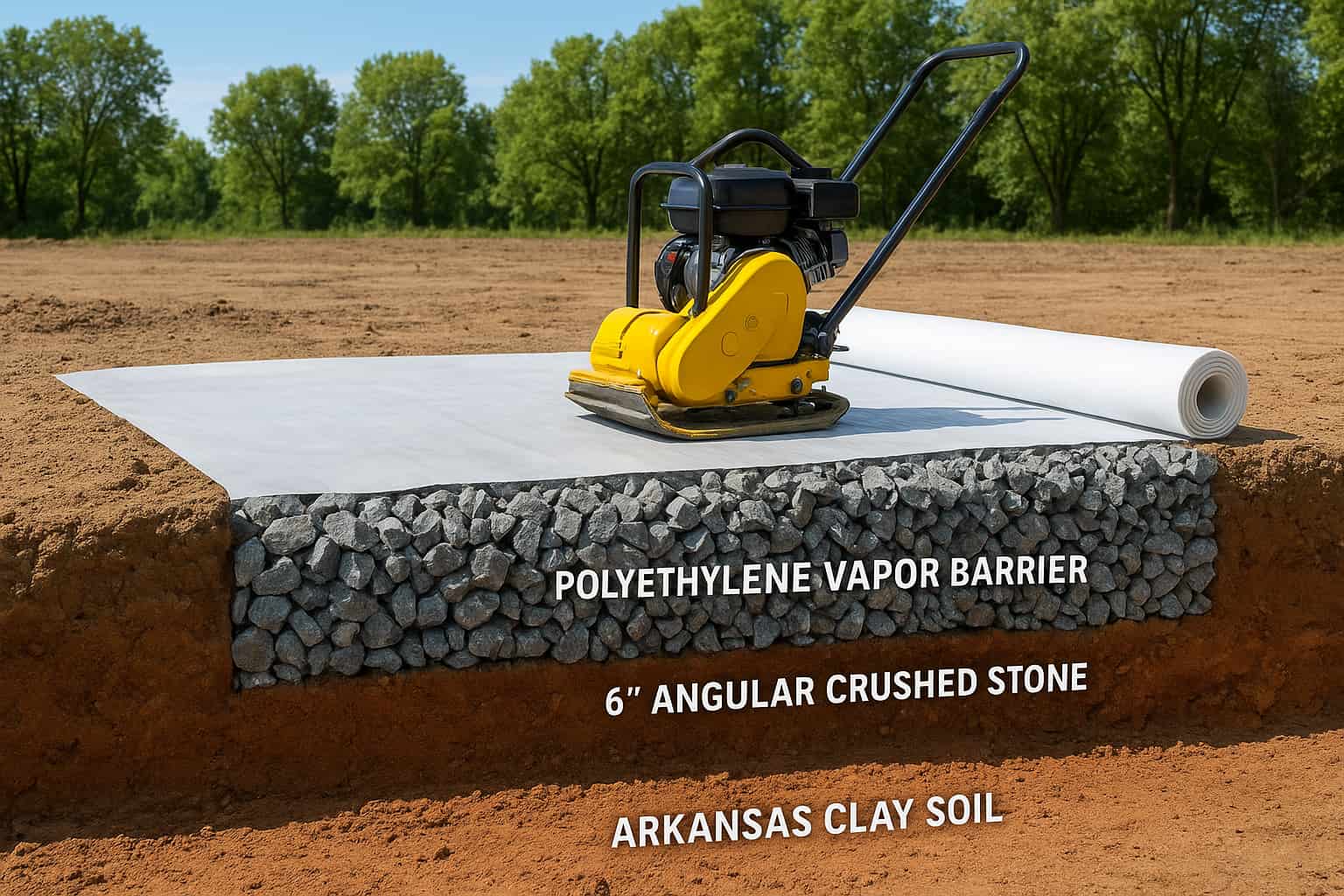
- A properly compacted 4-6 inch gravel base using ¾-inch crushed stone (#57) is essential for concrete slabs in Fayetteville
- Arkansas’s expansive clay soil requires specialized base preparation to prevent cracking and settling
- Vapor barriers (minimum 10-mil polyethylene) must be installed directly under the slab to control moisture
- Professional base compaction achieves 95% density and prevents future slab movement
- Base preparation costs represent 30-40% of total slab installation but prevent expensive repairs
Article Summary: The foundation for a strong concrete slab in Fayetteville Arkansas requires a compacted gravel base of 4-6 inches using angular crushed stone, proper soil preparation to address local clay conditions, and a vapor barrier to manage moisture—all designed to prevent the cracking and settling common in Northwest Arkansas’s challenging soil environment.
Understanding Fayetteville’s Unique Soil Challenges for Concrete Slab Bases
If you’re planning a concrete slab in Fayetteville, you’re building on some of Arkansas’s most challenging soil. The good news? Understanding what lies beneath helps you build a slab that lasts decades instead of showing cracks within years.
Fayetteville sits in an area dominated by expansive clay soil that acts like a sponge. [15] When rain soaks the ground, clay soil can expand by up to 10% in volume. [21] Then, when Arkansas’s hot summers dry everything out, that same soil shrinks back down. This constant swelling and shrinking puts tremendous pressure on any concrete sitting on top, causing cracks, shifting, and structural damage over time. [17]
The clay-rich soil in the Fayetteville area is often described in building manuals as “problematic” because of this high clay content and its tendency to expand and contract with moisture changes. [18] Even modest seasonal changes affect the soil that supports your foundation. Years of this cyclical expansion and contraction subject concrete to repeated stress, eventually causing parts to break down and lose load-bearing capacity.
The right base acts as a buffer between your concrete and Arkansas’s moody soil, providing stability, drainage, and protection that makes the difference between a slab that lasts and one that fails.
Why Porters Creek Clay Soil Requires Special Attention
The Arkansas Geological Survey identifies several soil types across the state, but Porters Creek clay-rich formations are particularly common in Northwest Arkansas. [17] These soils contain high concentrations of clay minerals that make them especially reactive to moisture. When you’re excavating for a slab, you’ll often see this characteristic red clay mixed with the dirt—but that doesn’t automatically mean disaster.
What matters most is how you prepare the site and what you put between that expansive soil and your concrete. A properly designed base system creates a stable platform that accommodates soil movement without transferring stress to the slab above.
Essential Components of a Proper Concrete Slab Base System
Building a concrete slab base in Fayetteville isn’t about following a one-size-fits-all approach. The best bases combine several key layers, each serving a specific purpose in creating a stable, long-lasting foundation.
Subgrade Preparation: Your Foundation’s Foundation
The subgrade is the native soil that’s been properly graded and compacted before anything else goes down. [7] Think of it as your foundation’s foundation. In Fayetteville, this step requires removing all organic material—topsoil, vegetation, roots, and debris—until you reach stable soil. [8]
Any organic matter left in place will continue to compress and decompose under your slab’s weight, creating voids and settlement issues. [6] Professional contractors excavate to the proper depth, typically 8-12 inches below your final slab height, to accommodate all the necessary layers.
The excavated subgrade should be graded to within plus or minus 1.5 inches of the specified elevation and compacted using a plate compactor or tamping equipment. [7] Proper compaction at this stage creates a stable base that won’t settle unevenly over time.
The Gravel Base Layer: Your Slab’s Critical Support System
Here’s where most homeowners get confused about specifications. The gravel base isn’t just any gravel thrown down and called good. For concrete slabs in Fayetteville, you need angular, crushed stone that compacts well and provides excellent drainage.
The ideal gravel size for concrete slabs is ¾-inch crushed stone, designated as ASTM #57. [5] This size offers the perfect balance of drainage capabilities and compaction characteristics. The angular shape of crushed stone allows pieces to interlock under pressure, creating a solid, stable base that resists shifting. [9]
Avoid rounded materials like pea gravel or river rock—they don’t compact well and will shift under your slab, leading to cracking and settlement. [5]
The thickness of your gravel base matters significantly. For residential slabs in Fayetteville, 4-6 inches of compacted gravel is standard. [6] However, specific applications require different depths:
- Light-duty residential slabs (patios, walkways): 4 inches compacted
- Standard garage slabs: 6 inches compacted
- Heavy vehicle traffic areas: 8-12 inches compacted [6]
- Areas with poor drainage or heavy clay: 6-8+ inches compacted [10]
Quick Decision Guide: Choosing Your Base Materials
| Slab Application | Gravel Depth | Material Type | Compaction Required | Best for Fayetteville |
|---|---|---|---|---|
| Residential Patio | 4-5 inches | ¾” Crushed Stone (#57) | 95% Standard Proctor | ✓ Standard approach |
| Home Garage | 6 inches | ¾” Crushed Stone or Crusher Run | 95% Standard Proctor | ✓ Recommended |
| Workshop/Heavy Equipment | 8-12 inches | Dense-Graded Base (DGB) | 98% Standard Proctor | ✓ For clay soil areas |
| Poor Drainage Areas | 6-8 inches | ¾” Clean Crushed Stone | 95% Standard Proctor + French Drain | ✓✓ Highly recommended |
| Freeze-Thaw Exposure | 8-24 inches | Graded Aggregate | 95-98% Standard Proctor | ✓ For extreme conditions [9] |
Alternative Base Materials for Specific Situations
While ¾-inch crushed stone works for most residential applications, some situations benefit from alternative materials:
Recycled Concrete Aggregate (RCA): Made from crushed reclaimed concrete, RCA provides a cost-effective and environmentally friendly alternative. [5] It compacts well and drains similarly to traditional crushed stone, though it should be sourced from reputable suppliers to ensure it’s clean and free from contaminants. In Fayetteville’s residential market, RCA can reduce material costs by 15-25% while providing excellent performance. [7]
Dense-Graded Base (DGB) or Crusher Run: This material combines crushed stone with stone dust, creating an extremely dense, stable layer. [5] It’s often used for heavily loaded slabs or areas with particularly challenging soil conditions. The fine particles help it compact tightly, but proper drainage becomes even more critical since those fines can retain moisture.
The Critical Importance of Proper Compaction
You can have the right materials and the perfect thickness, but without proper compaction, your base will fail. Compaction removes air voids and creates a solid, uniform surface that won’t settle under your concrete’s weight.
Professional contractors install gravel in layers—called “lifts”—of 3-4 inches thick, compacting each lift thoroughly before adding the next. [8] This process ensures consistent density throughout the entire base depth. Trying to compact 6 inches of gravel all at once simply doesn’t work; the equipment can’t reach the bottom layers effectively.
According to Matt Risinger, a building science expert who works extensively with concrete foundations, “Under proper compaction techniques using a plate compactor and the correct amount of water, a well-compacted gravel base should feel like concrete itself.” [6]
The compaction process involves:
- Spreading: Distribute gravel evenly in a 3-4 inch layer [8]
- Moistening: Slightly dampen the gravel to improve compaction (not soaking wet) [8]
- Compacting: Run a plate compactor or reversible tamper over the entire surface multiple times
- Checking: Verify compaction by walking on the surface—it should feel solid with no give
- Repeating: Add the next lift and repeat until reaching desired depth
Equipment Needed for Professional-Grade Compaction
Homeowners tackling DIY projects can rent compaction equipment, but understanding what works best helps ensure proper results. Plate compactors work well for most residential applications, providing 3,000-5,000 pounds of force. [8] For larger projects or particularly challenging soil, jumping jack tampers or even small vibratory rollers may be necessary.
The investment in proper compaction equipment rental (typically $75-150 per day) pays for itself by preventing settlement cracks that could cost thousands to repair later.
Vapor Barriers: Protecting Your Slab from Moisture
In Fayetteville’s humid climate, moisture control is critical for long-term slab performance. Water vapor naturally moves upward from the ground through concrete, potentially causing serious problems for flooring, coatings, and the concrete itself.
The International Residential Code requires a minimum 10-mil polyethylene vapor barrier under all heated concrete slabs. [29] However, most experts recommend 15-mil or thicker barriers for better puncture resistance during installation. [26]
Why Vapor Barriers Matter in Arkansas
Concrete is porous—water vapor can move through it over time. Without a proper vapor barrier, moisture from Arkansas’s soil continually enters your slab from below. [26] This moisture causes multiple problems:
- Flooring failures (buckling hardwood, delaminating vinyl, mold under carpet)
- Coating blistering and failure
- Efflorescence (white mineral deposits on the surface)
- Increased humidity in living spaces
- Radon gas infiltration [27]
The American Concrete Institute now recommends placing vapor barriers directly beneath the concrete slab, not under the gravel base. [28] This position prevents moisture from entering the slab while allowing any rain or curing water in the gravel layer to drain away before the pour.
Proper Vapor Barrier Installation Steps
Installing a vapor barrier correctly requires attention to detail:
- Level the base: The compacted gravel surface should be smooth with no sharp edges that could puncture the barrier [29]
- Add a sand layer (optional): Some contractors place 1-2 inches of sand over the gravel to create a smoother surface [33]
- Roll out the barrier: Position sheets with the longest dimension parallel to the pour direction [29]
- Overlap seams: All seams should overlap by minimum 6 inches and be sealed with compatible vapor barrier tape [30]
- Seal penetrations: Tape around all utility penetrations, column openings, and foundation walls [30]
- Protect during construction: Use caution to avoid puncturing the barrier with rebar or tools
Drainage Considerations for Arkansas’s Wet Season
Fayetteville receives an average of 45 inches of rainfall annually, with spring being particularly wet. Proper drainage planning prevents water from pooling under your slab, which could cause erosion, settlement, or frost heave.
The gravel base serves as your primary drainage layer. Its open structure allows water to move laterally away from the slab rather than being trapped underneath. [8] However, the gravel must have somewhere to drain to—either to daylight at a lower elevation or into a French drain system.
When to Add French Drains
Properties with poor natural drainage, high groundwater, or locations at the bottom of slopes benefit from perimeter French drains. These systems collect water before it reaches your slab area, directing it safely away from the foundation. [21]
A typical French drain installation for a slab involves digging a trench around the perimeter, installing perforated pipe in a gravel bed, and connecting to a drainage outlet. While this adds $8-15 per linear foot to your project cost, it provides insurance against future water-related problems.
Comparison: Gravel vs. Sand Base Materials
| Factor | ¾” Crushed Gravel | Sand | Winner for Fayetteville |
|---|---|---|---|
| Drainage Capability | Excellent – large voids allow water flow | Poor – retains moisture | Gravel |
| Load-Bearing Capacity | High when compacted | Moderate to low | Gravel |
| Compaction Stability | Excellent – angular pieces interlock | Fair – can shift when wet or dry | Gravel |
| Cost per Cubic Yard | $35-50 delivered | $25-40 delivered | Gravel (better value long-term) |
| Installation Difficulty | Moderate – requires proper compaction | Easier to level initially | Sand (simpler process) |
| Performance in Clay Soil | Excellent buffer against soil movement | Poor – can become saturated | Gravel [12] |
| Frost Heave Resistance | Excellent – drains water before freezing | Poor – holds water that can freeze | Gravel [9] |
While sand costs less upfront and feels easier to work with, it simply doesn’t provide the performance characteristics needed for long-lasting concrete slabs in Fayetteville’s conditions. [12] Sand’s primary drawback is its inability to drain effectively—it can actually hold moisture like a sponge, creating the exact problems you’re trying to prevent.
Step-by-Step Base Preparation Process for Fayetteville Conditions
Professional concrete contractors follow a systematic approach to base preparation that addresses Arkansas’s specific challenges:
Phase 1: Site Evaluation and Planning (1-2 days)
Before any excavation begins, evaluate your specific site conditions:
- Identify soil type and drainage patterns
- Mark utility locations (call 811 before digging)
- Plan slopes for water runoff (minimum 2% grade away from structures)
- Determine final slab elevation relative to surrounding grades
- Calculate material quantities needed
Phase 2: Excavation and Subgrade Preparation (1-3 days)
Remove all topsoil, organic material, and debris to reach stable soil. [8] The excavation depth should accommodate your gravel base, vapor barrier, and concrete slab thickness. For a typical 4-inch slab with 6 inches of gravel, you’ll excavate approximately 11-12 inches below your final surface height (accounting for some compaction).
Grade the subgrade to match your final slab slopes, then compact it thoroughly using appropriate equipment. The goal is creating a firm, stable surface that won’t compress further under weight.
Phase 3: Gravel Installation and Compaction (1-2 days)
Install gravel in 3-4 inch lifts, compacting each layer thoroughly before adding the next. [8] Use a straight edge or laser level to verify proper elevations as you work. The finished gravel surface should be smooth and level, sitting at exactly your slab thickness below the final elevation.
Phase 4: Vapor Barrier Installation (Half day)
Once gravel compaction is complete and the surface is smooth, install your vapor barrier following the steps outlined earlier. Take extra care around perimeter edges, utility penetrations, and seams—these are the most common failure points.
Phase 5: Final Inspection Before Pour (Half day)
Before calling for the concrete delivery, verify:
- Base elevations are correct throughout
- Vapor barrier has no visible punctures or tears
- All seams are properly overlapped and taped
- Edge forms are secure and at correct height
- Any required reinforcement (rebar, wire mesh) is in place
- Building inspector has approved the base if required
Permit Requirements and Building Code Compliance in Fayetteville
The City of Fayetteville requires building permits for most structural concrete slab installations, particularly for garages, sheds, or additions. Inspections typically verify soil compaction, foundation supports, moisture barriers, and compliance with International Building Code sections relevant to concrete foundations.
According to Fayetteville’s inspection guidelines, all forms, rebar, and supports must be in place and properly tied before pouring, and trenches must be clear of debris and water. Failing inspection means delays and potential rework, so getting your base preparation right the first time saves both time and money.
What Inspectors Look For in Base Preparation
Fayetteville building inspectors focus on several key elements during base inspections:
- Proper excavation depth and soil stability
- Adequate gravel thickness and material type
- Evidence of proper compaction
- Correct vapor barrier specification and installation
- Proper drainage planning and implementation
- Appropriate edge forms and grade elevations
Cost Considerations: Investing in Your Base
Base preparation typically represents 30-40% of your total slab installation cost, but this investment prevents expensive repairs down the road. For Fayetteville homeowners, expect these approximate costs:
Material Costs (2025 Pricing):
- ¾” Crushed stone: $40-55 per cubic yard delivered
- Sand cushion layer: $30-45 per cubic yard delivered
- 10-mil vapor barrier: $0.10-0.15 per square foot
- 15-mil vapor barrier: $0.15-0.25 per square foot
- Vapor barrier tape: $15-25 per roll
Labor and Equipment:
- Excavation: $150-300 per day (including equipment)
- Plate compactor rental: $75-125 per day
- Professional base preparation: $3-6 per square foot
A properly prepared base for a 500-square-foot garage slab might cost $1,500-3,000, while the same slab with a shortcuts-taken base might save $500-800 initially but risk $5,000-15,000 in future repair costs when cracks and settlement occur.
Common Base Preparation Mistakes to Avoid
Even experienced contractors sometimes cut corners on base preparation. Avoid these critical errors:
Mistake #1: Using Excavated Clay as Fill Material
Never use the clay-rich soil you excavated to build up low areas. [6] This soil will continue to compress and shift, causing settlement. Always use imported granular fill or engineered fill for building up grades.
Mistake #2: Insufficient Compaction
Simply dumping gravel and raking it level isn’t enough. Without proper compaction in layers, you’re essentially building on loose fill that will settle unevenly over time.
Mistake #3: Wrong Gravel Type
Pea gravel, river rock, or fine screenings don’t compact well and don’t provide adequate drainage. [5] Stick with angular crushed stone in the ¾-inch size range for best results.
Mistake #4: Skipping the Vapor Barrier
Some contractors still skip vapor barriers on “unheated” slabs like garages. However, Arkansas’s humidity levels make vapor barriers critical for any slab you want to last. [34] The cost difference is minimal compared to future flooring problems.
Mistake #5: Poor Drainage Planning
A great base with nowhere for water to drain still fails. Always ensure your site grading directs water away from the slab and that your gravel base can drain to daylight or a collection system.
Case Studies: Base Preparation Success Stories
A 2019 study by the American Concrete Institute found that slabs with properly prepared gravel bases experienced 87% fewer cracks in the first five years compared to slabs with inadequate base preparation. [7]
In Northwest Arkansas specifically, foundation repair company Olshan Foundation documented that proper base preparation including adequate gravel depth and moisture barriers reduced foundation movement by up to 65% in expansive clay soil areas compared to installations using minimal base preparation. [18]
When to Call Professionals vs. DIY Base Preparation
Some homeowners can successfully prepare bases for small projects like simple patio slabs. However, professional installation makes sense when:
- Your project involves structural slabs (garage floors, house foundations)
- You’re working with significantly sloped terrain
- The site has known drainage issues
- You’re excavating more than 12 inches deep
- Building permits and inspections are required
- The slab will support heavy equipment or vehicles
Professional contractors bring specialized equipment, experience with local soil conditions, and expertise in meeting building codes. They can typically complete base preparation in a fraction of the time it takes homeowners, with better results.
Conclusion
The base beneath your concrete slab determines whether it lasts for decades or develops problems within years. In Fayetteville Arkansas, where expansive clay soil and seasonal moisture fluctuations create unique challenges, proper base preparation isn’t optional—it’s essential.
A strong concrete slab base requires three key elements: properly prepared and compacted subgrade, 4-6 inches of compacted angular crushed stone (#57), and a minimum 10-mil vapor barrier directly beneath the concrete. This combination creates a stable, well-drained platform that buffers your slab from soil movement while controlling moisture infiltration.
While quality base preparation adds 30-40% to your project cost, this investment prevents the cracks, settlement, and moisture problems that plague shortcuts-taken installations. Whether you’re planning a patio, garage floor, or house foundation, building the right base from the start saves thousands in future repairs while ensuring your concrete performs as it should for generations.
Ready to build a concrete slab that’s engineered for Arkansas conditions? Contact AR Concrete Fayetteville for expert base preparation and installation that addresses Fayetteville’s unique soil challenges with proven techniques and quality materials.
Concrete Slab Base Fayetteville Arkansas FAQs
What kind of base is needed for a strong concrete slab in Fayetteville Arkansas?
A strong concrete slab base in Fayetteville Arkansas needs 4-6 inches of compacted ¾-inch crushed stone (#57) installed over prepared subgrade, with a 10-mil minimum vapor barrier placed directly beneath the concrete. [5][29] This combination provides stability, drainage, and moisture control needed for Arkansas’s expansive clay soil conditions.
Do I need a vapor barrier under my concrete slab in Arkansas?
Yes, the International Residential Code requires a minimum 10-mil vapor barrier under all heated concrete slabs, and it’s recommended for all slabs in Arkansas due to high humidity levels. [29] The vapor barrier prevents ground moisture from wicking through your concrete and causing flooring failures, mold growth, and structural issues.
Can I use sand instead of gravel under my concrete slab?
Sand is not recommended as the primary base material under concrete slabs because it retains moisture, has poor load-bearing capacity, and can shift when exposed to wet or dry conditions. [12] Angular crushed gravel provides superior drainage, stability, and performance, especially in Fayetteville’s clay soil conditions.
How thick should the gravel base be under a concrete slab in Fayetteville Arkansas?
The gravel base thickness for a concrete slab in Fayetteville Arkansas depends on the application: residential patios need 4-5 inches compacted, standard garages require 6 inches compacted, and heavy equipment areas need 8-12 inches compacted. [6][10] Areas with poor drainage or heavy clay soil may need additional depth for optimal performance.
What happens if I skip proper base preparation for my concrete slab?
Skipping proper base preparation leads to settlement cracks, uneven surfaces, moisture problems, and premature slab failure—repairs that typically cost $5,000-15,000 or more. [7] Without adequate base preparation, Arkansas’s expansive clay soil causes concrete to crack, tilt, and deteriorate much faster than properly prepared installations.
Concrete Slab Base Fayetteville Arkansas Citations
- Hello Gravel – What Type of Gravel Is Best to Use Under a Concrete Slab?
- TractorByNet – How much gravel under concrete?
- Concrete Network – Best Fill Under Concrete Slabs – Gravel Subbase
- Bartell Global – The Importance of Gravel Under Concrete
- Everything About Concrete – YES! You Need Gravel Under Concrete
- BuildMax – How much gravel is required under my slab foundation?
- GreenBuildingAdvisor – Compacting Slab Substrate
- Angi – Should I Use Sand or Gravel Under a Concrete Slab?
- Hello Gravel – What Size crushed Stone Should You Use for a Concrete Slab?
- Saunders Landscape Supply – How to Create a Pea Gravel Sub-Base for Concrete
- Airlift Concrete Experts – Concrete Slab Foundation Repair Arkansas
- Concrete Creations & Excavations – Building Strong: Our Concrete Foundations in Northwestern Arkansas
- Airlift Concrete Experts – How Arkansas Soil Types Affect Your Home’s Foundation
- Olshan Foundation Repair – Fayetteville, AR Foundation Repair & Crawl Space Service
- GreenBuildingAdvisor – How to get slab details right for clay soil build
- Groundworks – What Type of Foundation is Suitable for Clay Soil?
- Foundation Pro – Foundation Repair in Arkansas: How Rain and Heat Can Damage Your Home’s Foundation
- Ann Arbor Foundation Repair Experts – Best Foundation for Expansive Clay Soil
- Groundworks – West Memphis, AR Structural & Waterproofing Services
- Rosie On The House – What Arizona’s Clay Soils Can Mean to Your Homes Foundation and Concrete
- Stego Industries – When and Where to Install a Below-Slab Vapor Barrier
- Concrete Network – Concrete Vapor Barriers for Under Slabs
- Wagner Meters – Concrete Vapor Retarders: Everything You Need to Know
- Graniterock – Vapor Barriers under Concrete Floor Slabs: Friend or Foe?
- Americover – What is the Best Vapor Barrier to Use Under Concrete Slabs?
- Nevada Ready Mix – Vapor Retarders Under Slabs on Grade
- W. R. Meadows – 10 & 15 Mil Concrete Vapor Barriers
- Polyguard – Preventing Water & Vapor Transmission in Concrete Slabs
- The Garage Journal – Study: Vapor Barriers Under Concrete Slabs
- Plasticine House – Do I Need a Vapor Barrier Under Concrete Slab?
- HomeBlue – Fayetteville AR Concrete Slab Cost
- Gall Excavation – Fayetteville AR
- Davco Dirtworx – Concrete Site Prep
- Grife Excavation
- Never Yield Concrete – Concrete Slab
- AR Concrete Fayetteville – Concrete Slab Installation
- City of Fayetteville – Inspections Guide
- City of Fayetteville – Special Inspection Manual
- City of Fayetteville – Current Codes
Leave a Reply