Key Takeaways
- Concrete takes 28 days to reach full strength, but you can walk on it after 24-48 hours and drive light vehicles after 7 days
- Arkansas homeowners face unique challenges with freeze-thaw cycles, clay soil, and humidity that affect curing timelines
- Proper curing makes concrete 50-100% stronger than poorly cured concrete and prevents cracking and surface damage
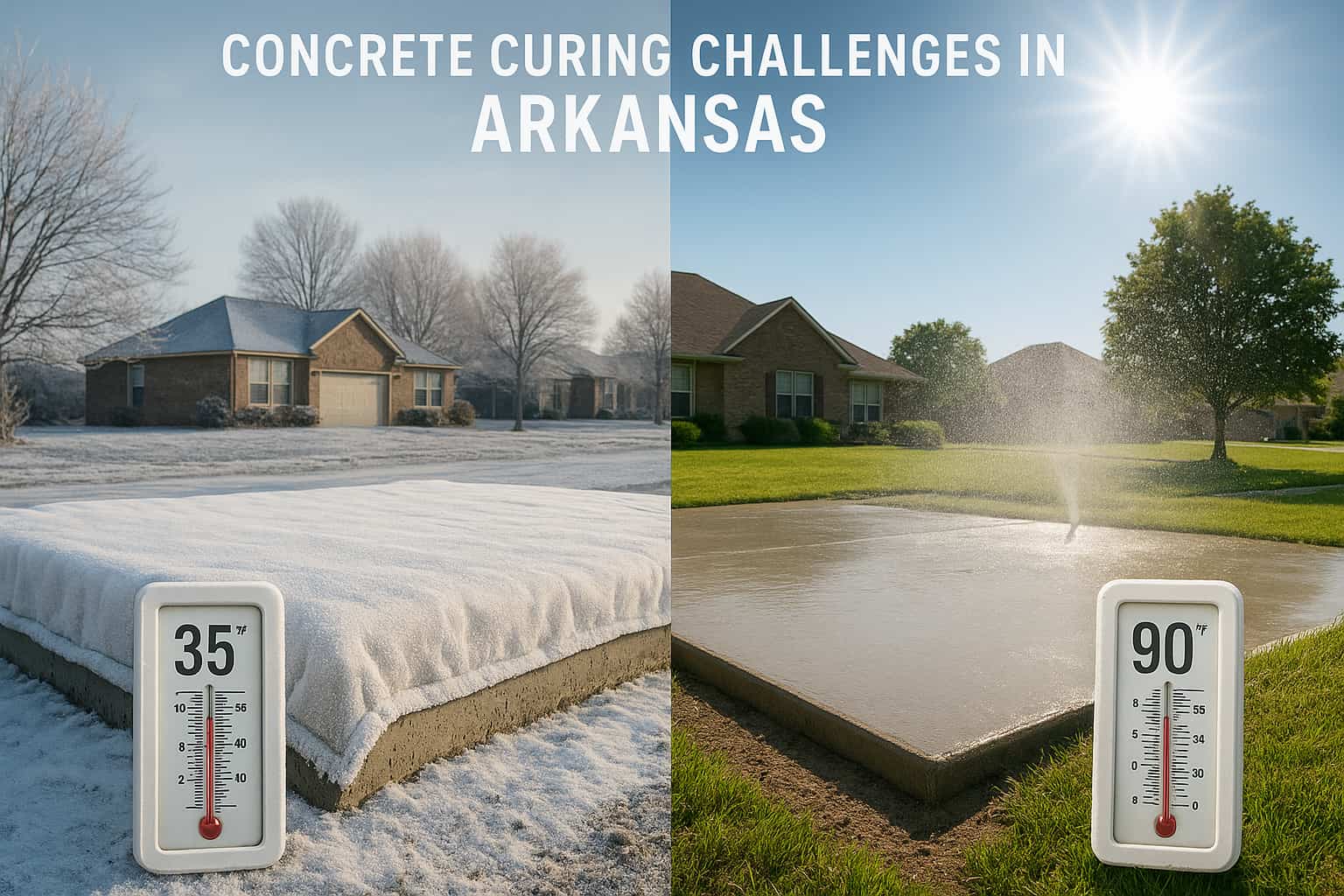
- Temperature matters—cold weather below 40°F dramatically slows curing, while heat above 85°F can cause too-fast drying and weaken your concrete
- Simple protection methods like wet blankets, plastic sheeting, and avoiding extreme temperatures ensure your concrete reaches maximum strength
Concrete fully cures in 28 days under normal conditions, reaching approximately 90-100% of its designed strength. However, you can safely walk on concrete after 24-48 hours and allow light vehicle traffic after 7 days when it has achieved about 60-75% of its final strength.[1][2]
The curing process involves a chemical reaction called hydration where cement particles bond with water molecules to create the hard, durable surface that makes concrete so valuable for driveways, patios, walkways, and foundations. Understanding how long concrete takes to cure helps you plan your project timeline, avoid damage to your new surface, and ensure your investment delivers the strength and longevity you expect.
For Fayetteville homeowners, Arkansas’s unique climate—including freeze-thaw cycles in winter, clay soil conditions, and seasonal humidity changes—creates specific challenges that affect how your concrete cures. This guide explains what happens during the curing process, how environmental factors impact the timeline, and what you can do to protect your concrete investment.
Understanding the Concrete Curing Process
Many people confuse concrete “drying” with “curing,” but they are completely different processes. Drying refers to moisture evaporation from the surface, while curing is the chemical process that creates concrete’s strength and durability.[3] When cement and water mix, they undergo hydration—a chemical reaction that forms new compounds binding the concrete together.
This hydration process requires moisture to continue. Without adequate moisture during curing, the chemical reaction stops prematurely, resulting in weaker concrete that is more prone to cracking, surface scaling, and deterioration. Properly cured concrete can be 50-100% stronger than uncured concrete exposed to dry conditions.[4][5]
The Science Behind Concrete Strength Development
Concrete gains strength progressively as hydration continues. Within the first few hours after pouring, concrete remains workable and can still be finished and shaped. Between 1-6 hours, it reaches initial set—meaning it is no longer workable but still fragile and requires protection from the elements.[3]
After 24-48 hours, concrete develops approximately 20-30% of its final strength, making it safe for light foot traffic and allowing forms to be removed.[2][6] By the 7-day mark, properly cured concrete reaches 60-75% of its designed strength, sufficient for light vehicle traffic and allowing construction activities to resume.[2][6] At 28 days, the standard industry benchmark, concrete achieves 90-100% of its specified compressive strength and is considered fully cured for most practical purposes.[1][2]
Why the 28-Day Standard Exists
The 28-day curing period is the industry standard established by the American Concrete Institute (ACI) and ASTM International for testing and specifying concrete strength.[1][7] This timeframe provides a consistent benchmark for testing procedures throughout the industry. However, it is important to understand that 28 days is somewhat arbitrary—chosen for practical consistency rather than because hydration stops at exactly that point.[1]
In reality, hydration continues for months or even years after pouring, with concrete slowly gaining additional strength over time. The 28-day mark simply represents the point at which concrete has achieved enough of its potential strength to meet design specifications and handle intended loads.[1]
Concrete Curing Timeline: What to Expect
| Time Frame | Strength Attained | Safe Activities | What’s Happening |
|---|---|---|---|
| 0-6 Hours (Initial Set) | Minimal | Still being finished; requires protection from rain, direct sun, wind | Concrete is setting but not yet hard; hydration is beginning |
| 24-48 Hours | 20-30% | Light foot traffic; forms can be removed | Surface is hard to touch; concrete still needs moisture for continued hydration |
| 7 Days | 60-75% | Light vehicle traffic; construction can resume | Concrete has sufficient strength for most activities; proper curing is critical during this period |
| 28 Days | 90-100% | Full use including heavy vehicles and equipment; ready for sealing | Considered fully cured; has reached designed strength for its mix |
These timelines assume ideal curing conditions—temperatures between 50-85°F and adequate moisture retention through proper curing methods.[2][3] Environmental factors can significantly alter these timelines, as discussed in the following sections.
Factors That Affect How Long Concrete Takes to Cure
The 28-day benchmark applies to concrete cured under ideal conditions with moderate temperatures and sufficient moisture. In reality, multiple factors influence how quickly or slowly your concrete cures and how strong it ultimately becomes.
Temperature: The Most Critical Factor for Arkansas Homeowners
Temperature has the most dramatic impact on concrete curing rates. The ideal temperature range for curing is between 50-85°F, with the sweet spot around 70°F where hydration proceeds at an optimal pace.[3][8] Within the first seven days, concrete should ideally stay at 68-77°F, then maintain 59-68°F until the 14-day mark, and 50-59°F until full cure at 28 days.[6]
Cold weather dramatically slows the curing process. According to the American Concrete Institute, cold weather conditions exist when air temperature falls to or is expected to fall below 40°F.[9][10] At 50°F, concrete requires roughly 14 days to reach 70% strength compared to just 7 days at 70°F.[8] When temperatures drop below 27-32°F, the freezing of water in the concrete can halt hydration entirely and cause permanent damage through internal cracking.[9][11]
For Fayetteville homeowners, this means winter concrete projects require special protection. Northwest Arkansas experiences freeze-thaw cycles throughout winter where temperatures fluctuate above and below freezing. New concrete must be protected from freezing for at least 48-72 hours until it reaches a minimum strength of 500 psi.[9][11][12] After that, it can tolerate a single freeze-thaw cycle if properly air-entrained, but repeated cycles require the concrete to reach at least 3,500-4,000 psi before exposure.[11]
Hot weather presents different challenges. High temperatures accelerate hydration initially, causing concrete to gain early strength quickly, but this rapid curing can result in 10-15% lower final strength at 28 days compared to concrete cured at moderate temperatures.[13][14] When concrete is about 18°F hotter than normal (88°F instead of 70°F), the 28-day compressive strength can be reduced by as much as 15%, especially without proper curing.[13]
Arkansas summers with temperatures regularly exceeding 85-90°F create conditions for rapid moisture evaporation. Combined with low humidity and wind, this can cause plastic shrinkage cracking, surface scaling, and incomplete hydration.[13][14] The key is preventing moisture loss through proper curing methods like wet blankets, plastic sheeting, or curing compounds applied immediately after finishing.
Moisture and Humidity: Essential for Complete Hydration
Concrete needs moisture throughout the curing process for hydration to occur. The internal relative humidity within concrete must remain above 80-85% for hydration to continue.[15][16] When moisture evaporates from the surface faster than the concrete can cure internally, the result is weaker surface concrete prone to dusting, scaling, and cracking.
High humidity slows evaporation, which helps concrete cure properly by retaining moisture longer. This is why Fayetteville’s humid spring and summer months can actually benefit concrete curing—the moisture in the air prevents the surface from drying out too quickly.[15][16]
Low humidity, especially when combined with heat and wind, acts like a sponge drawing moisture from concrete. This creates a high evaporation rate that can rob the concrete of the water it needs for complete hydration. Arkansas homeowners facing low-humidity conditions during fall should take extra precautions like more frequent misting, covering concrete with plastic sheeting, or applying curing compounds to lock in moisture.[16]
Concrete Mix Design and Thickness
Different cement types cure at different rates. Type III high-early-strength cement can achieve 3,000 psi concrete in just 24 hours and requires only 3-5 days of curing, while Type II moderate-heat cement may take 9-14 days to reach equivalent strength.[6] Standard Type I Portland cement, the most common for residential work, follows the typical 7-day (70% strength) and 28-day (100% strength) timeline.[6]
The water-to-cement ratio significantly affects both curing needs and final strength. Mixes with lower water content are stronger and denser but require more careful moisture management during curing to prevent premature drying. Additives and admixtures—such as accelerators for cold weather or retarders for hot weather—can modify curing times to match environmental conditions.[2]
Concrete thickness affects curing primarily through moisture retention. Thicker slabs retain moisture longer than thin sections, which can dry out faster from both the top and edges. However, regardless of thickness, full curing still takes approximately 28 days for concrete to reach its designed strength.[2] A 4-inch residential driveway cures at the same rate internally as a 6-inch commercial slab, though the thinner slab may require more aggressive moisture retention methods to prevent surface drying.
Proper Concrete Curing Methods for Arkansas Homeowners
The best curing method is the simplest: keep your concrete wet. For the first 7 days after pouring, maintaining moisture on the surface allows hydration to proceed optimally and ensures maximum strength development.[3] Studies show that properly cured concrete can have 50-100% higher strength at 28 days compared to uncured concrete in dry conditions.[4][5]
Wet Curing: The Gold Standard
Water curing involves keeping the concrete continuously wet by spraying, misting, ponding water on the surface, or covering it with wet burlap or blankets. This method is the most effective because it ensures adequate moisture for complete hydration while helping to regulate temperature.[3][5] Water curing for 7 days produces concrete approximately 50% stronger than uncured concrete, and even 3 days of water curing achieves about 80% of the benefit of a full 7-day cure.[3]
For Arkansas homeowners, wet curing is particularly valuable during hot, dry periods when evaporation rates are high. Simply running a sprinkler on your new driveway or patio several times per day for the first week dramatically improves final strength and durability.
Covering and Sealing Methods
Plastic sheeting creates a moisture barrier that prevents evaporation while allowing hydration to continue using the water already in the concrete mix. This method works well for Arkansas’s variable weather since it also protects concrete from unexpected rain while curing. The plastic should be placed as soon as the surface can support it without damage (typically 12-24 hours after finishing) and should be weighted down to prevent wind from lifting it.[3]
Wet burlap, blankets, or straw covered with plastic combine moisture retention with temperature protection. This method is especially valuable during cooler months in Fayetteville when you want to trap the heat of hydration while maintaining surface moisture. The coverings should be kept wet and should not be allowed to dry out and draw moisture from the concrete.[17]
Curing compounds are liquid membranes sprayed onto the concrete surface that form a barrier to slow evaporation. These work best when applied immediately after finishing when the surface sheen disappears but before the concrete fully dries.[3] Clear curing compounds allow you to see the concrete surface, while white-pigmented versions reflect sunlight, which can help keep the concrete cooler during hot weather.[3]
Cold Weather Protection for Fayetteville Winters
When temperatures drop below 40°F, concrete requires protection from freezing and measures to maintain adequate curing temperatures. Insulating blankets are the most practical solution for residential work, capturing the heat generated by the hydration reaction and maintaining concrete temperature without external heat sources.[9][11][18]
Blankets should be placed as soon as possible after finishing to capture early heat of hydration. They need to stay in place for at least 48-72 hours, or longer if subfreezing temperatures persist. The concrete must maintain a minimum temperature of 50-55°F for slabs less than 12 inches thick during the protection period.[9][11]
Critical cold weather guidelines for Arkansas homeowners:
- Never pour concrete on frozen ground—it will crack when the subgrade thaws and settles unevenly[18][19]
- Do not use deicing salts on concrete for the first year, as they can damage the surface and promote freeze-thaw deterioration[12][19]
- Do not seal concrete during cold weather curing, as this traps moisture that can freeze and damage the surface[12][19]
- Protect concrete from freezing until it reaches at least 500 psi (typically 24-48 hours) to prevent permanent damage from ice formation[9][11][18]
Hot Weather Curing for Arkansas Summers
High temperatures, low humidity, and wind create a perfect storm for rapid moisture loss. The primary goal during hot weather curing is preventing surface moisture from evaporating faster than the concrete can hydrate internally.[13][14]
Start protecting concrete immediately after finishing. In hot conditions, the surface can begin to dry and crack within minutes if left exposed to sun and wind. Evaporation retarders can be sprayed on during finishing to slow initial moisture loss until you can apply more permanent curing methods.[13]
For the first 7 days, use a combination of shade (if possible), frequent misting or sprinkling, and coverings like wet burlap under plastic sheeting to maintain moisture. Check the concrete several times per day and re-wet any areas that have dried out. Avoid adding water to the surface during initial set while bleed water is still present, as this weakens the surface.[3][13]
Special Considerations for Fayetteville Concrete Projects
Northwest Arkansas’s climate and soil conditions create specific challenges that affect both the curing process and long-term concrete performance.
Clay Soil and Ground Movement
Fayetteville sits on clay-rich soils that expand when wet and shrink when dry. This seasonal movement places stress on concrete slabs and requires proper site preparation before pouring. A well-compacted gravel base provides drainage and creates a stable foundation that minimizes the effects of clay soil movement on your concrete.[20]
During curing, ensure water used for wet curing drains away from the slab edges rather than saturating the clay subgrade, which could cause unwanted swelling and movement.
Freeze-Thaw Cycles in Northwest Arkansas
Unlike northern climates with sustained freezing or southern regions that rarely freeze, Arkansas experiences repeated freeze-thaw cycles throughout winter. Temperatures may drop below freezing at night and rise above freezing during the day, creating the worst-case scenario for concrete durability.
Each freeze-thaw cycle causes water in concrete pores to freeze and expand, then thaw and contract. Concrete that has not cured to at least 3,500-4,000 psi before exposure to these cycles is vulnerable to progressive damage called spalling—where the surface layer flakes off over time.[11][18]
For exterior flatwork in Fayetteville, specify air-entrained concrete with a minimum 28-day strength of 4,000 psi. The microscopic air bubbles created by air entrainment provide space for freezing water to expand without damaging the concrete matrix, dramatically improving freeze-thaw resistance.[12][19]
Seasonal Timing for Arkansas Concrete Projects
The best time to pour concrete in Fayetteville is during spring (April-May) or fall (September-October) when temperatures are moderate, humidity is reasonable, and you are less likely to face temperature extremes during the critical first week of curing. Summer pours require aggressive moisture retention methods and protection from heat, while winter pours need insulation and freeze protection.
Common Curing Mistakes Arkansas Homeowners Should Avoid
Understanding what not to do is just as important as knowing proper curing methods. These common mistakes can compromise your concrete’s strength and durability:
Sealing Too Soon
The decorative concrete industry’s 28-day waiting period before sealing is primarily about ensuring the concrete is dry enough to accept sealers without trapping moisture, not about achieving strength.[7] Many sealers can trap moisture beneath the surface, causing hazing, blushing, or bond failure. However, this does not apply to curing compounds, which are specifically designed to be applied within hours of finishing.
Wait at least 28 days before applying decorative sealers or topical coatings to allow the concrete to dry adequately. In high-humidity conditions, you may need to wait longer and verify moisture levels before sealing.
Walking or Driving on Concrete Too Early
While concrete may feel hard after 24 hours, it has only developed 20-30% of its final strength. Heavy foot traffic or vehicle loads during this period can cause surface damage, cracking, or permanent impressions. Wait the full 48 hours before allowing foot traffic and 7 days before driving vehicles on new concrete.[2][6]
Failing to Protect from Temperature Extremes
Both hot and cold temperature extremes damage curing concrete. Exposure to freezing before reaching 500 psi (usually 24-48 hours) can cause permanent strength loss of up to 50%.[11][18] Conversely, allowing concrete to dry out rapidly in hot weather results in incomplete hydration and reduced final strength.[13][14]
Adding Water to “Fix” the Surface
Adding water to concrete after it has begun to set increases the water-cement ratio at the surface, weakening that layer and making it prone to dusting and scaling. This is particularly tempting during hot weather when the surface dries quickly, but resist the urge. Instead, use proper misting or wet curing methods that do not saturate the surface.[13]
Comparison: Curing vs. Drying
| Aspect | Curing | Drying |
|---|---|---|
| Definition | Chemical process (hydration) where cement reacts with water to form strong bonds | Physical process where excess moisture evaporates from concrete surface |
| Timeline | Primary curing occurs over 28 days; hydration continues for months/years | Varies by thickness, temperature, and humidity; can take weeks to months for complete drying |
| Moisture Goal | Keep concrete moist to allow hydration to continue | Allow excess water to evaporate until concrete reaches equilibrium with environment |
| Effect on Strength | Proper curing develops maximum compressive strength and durability | Drying does not affect strength; it only relates to moisture content for sealing/coating compatibility |
| Best Practices | Use wet curing, plastic sheeting, curing compounds; maintain moisture for first 7 days | Allow natural evaporation; protect from premature drying during curing phase |
| When It Matters | Critical for first 7-28 days after pouring to achieve designed strength | Matters when applying sealers, coatings, or floor coverings that require dry substrate |
When to Call a Professional Concrete Contractor
While understanding concrete curing helps you make informed decisions, many factors require professional expertise. A qualified concrete contractor ensures proper mix design for Arkansas conditions, knows when weather requires special measures, and has the equipment and experience to protect your investment during curing.
Professional contractors understand local challenges like clay soil preparation, air-entrainment requirements for freeze-thaw resistance, and how Fayetteville’s climate affects curing timelines. They will adjust mix designs for seasonal conditions, schedule pours during optimal weather windows, and implement appropriate curing methods without you having to worry about the technical details.
For critical projects like foundations, structural slabs, or decorative concrete with expensive finishes, the expertise of an experienced contractor is invaluable in ensuring your concrete cures properly and performs as expected for decades to come.
Conclusion
Concrete takes 28 days to fully cure and reach its designed strength, but you can use your new driveway, patio, or walkway much sooner with proper precautions—walking after 24-48 hours and light vehicles after 7 days. The key to long-lasting, durable concrete is protecting it during those critical first 7 days when most strength development occurs.
Arkansas homeowners face unique challenges with temperature extremes, clay soils, and freeze-thaw cycles that require thoughtful planning and proper curing methods. Whether you are keeping concrete wet during a hot Fayetteville summer or protecting it with insulating blankets during a cold winter, taking curing seriously ensures your concrete investment delivers the strength, durability, and longevity you expect.
Understanding how concrete cures empowers you to make better decisions about project timing, helps you recognize when contractors are taking proper precautions, and gives you the knowledge to care for your new concrete correctly. If you have questions about your specific project or need professional concrete services in the Fayetteville area, contact experienced local contractors who understand Arkansas’s unique conditions and can ensure your concrete cures properly for maximum performance.
How Long Does Concrete Take to Cure FAQs
Can I walk on concrete after 24 hours?
Yes, concrete is generally safe for light foot traffic after 24-48 hours when it has hardened enough to support your weight without surface damage. At this point, concrete has developed about 20-30% of its final strength. However, you should still avoid heavy or concentrated loads, sharp impacts, or dragging heavy objects across the surface during this early stage.[2][6]
How long before I can drive on new concrete?
You should wait at least 7 days before driving on new concrete, when it has reached approximately 60-75% of its designed strength. For heavy vehicles, trailers, or loaded trucks, waiting closer to 14 days provides an extra margin of safety. Following these timelines prevents surface damage, cracking, and permanent impressions that can occur when loads are applied too early.[2][6]
Does concrete cure faster in hot weather?
Hot weather initially speeds up the hydration reaction, causing concrete to gain early strength more rapidly. However, this accelerated curing can actually result in lower final strength—potentially 10-15% weaker at 28 days compared to concrete cured at moderate temperatures. The rapid moisture loss in hot conditions also increases the risk of cracking and surface defects if proper curing methods are not used.[13][14]
What happens if concrete freezes while curing?
If concrete freezes before reaching a minimum strength of 500 psi (typically 24-48 hours after pouring), it can suffer permanent damage including up to 50% reduction in final strength. When water in concrete freezes, it expands by about 9%, creating internal cracks and disrupting the bond between cement paste and aggregates. Properly protecting concrete from freezing during the first 2-3 days is critical for Arkansas homeowners during winter months.[9][11][18]
How do I know when concrete is fully cured?
Concrete reaches its designed strength at 28 days, at which point it is considered fully cured for practical purposes. You cannot determine cure level by appearance alone—properly cured concrete and poorly cured concrete may look identical on the surface. The only way to verify strength is through professional testing, but following the 28-day timeline established by the American Concrete Institute ensures your concrete has achieved its specified performance.[1][2]
How Long Does Concrete Take to Cure Citations
- National Precast Concrete Association. “The 28-Day Myth.” https://precast.org/blog/28-day-myth/
- Concept Concrete. “How Long Should Concrete Cure Before Putting Weight on It?” https://conceptconcrete.com.au/blog/how-long-should-concrete-cure-before-putting-weight-on-it/
- Concrete Network. “Concrete Curing Time: How Long Does Concrete Take To Dry?” https://www.concretenetwork.com/curing-concrete/
- ToolsRail. “Concrete Curing Time Calculator – Estimate Ideal Curing Duration Online.” https://www.toolsrail.com/civil/concrete-curing-time-calculator.php
- The Constructor. “Curing of Cement Concrete – Time and Duration.” https://theconstructor.org/concrete/concrete-curing-time-duration/11119/
- Renovated. “Concrete Curing Time Charts for Homeowners and DIYers (Updated for 2025).” https://renovated.com/concrete-curing-time-chart/
- Concrete Decor. “Why Does the Decorative Concrete Industry Focus on a 28-day Cure Time?” https://www.concretedecor.net/departments/concrete-sealers/why-does-the-decorative-concrete-industry-focus-on-a-28-day-cure-time/
- Express Concrete Ltd. “How Does the Weather Affect the Setting Time of Ready Mix Concrete.” https://expressconcreteltd.com/how-does-the-weather-affect-the-setting-time-of-ready-mix-concrete/
- Ayres Associates. “How to Cure Concrete in Cold Conditions.” https://www.ayresassociates.com/how-to-cure-concrete-in-cold-conditions/
- Concrete Network. “Curing Concrete in Cold Weather – Concrete Blankets, Additives & Heaters.” https://www.concretenetwork.com/cold-weather-concrete/curing.html
- For Construction Pros. “How to Protect Concrete During Cold Weather Pours.” https://www.forconstructionpros.com/concrete/equipment-products/article/11232331/kb-engineering-llc-how-to-protect-concrete-during-cold-weather-pours
- Michigan Concrete. “Cold Weather Concreting.” https://www.miconcrete.org/cold-weather-concreting
- Concrete Network. “Hot Weather Concrete: Summer Pouring & Curing Tips.” https://www.concretenetwork.com/hot-weather-concreting/tips.html
- Maturix. “Hot Weather Concreting.” https://maturix.com/by-challenges/hot-weather-concreting/
- Converge. “Can Humidity Affect Concrete Curing Time?” https://www.converge.io/blog/concrete-humidity
- Concrete Countertop Institute. “Temperature and Relative Humidity: What They Mean for You and Your Concrete Countertops.” https://concretecountertopinstitute.com/free-training/temperature-and-relative-humidity-what-they-mean-for-you-and-your-concrete-countertops/
- Triangle Ready Mix. “Concrete Curing in Hot Weather.” https://trianglereadymix.com/concrete-curing-in-hot-weather/
- Converge. “What Happens if Concrete Freezes During Curing Time?” https://www.converge.io/blog/blog-what-happens-if-concrete-freezes
- MICONCRETE. “Cold Weather Concrete.” https://www.miconcrete.org/cold-weather
- AR Concrete Fayetteville. “How Thick Should a Concrete Driveway Be in Arkansas?” https://arconcretefayetteville.com/how-thick-should-a-concrete-driveway-be-in-arkansas/
Leave a Reply